Pages

Professional Pics

Hi FSP,

What do you think about putting a pic on the webpage that is out of the ordinary (passport style). For example, would it be "professional" to put a pic on a webpage that would depict a person playing with a bat or holding a parrot or something?


No on the bat, yes on the parrot.

Actually, it probably depends on the culture of your field and/or department. I don't think anyone in any(?) field would be denied a job or tenure because their webpage photo shows them playing with a bat, but if this person already has a problem being taken seriously in their profession/department and/or has a department/disciplinary culture that values formality and a traditional view of professionalism, not to mention personnel who do not have rabies, this might give one pause before posting the playful bat photo.

Even so, depending on what webpage you are talking about, it might be fine and even a very good thing. Some departments have a main page with the stiff passport-style photos of faculty, postdocs, grads etc., but then there are links to research group pages and/or individual webpages. The degree of formality may be less in these more personalized webpages, and I don't think that is unprofessional to have informal photos there as long as people visiting these other webpages can get the information they want/need.

That is, if the main reason people visit these more specialized pages is to find out about research, publications, and people and all they see is a picture of you kissing your parrot, that's not so good. If the pages are informative and a bit informal as well, that's fine. "Professional" webpages don't have to be dry and boring.

And you could always have a link to "X's personal webpage" and put your parrot photos there. You probably want to keep photos of you in your underwear for a (private) Facebook photo album or to send (via Twitter) to the US Representative of your district, but photos of you and cute animals (other than snakes) wouldn't be unprofessional if clearly on a page devoted to other aspects of your life. Not everyone wants such a page linked to their work-related webpages, but I've seen examples of this and did not think the person (student or professor) was unprofessional.

There are likely differences of opinion on this issue. A while ago when I was involved in updating the department webpages, there was one person who refused to provide a photo. For a while I just had "no photo" written in a box the size of everyone else's photo, but this was unsatisfying and ugly, so I decided to try to get some image related to this person. I asked him to give me some sort of image to use, even if not a photo of himself, or else I would come up with "something" for him. He did not provide an image, so I put in an image of my own choosing. He loved this image and was quite content with the situation, but a significant number of other people were bothered by it, saying it was "unprofessional". Eventually I did get a photo of the person in question and the problem was solved, but it interested (and surprised) me how many people commented on the "unprofessional" nature of including an image that was not a standard head-shot photo of a person.

So, I may not be the best person to as, but perhaps others can weigh in, ideally specifying their academic discipline so that we can see whether wacky photos are the norm in some fields but mildly to deeply unprofessional in others.
Read More >>

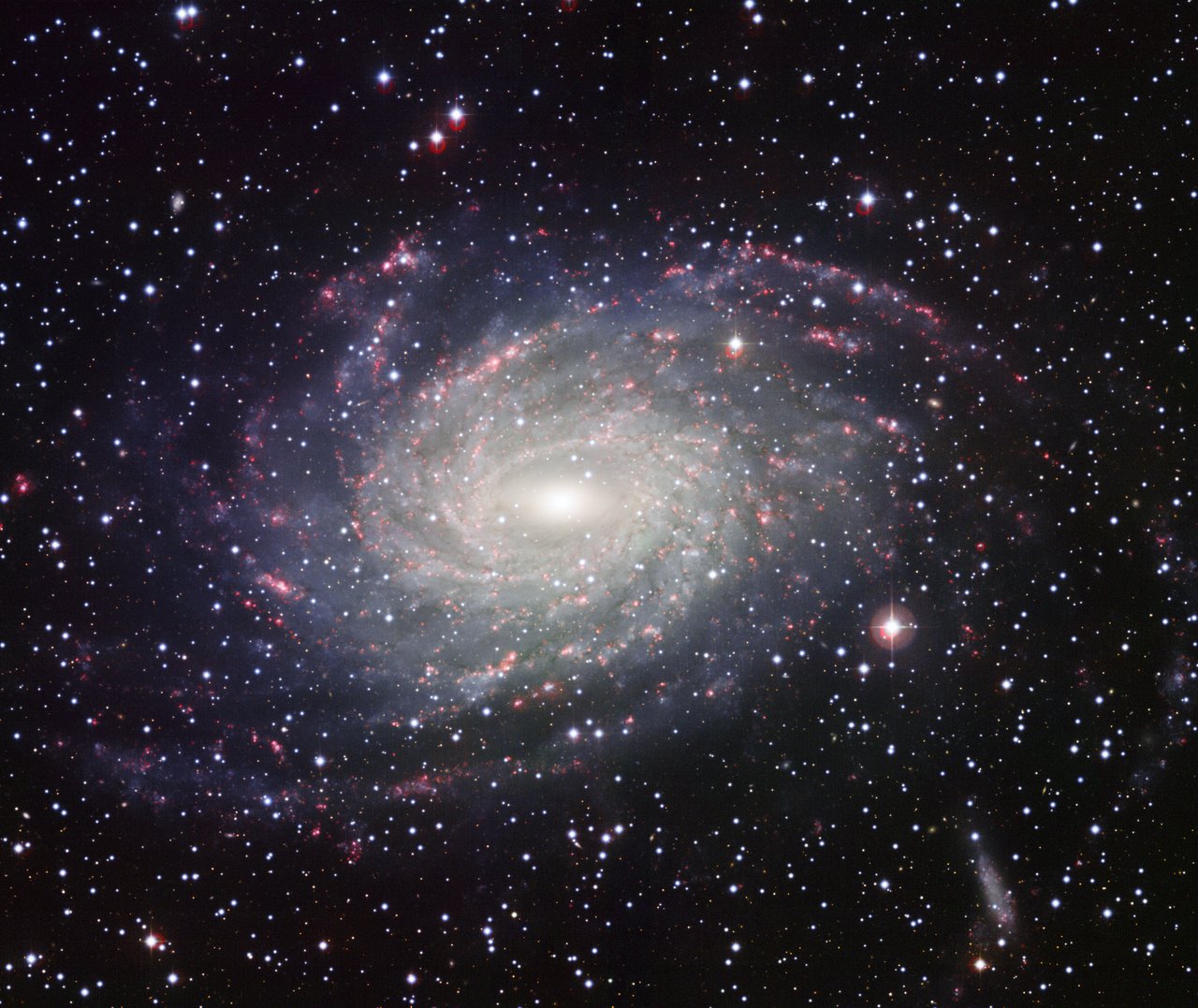
Wide Field Imager view of a Milky Way look-alike, NGC 6744

Wide Field Imager view of a Milky Way look-alike, NGC 6744 (6/1/11)
This picture of the nearby galaxy NGC 6744 was taken with the Wide Field Imager on the MPG/ESO 2.2-metre telescope at La Silla. The large spiral galaxy is similar to the Milky Way, making this image look like a picture postcard of our own galaxy sent from extragalactic space. The picture was created from exposures taken through four different filters that passed blue, yellow-green, red light, and the glow coming from hydrogen gas. These are shown in this picture as blue, green, orange and red, respectively.


NGC 6744 – click for 1280×1078 image


More: here, here, here, here, here, here, here
Read More >>

A Perfect Spiral with an Explosive Secret

A Perfect Spiral with an Explosive Secret (5/30/11)
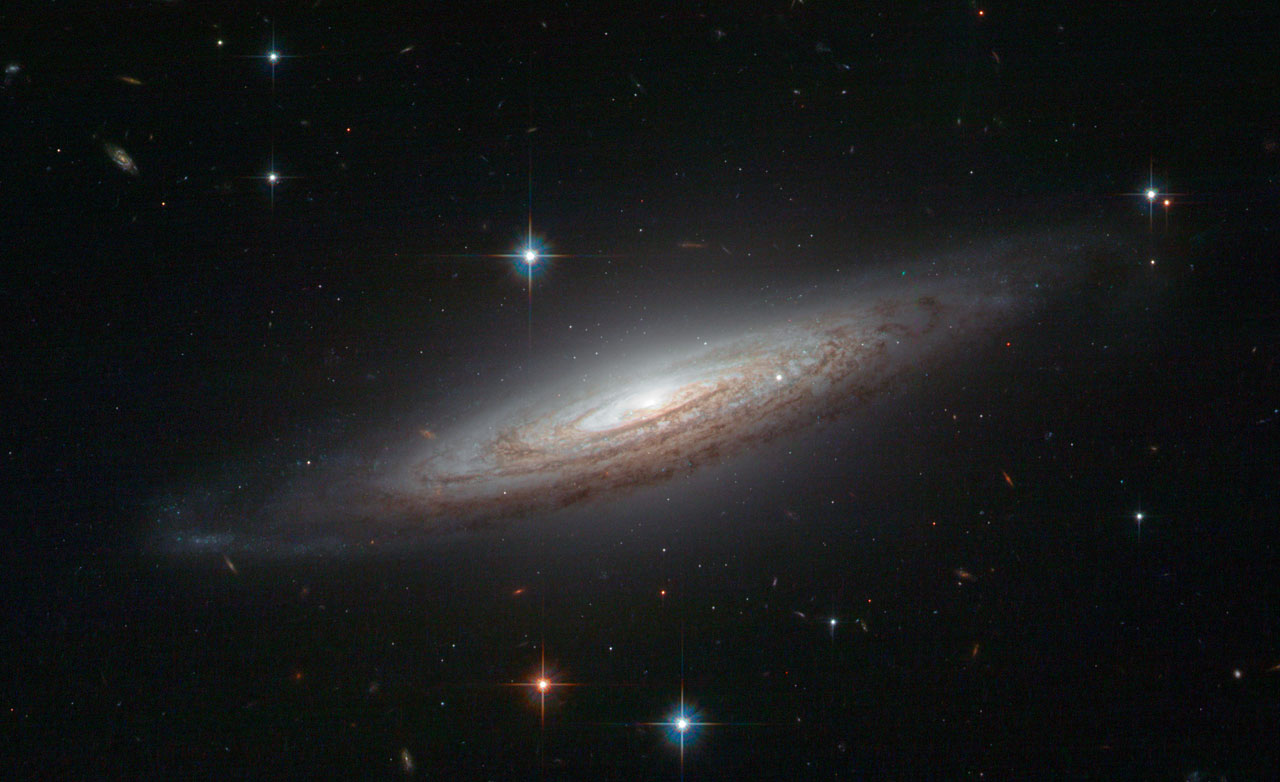
This spiral galaxy was discovered back in the nineteenth century by French astronomer Édouard Jean-Marie Stephan, but in 2008 it became a prime target for observations thanks to the violent demise of a white dwarf star. The type Ia supernova known as SN2008a was spotted in the galaxy and briefly rivalled the brilliance of its entire host galaxy but, despite the energy of the explosion, it can no longer be seen this Hubble image, which was taken around a year and a half later.


NGC 634 – click for 1280×782 image


More: here
Read More >>

Due or Overdue?

The blogosphere has done a rather thorough job of thrashing the recent *scathing* report by Senator Coburn (R-Oklahoma) on supposed mismanagement and waste by the NSF. I will therefore quell the urge to point out how poorly researched, written, and organized the report it. It's a good thing the report wasn't funded by NSF or it would indeed be an excellent example of wasted effort and money by that agency.

I was, however, bothered by a particular section that has not received as much attention: the part about the supposedly shocking number of late and never-turned-in project reports:

A 2005 audit found that “[a]pproximately 47 percent of the 151,000 final and annual project reports required in the past 5 years were submitted late or not at all.”

There is a handy chart, organized by Directorate, showing the % final reports submitted on time, late, or not at all. I have some points to make about this:

1 - It is not surprising that so many reports are late. Reports are due 90 days before the end of the budget period, and at that time some of us are still scrambling to submit additional grant-related publications to include in the report. I would rather submit a late but more impressive report than an on-time report with less substance. One of the main motivators for me to file my reports (annual or final) sooner rather than later is that it is necessary to be up-to-date with reports in order for the paperwork for new grants to be processed, but if there is no pressure from that, I will wait until I can write a more complete and informative report.

2 - According to the chart in Coburn's document, although there are many late reports, the number of missing (never submitted) reports is low. It is misleading to combine late + missing reports and then focus on that number as if there is a major problem.

3 - The reports are administratively important for NSF and are one way that the programs/directorates can see what has been produced from grants (publications, education, outreach etc.), but the reports are not the actual "products" of the research and therefore are an imperfect measure of project success. It would be more relevant (but perhaps more difficult) to look at the actual outcomes of a grant -- as opposed to whether a project report has been filed on time -- and to look at contributions and impact beyond the expiration date of the grant.

I also wondered about the numbers related to unspent grant money apparently lying around, uncollected by NSF. Does this include money that PIs retain as part of no-cost extensions that give more time to do the research, or is that apparently leftover money accounted for because the expiration date of the grant changes when a no-cost extension is approved? If you only consider the original expiration date of the grant, it would look like there is unspent grant money. I couldn't tell from the report whether the unspent money was real or not.

And did anyone else think it was strange, given Coburn's concern for duplication and overlap among programs that fund STEM education for underrepresented populations, that the subtitle of the report, "Under the Microscope", is also the name of an NSF-funded website created by The Feminist Press to encourage girls and women to be involved in STEM fields? How do we all feel about this duplication of titles? I don't have any real data, but I am sure I am against it.
Read More >>

Sundays with Your Advisor

In an e-mail about a (mostly) unrelated topic, a graduate student reader of this blog mentioned that she had requested regular meetings with her advisor. This request was part of an ongoing, long-standing effort to improve a rather grim situation for this student, and it seems that things have overall gotten better with time. What struck me, however, was this:
I asked for a regular bi-weekly meeting and he wanted to have Sunday night meetings- and so we have regular weekly meeting Sunday nights.
I hope I am not alone in thinking that is strange. But I had to think: What exactly bothers me about it (most)?

Is it because, although I have mostly gone over to the advisorial dark side, I am not so far gone as to appreciate that weekends are important for unstructured time for students to unwind from a stressful week and have time for a bit of independent work? No, I doubt that's it.

Is it because I enjoy my unstructured time on weekends and shudder to think of a regularly scheduled work-related event on a Sunday night? I am happy to work with my advisees on weekends if they need my help with something, and I tend to work on Sunday nights, typically in my office (and mostly watching things like this over and over), but I would nevertheless be very reluctant to schedule a regular meeting for Sunday nights. So yes, this seems to be part of my dislike for the idea.

Or could it be that -- without knowing much else about the situation -- I think there is something a bit creepy about scheduling weekend night meetings with a student?

Yes, but I also realize that I don't really know enough about the situation. Perhaps the research lab is buzzing with activity on Sunday nights, and there are swarms of grads and postdocs happily making interesting scientific discoveries 24/7. Perhaps it is a normal thing to do in that department/group, and the only time the advisor can fit in the requested meeting with his advisee, so it is actually kind of nice for him to make this time (???). It doesn't sound like a particular happy group -- perhaps because it is in the life sciences! -- but my knowledge of the research group environment is very incomplete. Nevertheless, this strikes me as strange.

Does this situation bother you -- advisors, students, others? Why or why not?

What would you do if you, as an advisor, didn't have time to meet regularly with all your students during weekday working hours? Would you (have you) set up a weekend/night meeting time or would you adjust your schedule in some other way so that there was time during the week to meet?

What would you do, as a student, if your advisor suggested regular meetings with you at night and/or on a weekend and you didn't feel comfortable with that?
Read More >>

Intersecting Spheres

Today in Scientopia, I discuss a question from readers who wonder what to do in situations in which advisor and student frequently encounter each other in their non-academic lives. These off-campus interactions can complicate advisor-advisee dynamics back on campus.
Read More >>

Great American Backyard Campout Blends Outdoors, Family Fun and Science

Memorial Day is the kickoff to the summer and where is the best place to spend the summer? Outside, of course, and family camping is one of the most popular summer time actitivites. On Saturday, June 25, 2011, the National Wildlife Federation is asking everyone to go camping! The Great American Backyard Campout is a grassroots initiative to Leave No Child Indoors! The National Wildlife Federation is raising awareness and also trying to raise funds for more outdoor youth programs. They are also encouraging families and communities spending time together outside camping. And while you're spending time outside - in the fresh air - why not explore nature (and science)!


So get your family and neighbors together and go camping - at a local campground, state or national park, or in your backyard. Being outdoors is a perfect time to connect to science. You can explore biology, conservation, ecology, astronomy, geology, geography, environmental science, and more.

I wrote a piece for COPUS - the Coalition of Public Understanding of Science encouraging its readers to participate in the Great American Backyard Campout and use that time to not only connect with family/neighbors but hace fun exploring science, too.  Check out the blog post (link here) and read the whole list of recommended Citizen Science and Arts and Science activities recommended.  Plus here's one I overlooked: Waving at the International Space Station as it orbits over your night time sky! The International Space Station is visible in the sky, assuming the weather agrees, so you could actually keep an eye out for it while you tell campfire stories and eat s'mores. Visit the website http://www.isswave.org/ for details on how to plan your wave. You can also follow them on Twitter @twisst for a tweet when it's visible from your skies.

Or if you're ready to sign up right now, then go for it.  You can register your 'camp site' - your family, church or community event with the National Wildlife Federation Great American Backyard Campout website (link here).  And visit my friend, Rue at Outdoor Afro for camping recommendations.  If camping is still new to you it might prove helpful to get some tips to make the night stress-free adn enjoyable.
 
In the meantime, let me know if you plan on participating and how.  And be sure to do a little exploration, too.  Can't wait to hear all about your Urban Camping Science Adventures! ©
Read More >>