Pages

Showing posts with label galaxy evolution. Show all posts

Supermassive black hole in a dwarf galaxy

Supermassive black hole in a type of galaxy where nobody expected to find one? Henize 2-10 is a small, mostly unremarkable compact dwarf galaxy. Its estimated dynamical mass is about 1010 M⊙, only a few percent of our galaxy's mass, and its distance from us is about 30 million light years. It is irregular in shape and does not fit in any category of the standard Hubble sequence.

The only respect in which Henize 2-10 has attracted attention – for several decades – before now is an extremely high rate of star formation in comparison to its size. The rate is 10 times that of the Large Magellanic Cloud, a satellite galaxy of the Milky Way that is also irregular in form and has approximately the mass of Henize 2-10.

This research – An actively accreting massive black hole in the dwarf starburst galaxy Henize 2-10 – recently published Nature, now offers good evidence that at the center of Henize 2-10 is an active black hole of substantial but somewhat uncertain mass between 2×10⁵ M⊙ and 2×10⁷ M⊙. That's a lot – it could exceed the mass of the Milky Way's black hole, ~4.2× 10⁶ M⊙.

The evidence presented that Henize 2-10 contains an actively accreting massive black hole is pretty good. It includes detection of radio emissions with a substantial non-thermal component. In other words, much of the radio emissions is due to something besides black body radiation – perhaps synchrotron radiation typical in active black hole jets. There is also a point source of high-energy X-ray emissions coming from the same location as the radio emissions. The evidence that these emissions are due to an active black hole isn't perfect. In particular, long-baseline interferometry shows gaps in the radio source, and the radio spectrum does not have the shape of a typical radio galaxy's. But consideration of other possible explanations indicates that the alternatives are rather improbable.

However, the paper concludes "the massive black hole in Henize 2-10 does not appear to be associated with a bulge, a nuclear star cluster or any other well-defined nucleus. This unusual property may reflect an early phase of black-hole growth and galaxy evolution that has not been previously observed. If so, this implies that primordial seed black holes could have pre-dated their eventual dwellings."

The authors are implying that this black hole could have existed before Henize 2-10 itself. And further, since galaxies in the very early universe (z≥7) have many similarities to Henize 2-10 (as well as certain differences), that many of these very early galaxies could also have formed around pre-existing massive black holes.

These concluding observations should, on the basis of the evidence provided, be regarded as rather speculative. There are substantial logical gaps in the reasoning.

For one thing, Henize 2-10 is pretty unusual based on its high rate of star formation. This implies an unusual and probably chaotic recent history. And so there really isn't much solid reason to think that the central black hole predated the galaxy.

How closely Henize 2-10 resembles very early galaxies is also open to question. The earliest stars, which made up the earliest galaxies, had very low metallicity and therefore tended to be much larger, brighter, and short-lived than stars forming in the present era. The assumption that galaxy evolution would be pretty similar between now and then is hard to make.

Some of the popular media accounts go even further and suggest that "most" galaxies probably formed around pre-existing black holes. Even if that were true for Henize 2-10, all that can legitimately be inferred is the possibility, not the necessity, of that circumstance in most cases.

There have been reports of the existence of supermassive black holes in galaxies without central bulges (not just irregular galaxies) – here, for example. There have even been studies of active black holes in the early universe that may have predated their galaxies, one of which I wrote about in this article: Which came first - the galaxy or the black hole?. There are also cases of fairly normal galaxies, such as M33, that seem to have at most a very small central black hole – see here.

So it's certainly a very real issue whether, at least in some cases, central black holes form before their galaxies, but the present study is just another interesting data point, not the last word on the subject.


ResearchBlogging.org
Reines, A., Sivakoff, G., Johnson, K., & Brogan, C. (2011). An actively accreting massive black hole in the dwarf starburst galaxy Henize 2-10 Nature, 470 (7332), 66-68 DOI: 10.1038/nature09724


Further reading:
Read More >>

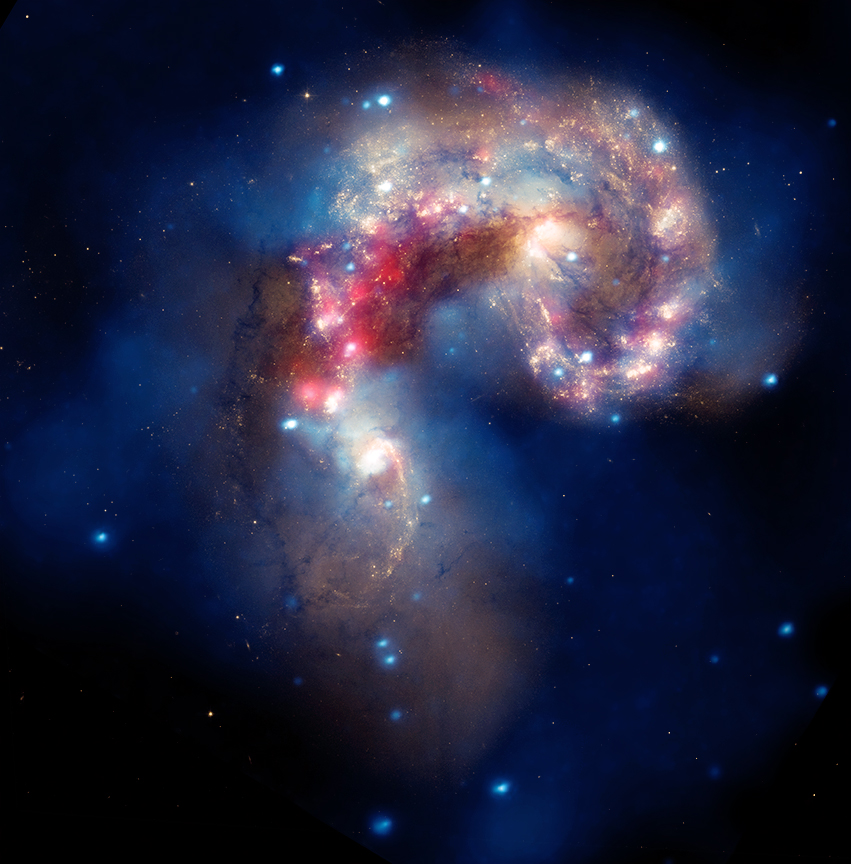
A Galactic Spectacle

A Galactic Spectacle (8/5/10)
The Antennae galaxies, located about 62 million light years from Earth, are shown in this composite image from the Chandra X-ray Observatory (blue), the Hubble Space Telescope (gold and brown), and the Spitzer Space Telescope (red). The Antennae galaxies take their name from the long antenna-like "arms," seen in wide-angle views of the system. These features were produced by tidal forces generated in the collision.

The collision, which began more than 100 million years ago and is still occurring, has triggered the formation of millions of stars in clouds of dusts and gas in the galaxies. The most massive of these young stars have already sped through their evolution in a few million years and exploded as supernovas.

The X-ray image from Chandra shows huge clouds of hot, interstellar gas that have been injected with rich deposits of elements from supernova explosions. This enriched gas, which includes elements such as oxygen, iron, magnesium and silicon, will be incorporated into new generations of stars and planets.


Antennae Galaxies – click for 851×864 image


More: here, here, here
Read More >>

Quasars in the very early universe

Quasars are powered by the gravitational (potential) energy of their central supermassive black holes. However, their distinctive features – their extremely high luminosity in particular – are very dependent on characteristics of matter close to the black hole.

Most supermassive black holes (SMBH), including those at the centers of the Milky Way and our close neighbor M31 (Andromeda), are responsible for fairly small amounts of radiation in any part of the electromagnetic spectrum. This is generally because the radiation of a quasar is produced mainly by the infall of matter during a relatively brief period of the object's life – a few percent of the total, i. e. a few hundred million years. Once the nearby matter is used up, the lights go out.

(For earlier articles on quasars, see here.)

In a quasar, where matter in significant quantities is still being accreted, most of the radiation originates in a central "accretion disk" close to the black hole. The radiation is thermal ("black body") produced by very hot gas consisting mostly of hydrogen and helium. This radiation covers the spectrum from infrared to X-rays. Since quasars are so bright, they can be seen individually at high redshifts – z≥6, which is not true of ordinary galaxies. That corresponds to times within a billion years of the big bang. At z≈6 photon wavelengths are stretched by a factor of 7, so what we actually see is not the rest-frame spectrum, but a considerably red-shifted version of it.

If rs is the Schwarzschild radius, then the accretion disk extends from a radius of about 3 times rs outward to a few hundred times rs. To give a sense of the scale, a largish SMBH has a mass of a billion solar masses. So for such an object rs is about the radius of the orbit of Uranus, by a simple calculation given here.

Quasars and active galaxies (i. e. just smaller versions of the same thing) have been intensively studied for several decades. In that time, a fairly clear picture has emerged of how matter is distributed further out from the accretion disk. The most prominent feature of this region is a thick (compared to the accretion disk) torus-shaped ring of cooler gas and dust. The "dust" consists of very small particles composed of various elements heavier than helium. Electromagnetic radiation from the torus is mostly in the infrared part of the spectrum (rest frame), and is produced by re-emission (at lower energies) of higher energy photons from the accretion disk.

The shape of this region is not strictly a torus, since it's considerably flattened, especially at higher distances from the center, but it's referred to as a torus for simplicity. The outer limits of quasar tori are hard to determine, but probably extend hundreds of light years from the center. However, the inner parts are thick enough that unless we are seeing the quasar almost face-on (i. e., along the symmetry axis of the accretion disk and torus), we cannot clearly see the accretion disk itself, because it's obscured by the dust in the torus.

One interesting thing about quasars is that as far as we can tell (until quite recently), their characteristics are very similar no matter how distant they are. Although the present-day universe is quite different in many respects from what it was a billion years after the big bang, quasars seem hardly different at all.

Research published just this year is starting to change this story:

Dust-free quasars in the early Universe
The most distant quasars known, at redshifts z ≈ 6, generally have properties indistinguishable from those of lower-redshift quasars in the rest-frame ultraviolet/optical and X-ray bands. This puzzling result suggests that these distant quasars are evolved objects even though the Universe was only seven per cent of its current age at these redshifts. Recently one z ≈ 6 quasar was shown not to have any detectable emission from hot dust, but it was unclear whether that indicated different hot-dust properties at high redshift or if it is simply an outlier. Here we report the discovery of a second quasar without hot-dust emission in a sample of 21 z ≈ 6 quasars. Such apparently hot-dust-free quasars have no counterparts at low redshift. Moreover, we demonstrate that the hot-dust abundance in the 21 quasars builds up in tandem with the growth of the central black hole, whereas at low redshift it is almost independent of the black hole mass. Thus z ≈ 6 quasars are indeed at an early evolutionary stage, with rapid mass accretion and dust formation. The two hot-dust-free quasars are likely to be first-generation quasars born in dust-free environments and are too young to have formed a detectable amount of hot dust around them.

Some things in these results are actually more interesting than that a few very early quasars are different from all other quasars. In the very early universe at z>6, less intergalactic dust is to be expected. This is because the dust – which is composed of elements heavier than helium – is (by conventional accounts) produced mostly in stars. It is expelled from stars only either gradually, as the star evolves, or suddenly in the rare case of supernova explosions.

We still don't know very precisely when the very first stars formed (see here), but that probably happened only a few hundred million years after the big bang. Since the very first stars must have consisted almost entirely of hydrogen and helium, star-formation models indicate they should have been much more massive than typical later stars, and they should have expoded as supernovae after only a few tens of millions of years. As heavier elements gradually accumulated in the universe, stars of a more modern sort, initially containing small amounts of heavier elements, began to form. These later stars were small enough so that most never ended as supernovae, but they continued to manufacture and expel heavier elements – and hence dust.

Observations of very early quasars therefore tell us a little about the pace of this process. We now know, for example, of at least two quasars that formed so early that they do not have any dust around them that we can observe. The evidence for this is that emissions of these two quasars at rest-frame wavelengths from ultraviolet to very near infrared appear normal. Dust, however, should also produce rest-frame emissions in farther infrared – and that's not seen in these two examples, although it is in all other of the sampled z≈6 quasars.

One other feature of z≈6 quasars is particularly interesting. The mass of a quasar can be estimated from total luminosity and certain spectral features. In all z≈6 quasars that do have evidence of dust, the amount of dust is roughly proportional to the SMBH mass. However, in low-redshift quasars, dust abundance is almost uncorrelated with mass. The implication, then, is that in their youngest stages, but not later, quasars accumulate dust at about the same rate as SMBH mass. And indeed, the two quasars without apparent dust also have the smallest SMBH mass of any in the sample, about 2 to 3×10⁸ M⊙.

This raises another interesting, unanswered question. Just where does this dust come from? It's generally thought that in the present universe most of the existing dust originated from ordinary stars. However, at z≈6 most stars would be less than 500 million years old, and it's not at all clear this would have allowed enough time for the production of sufficient dust. Supernovae are another possibility, but even in the early universe we don't know whether they would have been common enough.

Further, the existence of elements heavier than helium is necessary but not sufficient to produce dust. Most models assume also a proper combination of relatively low temperature (<2000 K) and high density is also required for dust to form. But a theoretical study (astro-ph/0202002) suggests that dust could actually form in the vicinity of a quasar itself. Some combination of all these possibilities may be the answer, but a lot more research will probably be needed to clear this up.

Every time we learn something new, it seems, we also find new questions.


ResearchBlogging.org
Jiang, L., Fan, X., Brandt, W., Carilli, C., Egami, E., Hines, D., Kurk, J., Richards, G., Shen, Y., Strauss, M., Vestergaard, M., & Walter, F. (2010). Dust-free quasars in the early Universe Nature, 464 (7287), 380-383 DOI: 10.1038/nature08877


Further reading:

NASA's Spitzer Unearths Primitive Black Holes (3/17/10)

Quasar Dust in the Early Universe (3/26/10)

Primordial Black Holes Formed Just After Big Bang (3/17/10)

First generation of quasars (3/17/10)


Related articles:

Where the action is in black hole jets (5/12/10)

Active galaxies and supermassive black hole jets (4/25/10)
Read More >>

Galaxies are slowly running out of gas

Galaxies are made of stars, and stars are made of... gas. So a large part of understanding how galaxies evolve and grow is understanding how much "gas" (literally, not "gasoline") is present in galaxies – but has not yet been incorporated in stars – at different periods in the history of the universe.

What periods of the universe are most interesting in this regard? The answer is: periods somewhat less than the first half of the universe's existence since the time of the big bang, roughly the first 5.5 billion years, 40% of the total. That's because astronomers have good reason to believe that is the time when star formation, and hence galaxy growth, occurred most vigorously.

Assuming the best current estimate, that is has been about 13.7 billion years since the big bang, this means we're interested in observing the universe as it was more than 8.2 billion years ago. That's quite a long time ago, and until fairly recently observation of objects that far back in time has been infeasible. Technology is only now becoming available to study the details of such a remote time.

Astronomers find it convenient to represent distance (in either space or time) in terms of redshift. Because it takes light a finite amount of time to travel, any observable object is seen not as it looks "today", 13.7 billion years after the big bang, but instead as it looked a some time T<13.7, and so we see the object as it looked 13.7-T billion years ago. The light from such an object has taken 13.7-T billion years to reach us.

Due to the expansion of the universe, the wavelength of any photon of light has been increased by a factor of (z+1), where z is the observed redshift – z=0 corresponding to nearby objects for which the shift is negligible. z increases as a complicated function of the distance of the object, but it increases in a regular way as the distance increases. For objects at an age T=5.5 billion years, corresponding to a distance of 8.2 billion light years, the redshift would be about 1.1.

Astronomers have now done surveys of galaxies around z≈1.1. It's not easy, but there is plenty of data, even though only very large, bright galaxies can be observed in detail at that distance. It's even more difficult, though still feasible, to survey galaxies that are even more remote, say at z≈2.3, which corresponds to T≈2.9 billion years.

For the research under discussion here, the investigators relied on existing surveys to sample from, because of the difficulty of doing new surveys from scratch. There was a trade-off to be made. In order to be able to study a selected sample of galaxies in sufficient detail, it's desirable to pick the largest, brightest galaxies. On the other hand, it's also important to study galaxies that are representative of "typical" mature galaxies today, such as our Milky Way. Unfortunately, the most luminous objects at large z tend to be atypical things like quasars and merging galaxies. Those are "freaks", quite unlike typical nearby galaxies, and whatever we might learn about them might not tell us much about the typical case.

So the investigators had to select galaxies for study that were as large and bright as possible, but still "normal". In this case, they included only galaxies of estimated stellar mass (excluding dark matter) of ≥ 3×10¹⁰ M⊙. (1 M⊙ is our Sun's mass.) Since we are inside the Milky Way and can't see all of it (because of thick dusty regions), it's hard to be sure of our galaxy's total stellar mass, but it's estimated to be about 5×10¹⁰ M⊙. (Ref: here.)

An important objective of the research was to get a better understanding of galaxies in which new stars are actively being formed – unlike the Milky Way and other nearby large spirals, which are currently forming stars at the rate of about 5 M⊙ per year. Star formation rate is something else that's easier to determine from outside the galaxy, by measuring light flux in various parts of the spectrum (especially infrared and ultraviolet). For the present research, only galaxies with a star formation rate ≥ 40 M⊙ per year were selected.

For reasons we're coming to, the required observations are difficult and time-consuming, so for this kind of preliminary study it was necessary to work with small numbers. The net result is that the study was done with 11 galaxies selected from one survey, with z≈1.2, and 12 galaxies selected from another survey with z≈2.3.

Remember that the ultimate objective of the research is to determine how much gas is available for star formation in typical galaxies at the given values of z. That's what is so difficult that it had not been done before (for such distant galaxies).

It's relatively straightforward to determine how much of a galaxy's mass is in the form of stars. This "stellar mass" is proportional to the intrinsic luminosity of the galaxy (which is known since the galaxy distance is known), because most galaxies consist of stars with a predictable distribution of stars of given mass and luminosity ("initial mass function").

However, the total mass of a galaxy also includes non-baryonic dark matter, whose mass in the universe as a whole is known to be about 5 times as large as the mass of "ordinary" baryonic matter. The total mass of a galaxy can sometimes be inferred from measuring galaxy rotation curves. The baryonic matter of a galaxy consists of stars, gas, and (perhaps) massive nonluminous objects such as black holes. Even if one knew reliably the total mass of a galaxy, including dark matter, and one could neglect the contribution of nonluminous objects, one still could not estimate the mass of gas as the difference between the mass of a galaxy's stars and the roughly 17% of total mass that baryonic matter represents in the universe as a whole.

That's because there's no a priori reason to expect that a 1:5 ratio of baryonic matter to non-baryonic matter is present in any particular galaxy – it might well be either more or less. So there needs to be some way to measure fairly directly the amount of matter a galaxy contains in the form of gas that could form stars.

It is known that stars form only out of gas that's rather cold – with temperature less than 100 K. This is simply because hotter gas has a higher internal pressure that prevents the gravitational collapse that's necessary to form a star. Gas that cold is very hard to detect. Black body radiation at 100 K peaks at 29 μm, in the far infrared, and cooler gas emits at even longer wavelengths. Redshift stretches the wavelengths even more (by factors of 2 or 3 for z=1 or 2). Most of the radiation at such wavelengths is blocked by our atmosphere, so is observable only from space – and the necessary instruments don't exist yet.

Fortunately, black body radiation is not the only type of electromagnetic emission from cold gas. Vibrations and rotations of gas molecules also radiate at certain frequencies. Now, most of a galaxy's cold gas is in the form of atomic helium and molecular hydrogen. It would be convenient if hydrogen molecules, especially, had emissions at convenient wavelengths for ground-based observation, but no such luck. It turns out, however, that there is one molecule present in small amounts in interstellar gas which does have a convenient emission: CO (carbon monoxide). CO has a rotational emission at 870 μm (346 GHz). At the values of z of interest here (1.2 and 2.3) these fall into the 2 mm and 3 mm bands – which can be observed.

In a nutshell, then, what the research under discussion did was to measure the total flux from the selected galaxies at the appropriate wavelengths. This indicates that amount of cold CO gas present in the galaxies. Studies of nearby galaxies show that this accurately indicates the total amount of cold gas present. From this, and the estimated mass in the form of stars, one has fraction of total mass (stars + gas) represented by the cold gas available to form stars.

For the galaxies in the sample, this fraction was found to be 34% at z≈1.2 and 44% at z≈2.3. By contrast, contemporary large spiral galaxies have fractions in the 3% to 12% range – quite a difference.

For a summary of the results, here's the abstract:

High molecular gas fractions in normal massive star-forming galaxies in the young Universe
Stars form from cold molecular interstellar gas. As this is relatively rare in the local Universe, galaxies like the Milky Way form only a few new stars per year. Typical massive galaxies in the distant Universe formed stars an order of magnitude more rapidly. Unless star formation was significantly more efficient, this difference suggests that young galaxies were much more molecular-gas rich. Molecular gas observations in the distant Universe have so far largely been restricted to very luminous, rare objects, including mergers and quasars, and accordingly we do not yet have a clear idea about the gas content of more normal (albeit massive) galaxies. Here we report the results of a survey of molecular gas in samples of typical massive-star-forming galaxies at mean redshifts of about 1.2 and 2.3, when the Universe was respectively 40% and 24% of its current age. Our measurements reveal that distant star forming galaxies were indeed gas rich, and that the star formation efficiency is not strongly dependent on cosmic epoch. The average fraction of cold gas relative to total galaxy baryonic mass at z = 2.3 and z = 1.2 is respectively about 44% and 34%, three to ten times higher than in today’s massive spiral galaxies. The slow decrease between z ≈ 2 and z ≈ 1 probably requires a mechanism of semi-continuous replenishment of fresh gas to the young galaxies.

The results from this research about star formation rates (SFR) are especially interesting. From other research involving much larger samples, it's known that when SFR is plotted against galaxy stellar mass, the distribution can be fit by a power law:
SFR (M⊙/year) = 150 (M*/1011M⊙)0.8×([1+z]/3.2)2.7
In this equation, M* is the galactic stellar mass. Thus SFR depends on total stellar mass of a galaxy, which makes sense, because the larger the galaxy, the more cold molecular gas is available to make stars. Further, because of the factor involving 1+z (where z is redshift), the SFR curve is shifted upwards at larger z – the rate of star formation is greater, in a regular way, at earlier times in the universe.

This equation is pretty close even in the nearby universe, where z=0. For a galaxy the size of the Milky Way (which is not among the largest of spirals), M* is estimated as 5×10¹⁰ M⊙, predicting SFR of about 3.7 M⊙/year – which is surprisingly accurate. So SFR has continued to decline in a fairly regular way.

Interestingly enough, however, in the galaxies sampled in the present research, the percentage of cold gas in a galaxy does not appear to have any clear relationship to either the SFR or the total stellar mass of a galaxy. So almost all of the variation in SFR is related to the total stellar mass. This is what it means to say that the "efficiency" of star formation is not very dependent on percentage of cold gas or cosmic epoch. Instead, SFR is probably largely dependent on total available cold gas, which is proportional (at a given z) to a galaxy's stellar mass.

One additional interesting conclusion can be drawn from the research. Namely, given the SFR in sampled galaxies at z≈2.3, there ought to be much less cold gas in equivalent galaxies at the later time (about 2.3 billion years later) corresponding to z≈1.2 than is actually observed. Much of that cold gas should have been incorporated into stars. Yet the amount of cold gas actually observed at the later time is more than the original amount less what was converted to stars. And so there is apparently more cold gas added over time, even though, as a whole, galaxies really are "runnng out of gas".


ResearchBlogging.org
Tacconi, L., Genzel, R., Neri, R., Cox, P., Cooper, M., Shapiro, K., Bolatto, A., Bouché, N., Bournaud, F., Burkert, A., Combes, F., Comerford, J., Davis, M., Schreiber, N., Garcia-Burillo, S., Gracia-Carpio, J., Lutz, D., Naab, T., Omont, A., Shapley, A., Sternberg, A., & Weiner, B. (2010). High molecular gas fractions in normal massive star-forming galaxies in the young Universe Nature, 463 (7282), 781-784 DOI: 10.1038/nature08773


Further reading:

Young galaxies gorge on gas (2/10/10)

Why Today's Galaxies Don't Make As Many Stars As They Once Did (2/11/10)

Early Galaxies Formed Stars Fast Because They Had More Gas (2/10/10)

Stellar Baby Boom of Early Universe Explained (2/11/10)

Ancient Galaxies Packed More Raw Material for Stellar Formation (2/10/10)

In the News this month: the molecular content of early galaxies (3/4/10)

Astrophysics: Less greedy galaxies gulp gas (2/11/10)
Read More >>

Spiral galaxies are taking over

Everybody knows what a spiral galaxy looks like. Here's a typical nearby example (M74):


Among the largest and brightest galaxies close to our own, about 72% are of this spiral type, like M74. There is a classification system for galaxy shapes, and the remaining 28% of large, bright, nearby galaxies fall into classes called "elliptical", "lenticular", or simply "peculiar". (For simplicity and for other reasons that will become apparent, we're ignoring smaller, dimmer galaxies – such as the Magellanic Clouds – which may be very small and difficult to detect. Such galaxies tend to have more irregular shapes.)

Actually, two types of spiral galaxies are normally recognized: "ordinary" spirals, such as M74, above. In these the spiral arms reach all the way in to the center of the galaxy. However, in the variant known as a "barred" spiral the arms originate at either end of a "bar" through the center of the galaxy. The figure to the right shows how the Milky Way is thought to appear if viewed from outside.

Our own galaxy, the Milky Way, has been placed in this category. Although we can't see it as it looks from a distance, the classification is based on detailed surveys of star frequencies in varying directions and distances. The Milky Way's bar is fairly small. Here's another, more dramatic, barred spiral, NGC 1300:


The classification system for galaxy shapes was developed by Edwin Hubble, and so it's called the Hubble sequence. In addition to the two types of spirals, it includes elliptical galaxies and lenticular galaxies. A final type that Hubble recognized is the irregular galaxy, which is anything that doesn't fit in another classification.

Elliptical galaxies are classified as such based on their 2-dimensional appearance being elliptical. The actual 3-dimensional shape is generally ellipsoidal, in which the three principal axes may be of different lengths. A purely spherical galaxy would be a special case. Elliptical galaxies lack any distinct internal features besides smoothly increasing brightness towards the center. A lenticular galaxy is a transition type between elliptical and spiral. It has a central bulge that is ellipsoidal in shape, but also a flattened disk outside the bulge, like the disk of a spiral galaxy, except that there are no distinct spiral arms.

The Hubble classification scheme recognizes distinctions within each type, based on the degree of elongation (for an ellipse) or how tightly wound the spiral arms are. For our purposes here, it's enough to consider just the main types: ellipticals, lenticulars, spirals, and everything else (irregulars).

Hubble constructed his classification based on nearby galaxies, whose structure was easily observable at the time (1936). There is no compelling reason to think that a very similar sequence could be used to classify galaxies in existence at some very different age of the universe, whose present age is ~13.7 billion years. So, now that our instruments are capable of studying galaxies at much greater distances, and hence at earlier times, a very interesting question is how much different would a useful classification system be for a very different time period. Would there be entirely different types? Or would the types be much the same, but perhaps in different proportions relative to each other?

Astronomers have been wondering about this for some time, and reaching out to greater distances as their equipment allows. Now there is some recent research that covers a substantial number of selected galaxies (143) at redshifts around z~.65, which are about 6 billion light-years distant, and hence observed as they were 6 billion years ago, about 7.7 billion years after the big bang. We have no way to know how old any particular galaxy is, but most must have been little more than 7 billion years old.

For comparison, an appropriate sample of 116 local galaxies was selected, to determine the relative proportion of each type at the present time. All galaxies sampled, both local and distant, were required to have at least a certain minimum intrinsic brightness.

In a nutshell, what the research found is that the types observed are just the same as today. There are no obviously distinct new types such as (say) circular rings with little in the center. However, the percentages of spiral and irregular galaxies are dramatically different, though the percentages of ellipticals and lenticulars are almost the same as in the present-day universe.

The research deliberately included only intrinsically bright, massive galaxies in both samples – because, in the distant group, dimmer, less massive galaxies would mostly not be sufficiently bright to reveal useful details of their shape, if they were even detectable at all. But on top of that, even today the less massive galaxies tend to have more irregular shapes that don't fit in the Hubble classification.

In the resulting sample, fully 72% of local galaxies were spirals, but only 31% of distant ones were. On the other hand, irregular galaxies made up only 10% of the local sample but 52% of the distant one. Yet there was hardly any difference in the percentages for ellipticals and lenticulars, being 3% and 15% (respectively) in the local case and 4% and 12% in the distant case.

Stated differently, on a percentage basis spirals are 2.3 times as abundant now as they were 6 billion years ago. Yet irregulars are now 5.2 times less abundant.

Here's the research abstract:

How was the Hubble sequence 6 Gyr ago?
The way galaxies assemble their mass to form the well-defined Hubble sequence is amongst the most debated topic in modern cosmology. One difficulty is to link distant galaxies, which emitted their light several Gyr ago, to those at present epoch. Such a link is affected by the evolution or the transformation of galaxies, as well as by numerous selection and observational biases. We aim to describe the galaxies of the Hubble sequence, 6 Gyr ago. We intend to derive a past Hubble sequence that can be causally linked to the present-day one.... We found that our single criterion is particularly appropriate to relating distant and nearby galaxies, either if gas is transformed to stars in relatively isolated galaxies or, alternatively, if they accrete significant amounts of gas from the intergalactic medium. Subsequent mergers during the elapsed 6 Gyr, as well as evolution of the stellar populations, are found to marginally affect the link between the past and the present Hubble sequence.... We do find an absence of number evolution for elliptical and lenticular galaxies, which strikingly contrasts with the strong evolution of spiral and peculiar galaxies. Spiral galaxies were 2.3 times less abundant in the past, which is compensated exactly by the strong decrease by a factor 5 of peculiar galaxies. It strongly suggests that more than half of the present-day spirals had peculiar morphologies, 6 Gyr ago, and this has to be taken into account by any scenario of galactic disk evolution and formation. The past Hubble sequence can be used to test these scenarios and to test evolution of fundamental planes for spirals and bulges.

One obvious concern with this kind of analysis is to eliminate as much as possible the chance that the results might be biased by selection effects. This is why the primary criterion from including galaxies in either the local or distant sample is that they all have more than a minimum intrinsic brightness. It goes a long way to ensure that enough detail is present in images of the remote galaxies that accurate classification is possible. There is additional analysis to show that effects such as very recent mergers of galaxies and overall aging of stellar populations should not make substantial differences.

Further, the criteria used to classify galaxies are the same for both samples, and simple enough that they can be applied just as accurately to the distant galaxies as the nearby ones. Consequently, it should not be the case that so many irregular (or "peculiar", in the terminology of the paper) types are found in the distant sample simply because the level of detail is inadequate.

Here are some of the characteristics necessary for a galaxy to be classified as irregular: (1) If more than half the object's light comes from a central region less than 1 kiloparsec (3.26 thousand light-years) in radius, the galaxy is classified as "compact". (2) The object appears to have more than one component – a possible merger of two or more galaxies. (3) The object is asymmetrical, with a central bright area and "tail" on only one side. (4) The light in the central area is bluer than the surrounding part (in which young, blue stars of spiral galaxies are usually found) – in the spiral galaxy pictures above you can see that the arms are bluer than the center.

Among objects that are not classified as irregular, the further distinction between elliptical, lenticular, and spiral is based on the percentage of light coming from the central region, with the highest percentage leading to an elliptical classification and the lowest (<50%) to spiral.

The results of this study are actually rather surprising. It has long been assumed that galaxies at present are largely the product of multiple mergers over time between smaller galaxies, and further, that this should lead to more rather than fewer irregularly shaped galaxies.

Instead, just the opposite seems to the case. The percentage of galaxies in both samples that are considered elliptical or lenticular is small and very similar, and therefore probably not representative of the typical evolutionary progression. This is so even if some galaxies in either class transitioned from (or to) the classes of spirals and irregulars.

The most natural conclusion would seem to be that a large percentage of galaxies 6 billion years ago either never had a regular shape or else were midway in the process of merging with others, whereas this is uncommon now. And further, the result at present of all those mergers consists mostly of symmetrical spiral galaxies, rather than ellipticals, lenticulars, or asymmetrical "peculiar" galaxies.

So it seems that the normal course of galaxy evolution is to produce galaxies with a spiral shape much like that of the Milky Way. This is surprising and unexpected.

The obvious question, then, is how so much symmetry and regularity evolved. The same research group responsible for the paper just described has made some specific hypotheses about how this process worked. But that is reported in another paper (here or here) – which we'll look at another time.


ResearchBlogging.org
Delgado-Serrano, R., Hammer, F., Yang, Y., Puech, M., Flores, H., & Rodrigues, M. (2010). How was the Hubble sequence 6 Gyr ago? Astronomy and Astrophysics, 509 DOI: 10.1051/0004-6361/200912704


Further reading:

Forming the present-day spiral galaxies (2/4/10)

Today's Spiral Galaxies Were Once the Ugly Ducklings (2/8/10)

Spiral Galaxies Exist — But Why? (2/14/10)

Older galaxies more peculiar, census shows (2/8/10)

How was the Hubble sequence 6 Gyrs ago? – open access arXiv version of the paper

The Hubble sequence: just a vestige of merger events? – companion paper (arXiv version)
Read More >>

Where have all the protons gone?

Astronomers have long known that there is a rather close relationship between the intrinsic luminosity of a spiral galaxy and the rotational velocity of stars (around the galactic center) in the outer portions of the galaxy. This relationship even has a name: the Tully-Fisher relation.

It has also been known that small, nearby dwarf galaxies, which are irregular in shape, are not nearly as bright as they "should" be, according to the Tully-Fisher relation, given the measured average velocities of their stars.

Recent research shows that, nevertheless, the Tully-Fisher relation can actually be extended, with slight modification, to very large structures: entire clusters of galaxies. In that case, the intrinsic brightness of a cluster is mostly in the X-ray part of the spectrum (because it's due to very hot intergalactic gas), yet the correlation of cluster brightness to the average velocities of galaxies in the cluster is still quite good.

There's actually a very good explanation for the correlation, in that intrinsic brightness and average velocity of constituents are both closely tied to the total mass of the object.

And this is where things get very interesting. One has to consider the mass of ordinary "baryonic" matter separately from the mass of non-luminous dark matter. Many different kinds of independent observations point to the existence of almost 5 times as much mass of the universe in the form of dark matter as there is in the form of ordinary matter. Stated differently, ordinary matter makes up only 17% (a bit more than 1 part in 6) of the total mass of matter in the universe.

As long as the intrinsic luminosity of an object is proportional to its total mass, then mass can be taken as a proxy for luminosity, and a relationship between total mass and average constituent velocity is to be expected. This relationship is in fact predicted even by Newtonian mechanics – total mass should be proportional to the 4th power of velocity (M ∝ V4).

If one could further assume that the ratio of mass in the form of ordinary matter to mass in the form of dark matter in a galaxy or cluster is the same as the ratio in the universe as a whole (1 : 5), then the Tully-Fisher relation makes perfect sense. And this is so even though luminosity is entirely produced by ordinary matter, not the invisible dark matter. Indeed, this holds up very well – for spiral galaxies.

Surprisingly, there is also a fairly good relationship between luminosity and average velocity even in galaxy clusters – but there's a slight difference in the exponent: M ∝ V3. Again, this holds regardless of whether one considers total mass (including dark matter), or just visible ordinary matter. (The mass of a large cluster can be determined independently by techniques such as gravitational lensing.)

It's customary to plot mass vs. velocity (on vertical and horizontal axes, respectively) with logarithmic scales on both axes. When this is done, one gets straight lines that have slopes of approximately 4 (for spiral galaxies) and 3 (for galaxy clusters).

However, when plotting visible mass vs. velocity, the relationship breaks down almost completely for nearby dwarf galaxies. The smallest and dimmest dwarf galaxies are far below the curve. Their visible mass and luminosity – not counting dark matter – is far too small. On a log-log plot, such galaxies fall, with quite a large scatter, around a straight line having a slope of 5 or more.

There's a simple way to restate this observation: dwarf galaxies have far less visible ordinary matter than predicted by a traditional Tully-Fisher relation, and even much less than that if the ratio of ordinary matter to dark matter in the dwarf galaxies were close to what it is in the universe as a whole. In most dwarf galaxies, the ratio is less than 1% of what it "should" be.

In other words, there's an awful lot of ordinary matter missing and unaccounted for in dwarf galaxies. Hence the question (since ordinary matter is mostly hydrogen (protons)): where have all the protons gone?

Observations of nearby dwarf galaxies are pretty reliable – these are our closest neighbors. Assuming Newtonian gravity, we know the masses of these objects very reliably from the velocities of the stars (which we can see individually) within them. There's no hot hydrogen in these galaxies, as there is in distant galaxy clusters, since we see no signal of it in any part of the spectrum down to the infrared. Astronomers are also pretty certain that there's not a lot of cold hydrogen, which should emit strongly at radio frequencies – the famous HI 21-centimeter line.

So where are all the protons? Quite possibly they've been blown outside of the dwarf galaxy entirely, by supernova winds. Escape velocity from a dwarf galaxy is a lot less than what it is for a typical spiral, yet supernovae have just as much bang as they do anywhere else. Very recent detailed simulations have supported this idea, as I discussed here.

An alternative, and rather more radical, possibility is that Newtonian gravity is wrong – the protons still aren't there (why?) but neither is any "dark matter". Instead, the total mass of visible stars – as surprisingly small as it seems to be – is still enough to account for observed stellar velocities, using some form of "modified Newtonian dynamics" (MOND).

Unfortunately, for believers in MOND, the theory was concocted as an alternative to dark matter for explaining rotational velocities in spiral galaxies. MOND theories are typically adjusted carefully to fit the spiral galaxy data. They would need to work differently in dwarf galaxies. And they are already known not to work right for large galaxy clusters either.

Lots of intriguing questions here...

Original abstract:

The Baryon Content of Cosmic Structures
We make an inventory of the baryonic and gravitating mass in structures ranging from the smallest galaxies to rich clusters of galaxies. We find that the fraction of baryons converted to stars reaches a maximum between M500 = 1012 and 1013 M⊙, suggesting that star formation is most efficient in bright galaxies in groups. The fraction of baryons detected in all forms deviates monotonically from the cosmic baryon fraction as a function of mass. On the largest scales of clusters, most of the expected baryons are detected, while in the smallest dwarf galaxies, fewer than 1% are detected. Where these missing baryons reside is unclear.


ResearchBlogging.org
McGaugh, S., Schombert, J., de Blok, W., & Zagursky, M. (2010). THE BARYON CONTENT OF COSMIC STRUCTURES The Astrophysical Journal, 708 (1) DOI: 10.1088/2041-8205/708/1/L14


Further reading:

The Baryon Content of Cosmic Structures – preprint at arXiv

Team Shines Cosmic Light on Missing Ordinary Matter (1/7/10)

Dark Matter and Dark Energy Update (1/9/10)

Inventory Asks: Where Is All the Non-Dark Matter Hiding? (1/15/10)
Read More >>

Dwarf galaxies start making sense

Cosmology has, for a decade, had its "standard model", which largely explains most of the cosmological phenomena that astronomers are able to observe. Except for a relatively small number of things that don't seem to make sense in the model. Prominent among the latter are dwarf galaxies – by one definition, galaxies having less than 10% of the total mass of the Milky Way.

The standard model of cosmology is known officially as the Λ-cold-dark-matter model – ΛCDM. (This theory has no particular relation to the Standard Model of particle physics.) Cold dark matter (CDM) refers to the hypothesis that a large part of the detectable mass content of the universe consists of particles that are not accounted for by the Standard Model of particle physics. The dark matter is said to be "cold", because it appears to consist mostly of "non-relativistic" particles, meaning particles moving at speeds not close to the speed of light. That excludes, for example, neutrinos.

As weird as the idea of dark matter might seem, there is abundant evidence for it, which can't easily be better explained in other possible ways. (Although, many other possibilities have been proposed.) I haven't written a lot about this recently, since the evidence for CDM just keeps piling up, but here's one important study. Dark matter is "observed" indirectly through its gravitational effects on ordinary visible matter. For instance, the motions of stars in the Milky Way have recently been analyzed closely enough to show that the dark matter in which the Milky Way is embedded has the shape of a squashed beach ball. (See here, here, here.)

Λ is the conventional symbol used for the "cosmological constant", which is a concept from Einstein's general theory of relativity. It is supposed to account for the observed phenomenon of "dark energy". This too is controversial, but there is much evidence for it, from a variety of different studies that are not all based on the same kinds of observations. I last wrote at length on the evidence here.

I need to write a lot more about recent evidence for dark energy, but I'll be very brief about it here. There is very recent evidence involving the motion of galaxies quite near our own (see here). Other than that, the evidence for dark energy is based on observations of distant Type Ia supernovae (about which there's a lot of recent news), "weak lensing" (see here), and "baryon acoustic oscillations" (a large topic).

In spite of all this evidence, ΛCDM isn't without its problems. As already suggested, one set of problems involves dwarf galaxies. There are at least two (somewhat related) parts to this problem. The larger part of the problem is simply that not enough very small dwarf galaxies (masses less than a percent of the Milky Way's) have been detected. This is often known as the "missing satellite problem".

Dwarf galaxies, being very small, are also intrinsically dim, and thus difficult to observe at all unless they're very nearby. However, only about 11 dwarf galaxies are known to be satellites of the Milky Way – and such satellites should be the easiest of dwarf galaxies to detect. This is a serious problem, since simluations of expected galaxies sizes based on the way that dark matter should be expected to clump together predict as many as 500 dwarf satellites of the Milky Way.

The other problem is known as the cuspy halo problem. "Halo" refers to the cloud of cold dark matter in which all visible galaxies are expected to be embedded. Simulations indicate that the dark matter should be concentrated in the center of the halo instead of being evenly distributed throughout. This is intuitively reasonable – after all, most of the ordinary matter in our solar system is concentrated right in the middle, in the Sun itself.

This problem exists somewhat even for large galaxies like the Milky Way, but it is much more severe for dwarf galaxies. In fact, it seems as though the smaller the galaxy is, the greater the tendency for the dark matter (as indicated by orbital motion of stars within the galaxy) to be distributed fairly smoothly, with little or no density cusp in the center.

Related to this is a recent finding (see here) that smaller galaxies seem to have a smaller proportion of ordinary baryonic matter to dark matter than does the universe as a whole. And, in fact, the smaller the galaxy, the smaller the proportion of ordinary matter. In the universe as a whole, there is much evidence, based on detected abundances of light elements and observations of the cosmic microwave background, that there should be about 5 times as much mass in the form of dark matter as there is of ordinary matter. One might expect this proportion to be about the same in galaxies. Yet instead, in the smallest galaxies, astronomers can detect less than 1% as much ordinary matter (in the form of visible stars) as one would expect to find.

This would suggest that an important reason we can't detect very many small galaxies is that they simply have too few stars and are too dim to see. But it still doesn't explain why this should be the case.

In fact, I wrote 2½ years ago about a study that reported finding many small galaxies consisting of 99% or more of dark matter (here). The authors of the study even speculated that the reason such galaxies were mostly composed of dark matter was that "the fierce ultraviolet radiation given off by the first stars, which formed just a few hundred million years after the Big Bang, may have blown all of the hydrogen gas out of the dwarf galaxies forming at that time." And they added, "The loss of gas prevented the galaxies from creating new stars, leaving them very faint, or in many cases completely dark. When this effect is included in theoretical models, the numbers of expected and observed dwarf galaxies agree."

Kind of makes sense, doesn't it? In fact, even for galaxies that began to form later, a large number of supernovae early in the life of a galaxy might be enough to blow away most of the hydrogen from which additional stars could form. And indeed, a recent much more detailed simulation of galaxy formation supports precisely this idea.

Why is it that previous simulations had not caught this? The reason is very simple: detailed simulations of galaxy formation and evolution are exceedingly demanding of computer resources. In order to make such simulations even possible – up until now – astrophysicists considered only the effect of gravitational collapse of a mixture of ordinary and dark matter. The effects resulting from star formation and subsequent supernovae were omitted entirely.

Duh.

Actually, this simplification is pretty understandable. The simulation that is the subject of the research under discussion here, that did take into account stellar formation processes, consumed an almost incredible amount of computing time. According to one report, "The simulation was carried out using about 250 processors running for about two months." That's more than 40 processor-years.

And that's just for one simulation, involving a single set of initial conditions.

Here's the abstract:

Bulgeless dwarf galaxies and dark matter cores from supernova-driven outflows
For almost two decades the properties of ‘dwarf’ galaxies have challenged the cold dark matter (CDM) model of galaxy formation. Most observed dwarf galaxies consist of a rotating stellar disk embedded in a massive dark-matter halo with a near-constant-density core. Models based on the dominance of CDM, however, invariably form galaxies with dense spheroidal stellar bulges and steep central dark-matter profiles, because low-angular-momentum baryons and dark matter sink to the centres of galaxies through accretion and repeated mergers. Processes that decrease the central density of CDM halos have been identified, but have not yet reconciled theory with observations of present-day dwarfs. This failure is potentially catastrophic for the CDM model, possibly requiring a different dark-matter particle candidate. Here we report hydrodynamical simulations (in a framework assuming the presence of CDM and a cosmological constant) in which the inhomogeneous interstellar medium is resolved. Strong outflows from supernovae remove low-angular-momentum gas, which inhibits the formation of bulges and decreases the dark-matter density to less than half of what it would otherwise be within the central kiloparsec. The analogues of dwarf galaxies—bulgeless and with shallow central dark-matter profiles—arise naturally in these simulations.

Basically what the simulation has to do is to incorporate a level of granularity that reflects the size of a typical star-forming region: "Baryonic processes are included, as gas cooling, heating from the cosmic ultraviolet field, star formation and supernova-driven gas heating. The resolution is such that dense gas clumps as small as 105 M⊙ are resolved, similar to real star-forming regions."

It certainly wasn't possible to do a simulation where the granularity was on the order of the size of a single star – that could take 105 times as long. Yet the results are very reasonable. The simulation produced a galaxy that closely resembles dwarf galaxies actually observed. In particular, the simulated galaxy has no "cusp" of dark matter density at the center, and no central bulge of visible stars in the center either.

And so the simulation adequately accounts for properties of real dwarf galaxies, which no previous simulation has done. The intense outflowing "winds" from supernovae that result from the heaviest initially-formed stars sweep all ordinary baryonic matter out of the central region. These winds are simply high-energy photons, which interact only with ordinary matter, not dark matter. However, the ordinary matter does interact gravitationally with the dark matter, which also then gets pulled away from the center.

The simulation does not directly settle the question of why so few very small dwarf galaxies are observed. Presumably, many small dwarfs actually do form. They just have so little ordinary matter that is able to coalesce into stars that the galaxies are too dim to detect at any great distance. This is in accord with other studies that show that the smallest galaxies have only a very small proportion of visible ordinary matter.


ResearchBlogging.org
Governato, F., Brook, C., Mayer, L., Brooks, A., Rhee, G., Wadsley, J., Jonsson, P., Willman, B., Stinson, G., Quinn, T., & Madau, P. (2010). Bulgeless dwarf galaxies and dark matter cores from supernova-driven outflows Nature, 463 (7278), 203-206 DOI: 10.1038/nature08640


Further reading:

Supernova winds blow galaxies into shape (1/13/10)

Supernovae put dark matter in the right place (1/13/10)

New research resolves conflict in theory of how galaxies form (1/13/10)

Astrophysicists unwind 'Cold Dark Matter Catastrophe' conundrum (1/14/10)

Puzzling Dwarf Galaxies Finally Make Sense (1/13/10)

Galaxy formation: Gone with the wind? (1/13/10)
Read More >>

Far out!

If you're interested in something out of the ordinary, astronomically speaking, the best place to look for the exotic may be as far away (in both space and time) as possible.

Perhaps that's why I like to consider really far out stuff, like the most distant gamma-ray burst seen yet. Or maybe I just like to get away from the depressing chaos and confusion of "modern" life.

In any case, there's always something new, just beyond the farthest thing we've seen yet. That far-out gamma-ray burst (GRB 090423) discussed in the post just linked – which resides at z~8.2, about 13 billion light-years away – has already been superseded in remoteness by 3 galaxies around z~10, 13.2 billion light-years away. z~10 objects are seen as they were only about 480 million years after the big bang. (See here for a refresher on how redshift works.)

How are high-z objects actually detected? It's surprisingly easy, in principle, even though astronomers are working at the outer limits of their instruments. The term of art for the technique used is "Lyman-break" detection, which we've discussed in detail here.

Here's the short summary of that technique. We assume that the objects of interest are galaxies composed of stars, instead of something really strange. (GRBs can be ruled out, since they appearance is very brief, and gamma-rays are far outside the range of emissions produced by stars, even given substantial redshifts.) The thing is that even the hottest stars produce relatively little output (such as x-rays) on the high-energy side of the part of the ultraviolet spectrum known as the "Lyman limit", which has a wavelength of 91.1 nm. And almost all higher energy photons will be absorbed by the interstellar medium anyhow.

At z=10, the shift factor (z+1) is 11, yielding a wavelength of 1002 nm – i. e. about 1 micron, which is in the infrared. So an object that's really at z~10 will not have any observable light to the blue side (shorter wavelength) of 1002 nm.

The main instrument used in the recently refurbished Hubble telescope to detect the high-redshift galaxies is known as the Wide Field Camera 3 (WFC3). It was installed in May 2009, and in August it did the infrared imaging on which the research described here is based. As noted, the research team identified 3 objects at z~10, using WFC3. Two of those objects were also captured in an image of the same area, using Hubble's Near Infrared Camera and Multi-Object Spectrometer (NICMOS).

WFC3 has three filters covering near-infrared wavelengths. The light from a galaxy at z~10 will be visible through the filter that passes only longer infrared photons, but not through the other two filters that pass only shorter (bluer) photons. So z~10 galaxies will stand out on account of their absence from images made using the shorter-wave filters.

The neat thing about this technique is that it does not require collecting a somewhat complete spectrum, which is a much more difficult feat. In principle, all sufficiently luminous z~10 galaxies should be caught. The problem is false positives – things that aren't really z~10 galaxies, such as dim reddish galaxies that are actually much closer (z<3), or even dim nearby stars.

The research that reports on this has used careful statistical tests to rule out false positives. The analysis in fact suggests that a slightly earlier study that claimed to find 20 z~10 galaxies could be all false positives.

This is the study we're discussing now:

Constraints on the First Galaxies: z~10 Galaxy Candidates from HST WFC3/IR
The first galaxies likely formed a few hundred million years after the Big Bang. Until recently, it has not been possible to detect galaxies earlier than ~750 million years after the Big Bang. The new HST WFC3/IR camera changed this when the deepest-ever, near-IR image of the universe was obtained with the HUDF09 program. Here we use this image to identify three redshift z~10 galaxy candidates in the heart of the reionization epoch when the universe was just 500 million years old. These would be the highest redshift galaxies yet detected, higher than the recent detection of a GRB at z~8.2. The HUDF09 data previously revealed galaxies at z~7 and z~8. Galaxy stellar population models predict substantial star formation at z>9-10. Verification by direct observation of the existence of galaxies at z~10 is the next step. ... Our z~10 sample suggests that the luminosity function and star formation rate density evolution found at lower redshifts continues to z~10, and pushes back the timescale for early galaxy buildup to z>10, increasing the likely role of galaxies in providing the UV flux needed to reionize the universe.

There was a more serious purpose behind this effort than simply bagging a few more objects at record-breaking distances. The ultimate goal is to understand the sequence of events when the earliest stars and galaxies formed in the early universe, and what characteristics those first stars and galaxies had.

As we discussed here and here, at the time of "recombination", about 380,000 years after the big bang, most of the hydrogen and helium gas in the universe was in the form of neutral (un-ionized) atoms. Much later (relatively speaking), in what is known as the "reionization" period, this gas became ionized again by the intense light from young, very hot stars and galaxies. This probably happened over a period of several hundred million years and was essentially complete by 900 million years after the big bang.

What is not so clear is when the reionization (and hence the first stars) began, or how rapidly it proceeded. The best way to understand this process is to determine the numbers of galaxies per unit volume of space throughout this period, and the intrinsic brightness of these galaxies.

Astronomers have gradually been able to make reliable counts of the number of bright galaxies for z<7, corresponding to ~780 million years after the big bang and later. Of course, many galaxies for even much smaller z are too dim to be visible, but it is possible to count the number of galaxies, having at least a minimum intrinsic brightness, per unit volume of space. There is a relatively simple function that fits the data and describes the number of galaxies we can see in a given patch of sky at different redshift values.

We can see more galaxies at smaller values of z not only because the necessary intrinsic brightness decreases with z, but also because there are actually increasing numbers of galaxies having any given intrinsic brightness as the universe grows older – up to a point. This is simply because galaxies themselves became larger and brighter over time as new stars formed.

Another way to view the accumulated data is in terms of the rate of star formation. The more rapidly stars are forming, the more rapidly galaxies grow to reach any particular intrinsic brightness. When read in this way, the data show that the number of stars being formed per year increased monotonically from as far back as we can tell up to a peak with z between 2 and 3, and that the rate of star formation drops after z~2, 3.3 billion years after the big bang.

However, the actual data, so far, become very sparse for z>6. If stars were forming at z~10 at the same rate as they do at z~6, astronomers should find 20±5 galaxies at z~10. Or, using z~7 as a baseline, there should be 9±3 galaxies at z~10. Instead, there were only 3. (Keep in mind this is all for a patch of sky of the same size.)

What this means is that for z>7, stars were forming at even slower rates. And in fact, if one extrapolates the function for the number of observable galaxies back to z~10, 2 or 3 fits very nicely. Further, if that is the case, then the energy emitted by galaxies at z~10 is only about 13% of what would be needed to completely ionize the interstellar gas. Which means, finally, that the largest part of reionization occurred more than 500 million years after the big bang.

Astronomers would, however, like to know much more than that. Ideally one would like more precisely the rates of star formation during the whole time period beginning with the first stars, perhaps 200 or 300 million years after the big bang. As well as other things, such as the distribution of shapes and sizes of galaxies in that period.

Such information isn't important just for its own sake, either. It will also help astronomers answer other questions, such as: What were the characteristics of the very first stars and galaxies, and how did they form? How was dark matter distributed at that time, and how did that affect the formation of stars and galaxies? What role did black holes play in the formation and evolution of galaxies?

As impressive as the recent upgrades to Hubble's instruments have been, they are still at the limits of their capability. So astronomers are eagerly awaiting the James Webb Space Telescope – a much bigger piece of equipment (with a 6.5 m diameter mirror) than Hubble – now scheduled for launch in 2014.


ResearchBlogging.org
R. J. Bouwens, G. D. Illingworth, I. Labbe, P. A. Oesch, M. Carollo, M. Trenti, P. G. van Dokkum, M. Franx, M. Stiavelli, V. Gonzalez, & D. Magee (2009). Constraints on the First Galaxies: z~10 Galaxy Candidates from HST
WFC3/IR Nature arXiv: 0912.4263v2


Further reading:

New-found Galaxies May Be Farthest Back In Time And Space Yet (1/3/09)

Hubble Spots Oldest Galaxies Yet (1/5/10)

Earliest Known Galaxies Spied in Deep Hubble Picture (1/5/10)

Hubble Reaches the 'Undiscovered Country' of Primeval Galaxies (1/5/10)

Hubble Ultra Deep Field 2009 detects earliest galaxies (1/6/10)

Oldest Galaxies Show Stars Came Together in a Hurry (1/15/10)
Read More >>

A surprisingly compact early galaxy

Astronomers are beginning to learn significant details of the structure of galaxies in the early universe. And what they're learning is rather surprising: at least some early galaxies are almost as massive as otherwise similar galaxies in the present universe, yet they are much smaller in linear size, by a factor of five, thus much more compact.

What time period are we talking about here? It's not actually the time that the earliest galaxies formed, which was less than a billion years after the big bang. Instead, the time in question was around 3 billion years after the big bang.

Although that's roughly 10.7 billion years ago, many galaxies at that time were actually fairly mature, even old. This is because they had been around for more than 2 billion years, which is more than time enough for all their massive, hot, bright stars to have burned out long before. If these galaxies had depleted most of their star-forming material, not many new, hot, young stars could form. The rate of star formation might be as small as it is now in the Milky Way, only two to four solar masses worth per year, compared to thousands per year at the peak.

Young stars include proportionately more massive stars, because it's the massive ones that burn out quickly. Stars that are more than 2 billion years old have to be smaller. Smaller stars are also dimmer, cooler, and redder in color. (Recall the Hertzsprung–Russell diagram, which displays the relationship between luminosity and color.) Consequently, older galaxies that are no longer forming many new stars are also redder, and that's how astronomers estimate roughly galaxy age, or at least the length of time since rapid star formation ceased.

Certain events, such as collisions and mergers between galaxies can fire up rapid star formation again. So the correlation between color and age is not at all exact, but it's still there.

Another fact about galactic appearance is that the central part of any galaxy, even a spiral, is much brighter than the outer reaches, like the spiral arms (if any), simply because the central part of a galaxy contains most of the stars. So at the distances we're concerned with here – over 10 billion light-years – all we can really observe with existing optical telescopes is the central part of a galaxy. To a first approximation, then, very distant galaxies look ellipsoidal in shape, even if they're really spirals.

For the time period we're interested in, 3 billion years after the big bang, the redshift of light we see from objects at that time (denoted by z) is about 2.2. (See here for a fuller explanation.) The definition of redshift means that the wavelength of light emitted at z~2.2 is stretched by a factor of z+1~3.2. So visible light, with a wavelength of about 400 to 700 nanometers is shifted to 1.3 to 2.2 microns, in the near infrared. Although this kind of infrared light can be studied by ground-based spectroscopy, the best optical imagery has to be done from space-based instruments, which makes the job a lot harder.

With all that as background, the newly published result we're concerned with is really pretty simple. It has confirmed that a certain galaxy, named 1255-0, at z=2.186 is about a third as massive (~2×10¹¹M⊙) as the Milky Way and similar galaxies in our neighborhood at the present time, even though its central region is much smaller, with a radius of about 2500 light years. Consequently, stars in the central region of 1255-0 are packed much more closely together.

This observation raises two distinct problems: First, most existing models of galaxy formation do not predict that typical galaxies of that age will be so compact. Second, no galaxies of that sort seem to exist in our general neighborhood, so at least some of them presumably evolved from galaxies like 1255-0 – and it's not clear how that could happen.

Here's the research abstract:

A high stellar velocity dispersion for a compact massive galaxy at redshift z = 2.186
Recent studies have found that the oldest and most luminous galaxies in the early Universe are surprisingly compact, having stellar masses similar to present-day elliptical galaxies but much smaller sizes. This finding has attracted considerable attention, as it suggests that massive galaxies have grown in size by a factor of about five over the past ten billion years (10 Gyr). A key test of these results is a determination of the stellar kinematics of one of the compact galaxies: if the sizes of these objects are as extreme as has been claimed, their stars are expected to have much higher velocities than those in present-day galaxies of the same mass. Here we report a measurement of the stellar velocity dispersion of a massive compact galaxy at redshift z = 2.186, corresponding to a look-back time of 10.7 Gyr.

Note that the research isn't the first to identify very massive but compact galaxies at z~2. Rather, it's new in that it has confirmed the estimate of mass by a new method, and that's what's significant.

You see, there are basically two different ways, at present, to estimate the mass of a very distant galaxy. One method relies on a plausible assumption, that stars less than 2 billion years old, except for the very youngest, have fairly well-known distributions of mass and luminosity. And so, from the total luminosity of the galaxy that we can observe, we can form a good estimate of the total mass of stars. This is sometimes called the "photometric" mass.

This sort of measurement is what has been used to infer that a number of galaxies at z~2 may have been very massive in spite of being small in extent. As suggested above, this observation raises at least two problems, so astronomers would like to measure mass in a different way, just to be sure. Besides, perhaps the assumptions about the mass and luminosity distributions of the stars in such galaxies could be wrong.

Fortunately, there is another type of observation that can lead to good mass estimates, but it is much more difficult to make. This involves measuring the "dispersion" of velocities of stars in the galaxy. That is related to the distribution of stellar velocities. But since we can't distinguish individual stars at that distance we certainly can't measure their velocities (by very slight differences in stellar redshifts from the redshift of the galaxy as a whole).

Even though the measurement is difficult to make in practice, it's simple to describe. One simply looks at the width of a few absorption lines in the galaxy's spectrum. If the lines are wide, it means that individual stars have substantially different velocities, including a certain proportion which are quite large. This is, basically, the meaning of "dispersion".

From the relative number stars with high velocities one can infer the total mass. This yields what is called the "dynamical" mass of the galaxy. What the present research found is simply that the dynamical mass of 1255-0 is pretty close to the known photometric mass.

Why is it that lots of high-velocity stars indicates a substantial mass? Just fairly basic physics, based on two of Newton's laws. (If you're a physicist, you learned this a long time ago, so it's "obvious".) The first is Newton's law of gravitation, which is F=G×M×m/r2. This describes the gravitational force (F) between two objects having masses M and m separated by a distance r. G is a certain constant called, of course, the gravitational constant. This can be applied to a galaxy with mass M and one of its stars, with mass m, where r is the distance from the star to the center of mass of the galaxy.

The other law is Newton's second law of motion, which says F=ma. F is, again, the gravitational force of the galaxy, m is the mass of a particular star, and a is the acceleration of the star due to the force. (F and a are actually "vector" quantities, of couse, meaning they have a direction in 3-space.) You can think of the acceleration of an object as a way of measuring the force acting on it.

Putting the two laws together, we find that for any particular star its accleration will satisfy a = G×M/r2, so the star's mass doesn't matter at all, only the mass of the galaxy. Just as in our own galaxy, almost all stars are in orbit around the center of mass of the galaxy, so a star's velocity, as seen from far away, varies periodically in a predictable way, deducible from acceleration (which is the rate of change of velocity).

From calculations that are routine (at least for a physicist) one thus obtains a good estimate of the mass of a galaxy from the distribution of velocities of its stars, which in turn is deducible from the dispersion of spectral lines.

There is one additional complication: matter in any form other than what makes up stars, most especially dark matter. But the present research shows that the mass as estimated photometrically (where any nonluminous matter plays no part) and the mass as estimated dynamically (where dark matter could be important) are pretty close.

Consequently, there isn't much nonluminous matter (including nonbaryonic dark matter) in the central part of the galaxy where most of the stars are. This is as expected, since most galaxy models as well as observations have the dark matter distributed over a much larger volume than the central part of the galaxy. (Other elementary physics shows that matter outside the orbit of a star does not affect the star's motion, as long as that matter is evenly distributed.)

The net of all this is that the two problems mentioned above are real and pose questions that need to be answered.

How could massive galaxies as compact as 1255-0 have formed in the first place? It is not the case that massive compact galaxies like 1255-0 are exceptional anomalies at z~2. Instead, they seem to make up as much as 30 to 40% of galaxies whose masses have been estimated (photometrically) at that distance.

Existing models involving cold dark matter mostly do not predict such a thing. But this doesn't mean that the models can't be refined. In particular, the whole theory of cold dark matter as a driver of galaxy formation need not be discarded. It isn't necessary to invoke some exotic new physics or variations of Einstein's general relativity. The most natural approach is to find a suitable refinement of the galaxy formation model. There is research that was reported in January 2009 and offers one sort of model. It involves filaments of dark matter that conduct streams of cold gas into a central region around which a galaxy grows. Research paper: here. Additional stories: here, here, here, here.

The other problem has received less attention. The difficulty is in explaining how a galaxy (or rather, its central region) grows by a linear factor of five or so over a period of ~10 billion years, even though the mass contained in that region doesn't grow much at all. It just seems to "puff up".

Galaxies have long been presumed to grow through mergers of less massive galaxies, the most important of which are of roughly equal mass. One possibility is that few such mergers actually occur, and instead colliding galaxies mostly pass through each other without merging, but with some expansion of linear size each time. Another possibility is that there are many mergers involving mostly low-mass galaxies captured by much larger ones. That would also help explain another major puzzle: why many fewer low-mass galaxies are observed than current models predict.

Questions of this sort are not easy to resolve. They're a lot like questions about the evolution of life. All we can actually observe consists of snapshots from different points of time. Events unfold too slowly to actually see what happens. And moreover, the very small galaxies that might play a role are currently too faint to observe over most of the past 12 billion or so years of cosmic history.


ResearchBlogging.org
van Dokkum, P., Kriek, M., & Franx, M. (2009). A high stellar velocity dispersion for a compact massive galaxy at redshift z = 2.186 Nature, 460 (7256), 717-719 DOI: 10.1038/nature08220


Further reading:

Astronomers Find Hyperactive Galaxies in the Early Universe (8/5/09) – press release

Speeding Stars Confirm Bizarre Nature of Faraway Galaxies (8/5/09) – article at space.com

Galactic evolution: more data, no more answers (8/12/09) – article at arstechnica.com

Galaxy formation: Too small to ignore (8/6/09) – Nature news article

Puffing up elliptical galaxies (10/3/09) – blog post (SarahAskew)

Tags: ,
Read More >>