Pages

Showing posts with label star formation. Show all posts

Young stars biting the cloud that feeds them

Young stars biting the cloud that feeds them (8/30/10)
A billowing cloud of hydrogen in the Triangulum galaxy (Messier 33), about 2.7 million light-years away from Earth, glows with the energy released by hundreds of young, bright stars. This NASA/ESA Hubble Spare Telescope image provides the sharpest view of NGC 604 so far obtained.

Some 1500 light-years across, this is one of the largest, brightest concentrations of ionised hydrogen (H II) in our local group of galaxies, and is a major centre of star formation.

The gas in NGC 604, around nine tenths of it hydrogen, is gradually collapsing under the force of gravity to create new stars. Once these stars have formed, the vigorous ultraviolet radiation they emit excites the remaining gas in the cloud, making it glow a distinct shade of red. This colour is typical not only of NGC 604 but of other H II regions too.


NGC 604 – click for 1280×919 image


More: here, here
Read More >>

Hubble captures bubbles and baby stars

Hubble captures bubbles and baby stars (6/22/10)
The NASA/ESA Hubble Space Telescope captures a complex network of gas clouds and star clusters within our neighbouring galaxy, the Large Magellanic Cloud. This region of energetic star birth is one of the most active in the nearby Universe.

The Large Magellanic Cloud contains many bright bubbles of glowing gas. One of the largest and most spectacular is LHA 120-N 11, from the catalogue compiled in 1956 by the late astronomer and astronaut Karl Henize. It is informally known as N11.

Close up, N11’s billowing pink clouds of glowing gas resemble a puffy swirl of fairground candyfloss. From further away, its distinctive overall shape led some observers to nickname it the Bean Nebula. The dramatic and colourful features in the nebula are the telltale signs of star birth.

N11 is a well-studied region that extends across 1000 light-years. It is the second largest star-forming region within the Large Magellanic Cloud and has produced some of the most massive stars known.


N11 – click for 2500×2458 image


More: here
Read More >>

Starburst Cluster Shows Celestial Fireworks

Starburst Cluster Shows Celestial Fireworks (7/6/10)
Like a July 4 fireworks display, a young, glittering collection of stars looks like an aerial burst. The cluster is surrounded by clouds of interstellar gas and dust—the raw material for new star formation. The nebula, located 20,000 light-years away in the constellation Carina, contains a central cluster of huge, hot stars, called NGC 3603.

This environment is not as peaceful as it looks. Ultraviolet radiation and violent stellar winds have blown out an enormous cavity in the gas and dust enveloping the cluster, providing an unobstructed view of the cluster.

Most of the stars in the cluster were born around the same time but differ in size, mass, temperature, and color. The course of a star's life is determined by its mass, so a cluster of a given age will contain stars in various stages of their lives, giving an opportunity for detailed analyses of stellar life cycles. NGC 3603 also contains some of the most massive stars known. These huge stars live fast and die young, burning through their hydrogen fuel quickly and ultimately ending their lives in supernova explosions.


NGC 3603 – click for 1000×891 image


More: here, here, here, here, here, here, here, here, here, here, here, here
Read More >>

Hubble captures bubbles and baby stars

Hubble captures bubbles and baby stars (6/22/10)
The NASA/ESA Hubble Space Telescope captures a complex network of gas clouds and star clusters within our neighbouring galaxy, the Large Magellanic Cloud. This region of energetic star birth is one of the most active in the nearby Universe.

The Large Magellanic Cloud contains many bright bubbles of glowing gas. One of the largest and most spectacular is LHA 120-N 11, from the catalogue compiled in 1956 by the late astronomer and astronaut Karl Henize. It is informally known as N11. ...

N11 is a well-studied region that extends across 1000 light-years. It is the second largest star-forming region within the Large Magellanic Cloud and has produced some of the most massive stars known.


LHA 120-N 11 – click for 2500×2458 image


More: here
Read More >>

The Glow of the Lagoon Nebula

The Glow of the Lagoon Nebula
Gas and dust condense, beginning the process of creating new stars in this image of Messier 8, also known as the Lagoon Nebula. Located four to five thousand light-years away, in the constellation of Sagittarius (the Archer), the nebula is a giant interstellar cloud, one hundred light-years across. It boasts many large, hot stars, whose ultraviolet radiation sculpts the gas and dust into unusual shapes. Two of these giant stars illuminate the brightest part of the nebula, known as the Hourglass Nebula, a spiralling, funnel-like shape near its centre. Messier 8 is one of the few star-forming nebulae visible to the unaided eye, and was discovered as long ago as 1747, although the full range of colours wasn’t visible until the advent of more powerful telescopes. The Lagoon Nebula derives its name from the wide lagoon-shaped dark lane located in the middle of the nebula that divides it into two glowing sections.


Lagoon Nebula – click for 1280×1303 image
Read More >>

Soul Nebula

Soul Nebula (4/2/10)
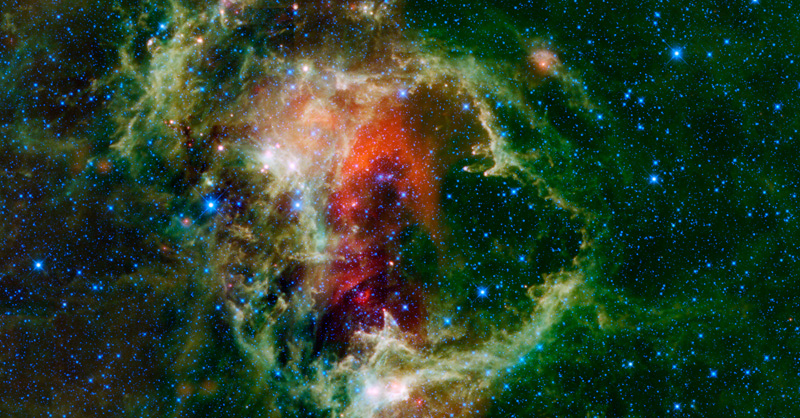
This WISE mosaic is of the Soul Nebula (a.k.a. the Embryo Nebula, IC 1848, or W5). It is an open cluster of stars surrounded by a cloud of dust and gas over 150 light-years across and located about 6,500 light-years from Earth in the constellation Cassiopeia, near the Heart Nebula (partially seen in the WISE image of Maffei 1 & 2).

The cluster of stars, IC 1848, formed about a million years ago from the material of the nebula. Winds and ultraviolet light from these young stars are excavating a cavity in the cloud. Parts of the cloud that are more dense than their surroundings are being eroded more slowly and form giant towers, or pillars of dust and gas, which all point toward the central star cluster. It’s reminiscent of the landscape of Badlands National Park in South Dakota. Material at the interior edges of the cavity is also being compressed by the winds and radiation from the star cluster. This triggers new star formation in those areas. The pillars inside the Soul Nebula are each about 10 light-years tall and have stars forming at their tips.


Soul Nebula – click for 800×418 image
Read More >>

VISTA’s infrared view of the Cat’s Paw Nebula

VISTA’s infrared view of the Cat’s Paw Nebula
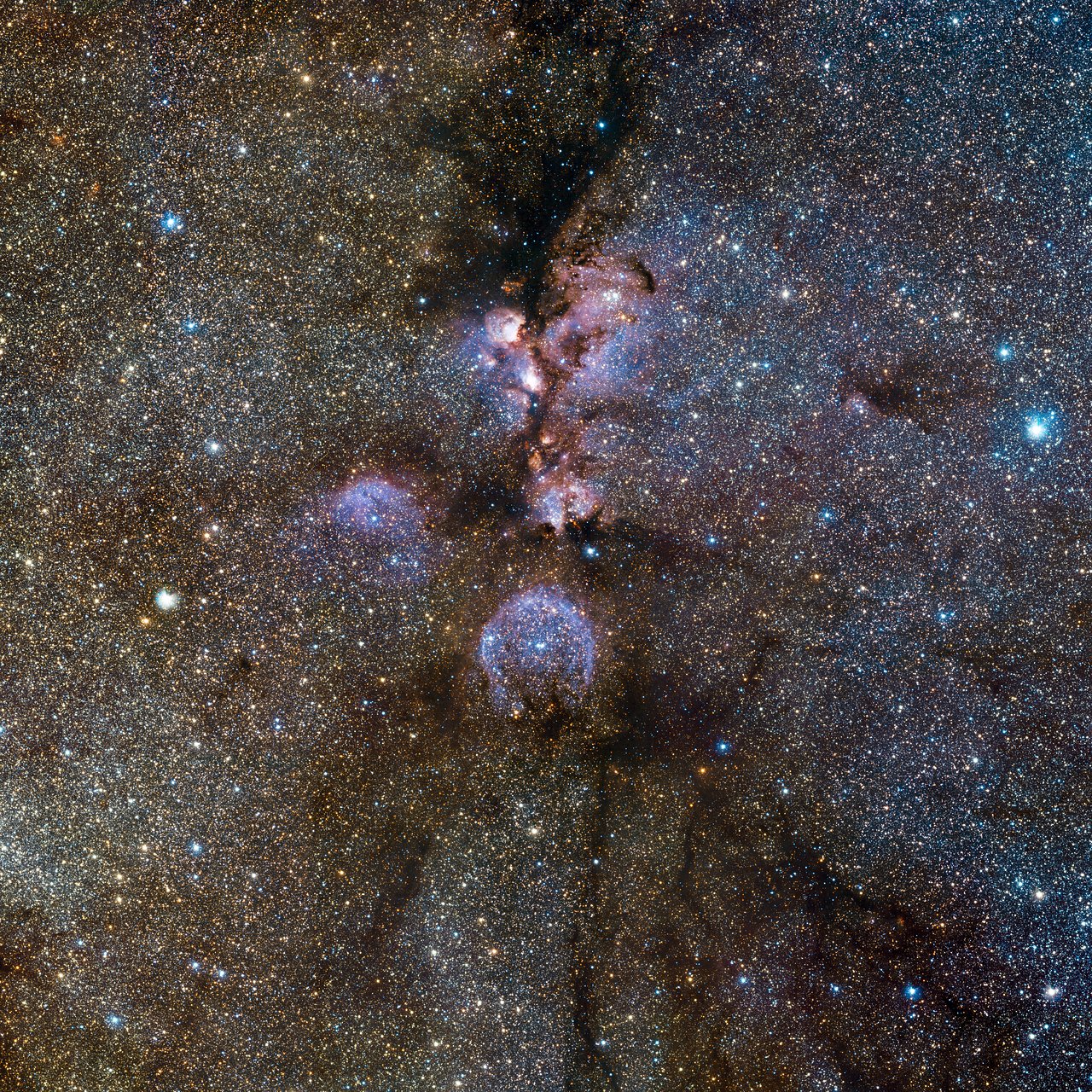
The Cat’s Paw Nebula, NGC 6334, is a huge stellar nursery, the birthplace of hundreds of massive stars. In a magnificent new ESO image taken with the Visible and Infrared Survey Telescope for Astronomy (VISTA) at the Paranal Observatory in Chile, the glowing gas and dust clouds obscuring the view are penetrated by infrared light and some of the Cat’s hidden young stars are revealed.

Towards the heart of the Milky Way, 5500 light-years from Earth in the constellation of Scorpius (the Scorpion), the Cat’s Paw Nebula stretches across 50 light-years. In visible light, gas and dust are illuminated by hot young stars, creating strange reddish shapes that give the object its nickname. A recent image by ESO’s Wide Field Imager (WFI) at the La Silla Observatory (eso1003) captured this visible light view in great detail. NGC 6334 is one of the most active nurseries of massive stars in our galaxy.


NGC 6334 – click for 1280×1280 image


More: here, here
Read More >>

Orion's Dreamy Stars

Orion's Dreamy Stars (4/1/10)
A colony of hot, young stars is stirring up the cosmic scene in this new picture from NASA's Spitzer Space Telescope. The image shows the Orion nebula, a happening place where stars are born. The young stars dip and peak in brightness due to a variety of reasons. Shifting cold and hot spots on the stars' surfaces cause brightness levels to change, in addition to surrounding disks of lumpy planet-forming material, which can obstruct starlight. Spitzer is keeping tabs on the young stars, providing data on their changing ways.

The hottest stars in the region, called the Trapezium cluster, are bright spots at center right. Radiation and winds from those stars has sculpted and blown away surrounding dust. The densest parts of the cloud appear dark at center left.


Orion Nebula – click for 1000×427 image


More: here, here
Read More >>

Orion in a New Light

Orion in a New Light (2/10/10)
The Orion Nebula is a vast stellar nursery lying about 1350 light-years from Earth. Although the nebula is spectacular when seen through an ordinary telescope, what can be seen using visible light is only a small part of a cloud of gas in which stars are forming. Most of the action is deeply embedded in dust clouds and to see what is really happening astronomers need to use telescopes with detectors sensitive to the longer wavelength radiation that can penetrate the dust. VISTA has imaged the Orion Nebula at wavelengths about twice as long as can be detected by the human eye.

As in the many visible light pictures of this object, the new wide field VISTA image shows the familiar bat-like form of the nebula in the centre of the picture as well as the fascinating surrounding area. At the very heart of this region lie the four bright stars forming the Trapezium, a group of very hot young stars pumping out fierce ultraviolet radiation that is clearing the surrounding region and making the gas glow. However, observing in the infrared allows VISTA to reveal many other young stars in this central region that cannot be seen in visible light.


Orion Nebula – click for 1280×1574 image


More: here, here, here
Read More >>

The Stars behind the Curtain

The Stars behind the Curtain (2/3/10)
ESO is releasing a magnificent VLT image of the giant stellar nursery surrounding NGC 3603, in which stars are continuously being born. Embedded in this scenic nebula is one of the most luminous and most compact clusters of young, massive stars in our Milky Way, which therefore serves as an excellent “local” analogue of very active star-forming regions in other galaxies. The cluster also hosts the most massive star to be “weighed” so far.

NGC 3603 is a starburst region: a cosmic factory where stars form frantically from the nebula’s extended clouds of gas and dust. Located 22 000 light-years away from the Sun, it is the closest region of this kind known in our galaxy, providing astronomers with a local test bed for studying intense star formation processes, very common in other galaxies, but hard to observe in detail because of their great distance from us.


NGC 3603 – click for 1280×1291 image


More: here
Read More >>

Galaxies are slowly running out of gas

Galaxies are made of stars, and stars are made of... gas. So a large part of understanding how galaxies evolve and grow is understanding how much "gas" (literally, not "gasoline") is present in galaxies – but has not yet been incorporated in stars – at different periods in the history of the universe.

What periods of the universe are most interesting in this regard? The answer is: periods somewhat less than the first half of the universe's existence since the time of the big bang, roughly the first 5.5 billion years, 40% of the total. That's because astronomers have good reason to believe that is the time when star formation, and hence galaxy growth, occurred most vigorously.

Assuming the best current estimate, that is has been about 13.7 billion years since the big bang, this means we're interested in observing the universe as it was more than 8.2 billion years ago. That's quite a long time ago, and until fairly recently observation of objects that far back in time has been infeasible. Technology is only now becoming available to study the details of such a remote time.

Astronomers find it convenient to represent distance (in either space or time) in terms of redshift. Because it takes light a finite amount of time to travel, any observable object is seen not as it looks "today", 13.7 billion years after the big bang, but instead as it looked a some time T<13.7, and so we see the object as it looked 13.7-T billion years ago. The light from such an object has taken 13.7-T billion years to reach us.

Due to the expansion of the universe, the wavelength of any photon of light has been increased by a factor of (z+1), where z is the observed redshift – z=0 corresponding to nearby objects for which the shift is negligible. z increases as a complicated function of the distance of the object, but it increases in a regular way as the distance increases. For objects at an age T=5.5 billion years, corresponding to a distance of 8.2 billion light years, the redshift would be about 1.1.

Astronomers have now done surveys of galaxies around z≈1.1. It's not easy, but there is plenty of data, even though only very large, bright galaxies can be observed in detail at that distance. It's even more difficult, though still feasible, to survey galaxies that are even more remote, say at z≈2.3, which corresponds to T≈2.9 billion years.

For the research under discussion here, the investigators relied on existing surveys to sample from, because of the difficulty of doing new surveys from scratch. There was a trade-off to be made. In order to be able to study a selected sample of galaxies in sufficient detail, it's desirable to pick the largest, brightest galaxies. On the other hand, it's also important to study galaxies that are representative of "typical" mature galaxies today, such as our Milky Way. Unfortunately, the most luminous objects at large z tend to be atypical things like quasars and merging galaxies. Those are "freaks", quite unlike typical nearby galaxies, and whatever we might learn about them might not tell us much about the typical case.

So the investigators had to select galaxies for study that were as large and bright as possible, but still "normal". In this case, they included only galaxies of estimated stellar mass (excluding dark matter) of ≥ 3×10¹⁰ M⊙. (1 M⊙ is our Sun's mass.) Since we are inside the Milky Way and can't see all of it (because of thick dusty regions), it's hard to be sure of our galaxy's total stellar mass, but it's estimated to be about 5×10¹⁰ M⊙. (Ref: here.)

An important objective of the research was to get a better understanding of galaxies in which new stars are actively being formed – unlike the Milky Way and other nearby large spirals, which are currently forming stars at the rate of about 5 M⊙ per year. Star formation rate is something else that's easier to determine from outside the galaxy, by measuring light flux in various parts of the spectrum (especially infrared and ultraviolet). For the present research, only galaxies with a star formation rate ≥ 40 M⊙ per year were selected.

For reasons we're coming to, the required observations are difficult and time-consuming, so for this kind of preliminary study it was necessary to work with small numbers. The net result is that the study was done with 11 galaxies selected from one survey, with z≈1.2, and 12 galaxies selected from another survey with z≈2.3.

Remember that the ultimate objective of the research is to determine how much gas is available for star formation in typical galaxies at the given values of z. That's what is so difficult that it had not been done before (for such distant galaxies).

It's relatively straightforward to determine how much of a galaxy's mass is in the form of stars. This "stellar mass" is proportional to the intrinsic luminosity of the galaxy (which is known since the galaxy distance is known), because most galaxies consist of stars with a predictable distribution of stars of given mass and luminosity ("initial mass function").

However, the total mass of a galaxy also includes non-baryonic dark matter, whose mass in the universe as a whole is known to be about 5 times as large as the mass of "ordinary" baryonic matter. The total mass of a galaxy can sometimes be inferred from measuring galaxy rotation curves. The baryonic matter of a galaxy consists of stars, gas, and (perhaps) massive nonluminous objects such as black holes. Even if one knew reliably the total mass of a galaxy, including dark matter, and one could neglect the contribution of nonluminous objects, one still could not estimate the mass of gas as the difference between the mass of a galaxy's stars and the roughly 17% of total mass that baryonic matter represents in the universe as a whole.

That's because there's no a priori reason to expect that a 1:5 ratio of baryonic matter to non-baryonic matter is present in any particular galaxy – it might well be either more or less. So there needs to be some way to measure fairly directly the amount of matter a galaxy contains in the form of gas that could form stars.

It is known that stars form only out of gas that's rather cold – with temperature less than 100 K. This is simply because hotter gas has a higher internal pressure that prevents the gravitational collapse that's necessary to form a star. Gas that cold is very hard to detect. Black body radiation at 100 K peaks at 29 μm, in the far infrared, and cooler gas emits at even longer wavelengths. Redshift stretches the wavelengths even more (by factors of 2 or 3 for z=1 or 2). Most of the radiation at such wavelengths is blocked by our atmosphere, so is observable only from space – and the necessary instruments don't exist yet.

Fortunately, black body radiation is not the only type of electromagnetic emission from cold gas. Vibrations and rotations of gas molecules also radiate at certain frequencies. Now, most of a galaxy's cold gas is in the form of atomic helium and molecular hydrogen. It would be convenient if hydrogen molecules, especially, had emissions at convenient wavelengths for ground-based observation, but no such luck. It turns out, however, that there is one molecule present in small amounts in interstellar gas which does have a convenient emission: CO (carbon monoxide). CO has a rotational emission at 870 μm (346 GHz). At the values of z of interest here (1.2 and 2.3) these fall into the 2 mm and 3 mm bands – which can be observed.

In a nutshell, then, what the research under discussion did was to measure the total flux from the selected galaxies at the appropriate wavelengths. This indicates that amount of cold CO gas present in the galaxies. Studies of nearby galaxies show that this accurately indicates the total amount of cold gas present. From this, and the estimated mass in the form of stars, one has fraction of total mass (stars + gas) represented by the cold gas available to form stars.

For the galaxies in the sample, this fraction was found to be 34% at z≈1.2 and 44% at z≈2.3. By contrast, contemporary large spiral galaxies have fractions in the 3% to 12% range – quite a difference.

For a summary of the results, here's the abstract:

High molecular gas fractions in normal massive star-forming galaxies in the young Universe
Stars form from cold molecular interstellar gas. As this is relatively rare in the local Universe, galaxies like the Milky Way form only a few new stars per year. Typical massive galaxies in the distant Universe formed stars an order of magnitude more rapidly. Unless star formation was significantly more efficient, this difference suggests that young galaxies were much more molecular-gas rich. Molecular gas observations in the distant Universe have so far largely been restricted to very luminous, rare objects, including mergers and quasars, and accordingly we do not yet have a clear idea about the gas content of more normal (albeit massive) galaxies. Here we report the results of a survey of molecular gas in samples of typical massive-star-forming galaxies at mean redshifts of about 1.2 and 2.3, when the Universe was respectively 40% and 24% of its current age. Our measurements reveal that distant star forming galaxies were indeed gas rich, and that the star formation efficiency is not strongly dependent on cosmic epoch. The average fraction of cold gas relative to total galaxy baryonic mass at z = 2.3 and z = 1.2 is respectively about 44% and 34%, three to ten times higher than in today’s massive spiral galaxies. The slow decrease between z ≈ 2 and z ≈ 1 probably requires a mechanism of semi-continuous replenishment of fresh gas to the young galaxies.

The results from this research about star formation rates (SFR) are especially interesting. From other research involving much larger samples, it's known that when SFR is plotted against galaxy stellar mass, the distribution can be fit by a power law:
SFR (M⊙/year) = 150 (M*/1011M⊙)0.8×([1+z]/3.2)2.7
In this equation, M* is the galactic stellar mass. Thus SFR depends on total stellar mass of a galaxy, which makes sense, because the larger the galaxy, the more cold molecular gas is available to make stars. Further, because of the factor involving 1+z (where z is redshift), the SFR curve is shifted upwards at larger z – the rate of star formation is greater, in a regular way, at earlier times in the universe.

This equation is pretty close even in the nearby universe, where z=0. For a galaxy the size of the Milky Way (which is not among the largest of spirals), M* is estimated as 5×10¹⁰ M⊙, predicting SFR of about 3.7 M⊙/year – which is surprisingly accurate. So SFR has continued to decline in a fairly regular way.

Interestingly enough, however, in the galaxies sampled in the present research, the percentage of cold gas in a galaxy does not appear to have any clear relationship to either the SFR or the total stellar mass of a galaxy. So almost all of the variation in SFR is related to the total stellar mass. This is what it means to say that the "efficiency" of star formation is not very dependent on percentage of cold gas or cosmic epoch. Instead, SFR is probably largely dependent on total available cold gas, which is proportional (at a given z) to a galaxy's stellar mass.

One additional interesting conclusion can be drawn from the research. Namely, given the SFR in sampled galaxies at z≈2.3, there ought to be much less cold gas in equivalent galaxies at the later time (about 2.3 billion years later) corresponding to z≈1.2 than is actually observed. Much of that cold gas should have been incorporated into stars. Yet the amount of cold gas actually observed at the later time is more than the original amount less what was converted to stars. And so there is apparently more cold gas added over time, even though, as a whole, galaxies really are "runnng out of gas".


ResearchBlogging.org
Tacconi, L., Genzel, R., Neri, R., Cox, P., Cooper, M., Shapiro, K., Bolatto, A., Bouché, N., Bournaud, F., Burkert, A., Combes, F., Comerford, J., Davis, M., Schreiber, N., Garcia-Burillo, S., Gracia-Carpio, J., Lutz, D., Naab, T., Omont, A., Shapley, A., Sternberg, A., & Weiner, B. (2010). High molecular gas fractions in normal massive star-forming galaxies in the young Universe Nature, 463 (7282), 781-784 DOI: 10.1038/nature08773


Further reading:

Young galaxies gorge on gas (2/10/10)

Why Today's Galaxies Don't Make As Many Stars As They Once Did (2/11/10)

Early Galaxies Formed Stars Fast Because They Had More Gas (2/10/10)

Stellar Baby Boom of Early Universe Explained (2/11/10)

Ancient Galaxies Packed More Raw Material for Stellar Formation (2/10/10)

In the News this month: the molecular content of early galaxies (3/4/10)

Astrophysics: Less greedy galaxies gulp gas (2/11/10)
Read More >>

Hubble Image Showcases Star Birth in M83, the Southern Pinwheel

Hubble Image Showcases Star Birth in M83, the Southern Pinwheel
The spectacular new camera installed on NASA's Hubble Space Telescope during Servicing Mission 4 in May has delivered the most detailed view of star birth in the graceful, curving arms of the nearby spiral galaxy M83.

Nicknamed the Southern Pinwheel, M83 is undergoing more rapid star formation than our own Milky Way galaxy, especially in its nucleus. The sharp "eye" of the Wide Field Camera 3 (WFC3) has captured hundreds of young star clusters, ancient swarms of globular star clusters, and hundreds of thousands of individual stars, mostly blue supergiants and red supergiants.


M83 – click for 995×1000 image


More: here, here
Read More >>

Opening up a Colourful Cosmic Jewel Box

Opening up a Colourful Cosmic Jewel Box (10/29/09)
The combination of images taken by three exceptional telescopes, the ESO Very Large Telescope on Cerro Paranal , the MPG/ESO 2.2-metre telescope at ESO’s La Silla observatory and the NASA/ESA Hubble Space Telescope, has allowed the stunning Jewel Box star cluster to be seen in a whole new light. ...

The Kappa Crucis Cluster, also known as NGC 4755 or simply the “Jewel Box” is just bright enough to be seen with the unaided eye. It was given its nickname by the English astronomer John Herschel in the 1830s because the striking colour contrasts of its pale blue and orange stars seen through a telescope reminded Herschel of a piece of exotic jewellery.

Open clusters [1] such as NGC 4755 typically contain anything from a few to thousands of stars that are loosely bound together by gravity. Because the stars all formed together from the same cloud of gas and dust their ages and chemical makeup are similar, which makes them ideal laboratories for studying how stars evolve.


NGC 4755 – click for 1280×1283 image


More: here, here
Read More >>

A Look into the Hellish Cradles of Suns and Solar Systems

A Look into the Hellish Cradles of Suns and Solar Systems (8/19/09)
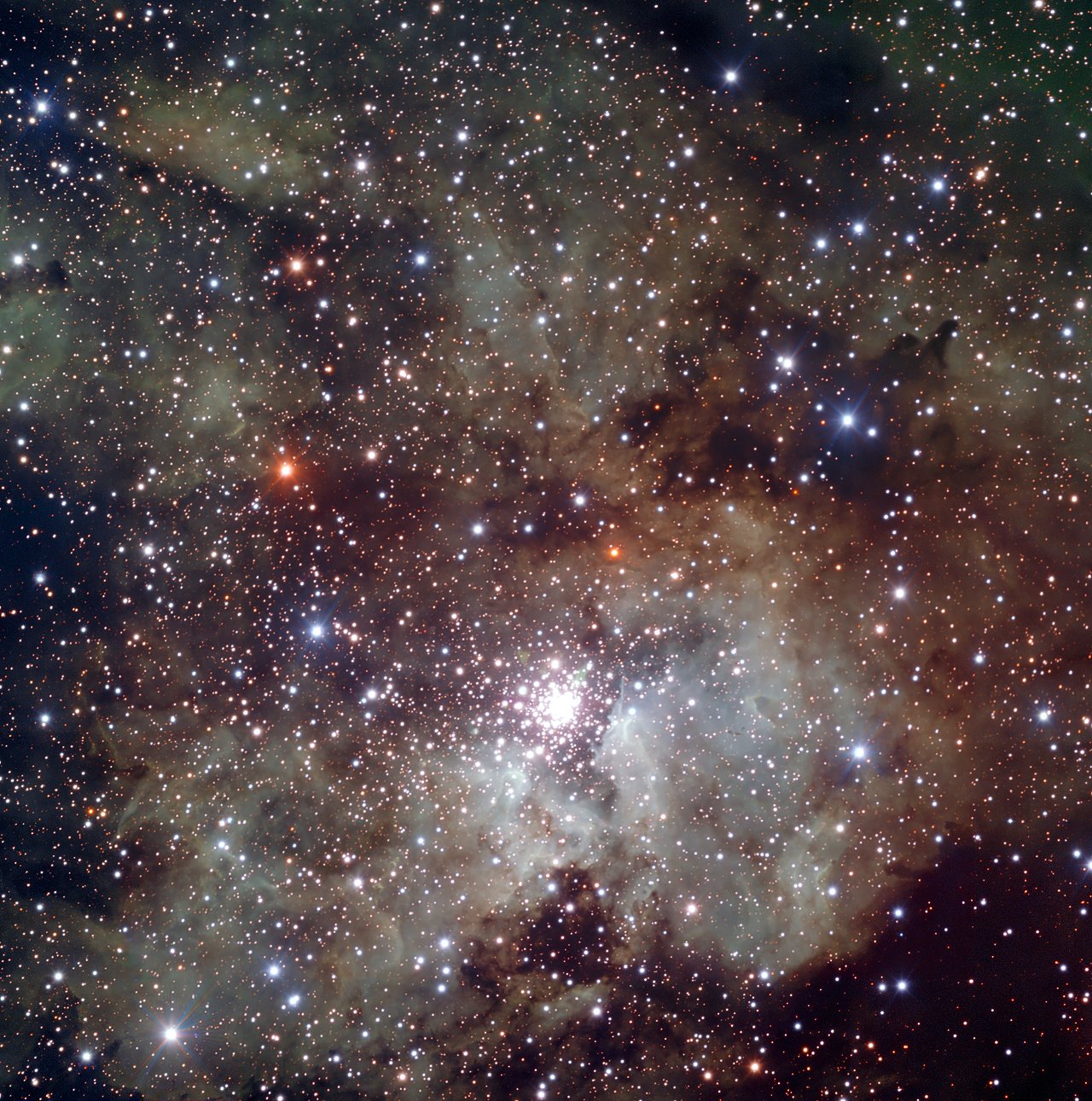
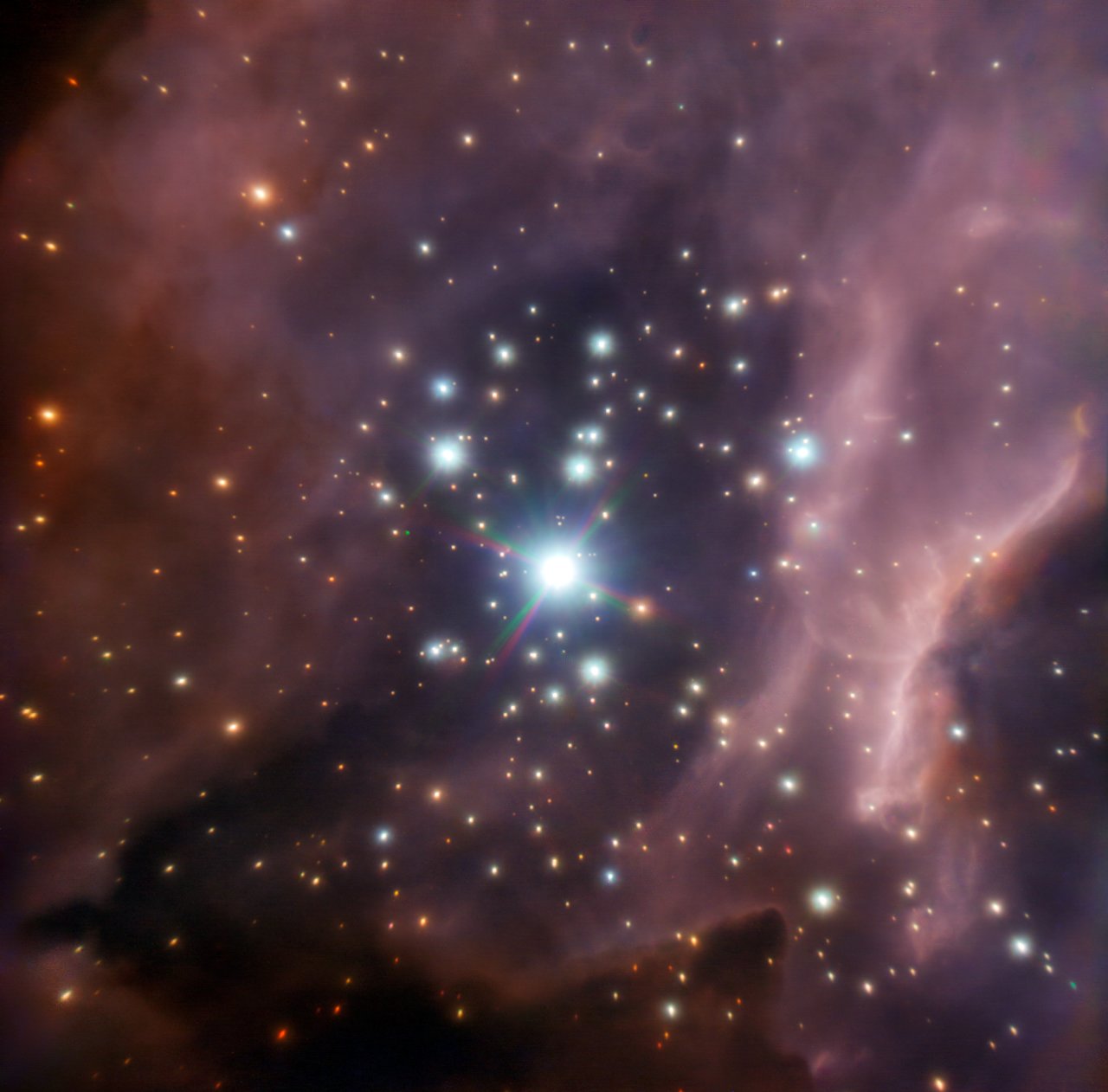
New images released today by ESO delve into the heart of a cosmic cloud, called RCW 38, crowded with budding stars and planetary systems. There, young stars bombard fledgling suns and planets with powerful winds and blazing light, helped in their task by short-lived, massive stars that explode as supernovae. In some cases, this onslaught cooks away the matter that may eventually form new solar systems. Scientists think that our own Solar System emerged from such an environment.

The dense star cluster RCW 38 glistens about 5500 light years away in the direction of the constellation Vela (the Sails). Like the Orion Nebula Cluster (ESO 12/01), RCW 38 is an “embedded cluster”, in that the nascent cloud of dust and gas still envelops its stars. Astronomers have determined that most stars, including the low mass, reddish ones that outnumber all others in the Universe, originate in these matter-rich locations. Accordingly, embedded clusters provide scientists with a living laboratory in which to explore the mechanisms of star and planetary formation.


Stellar cluster RCW 38 – click for 1280×1262 image


More: here, here
Read More >>

Trigger-Happy Star Formation

Trigger-Happy Star Formation (8/12/09)
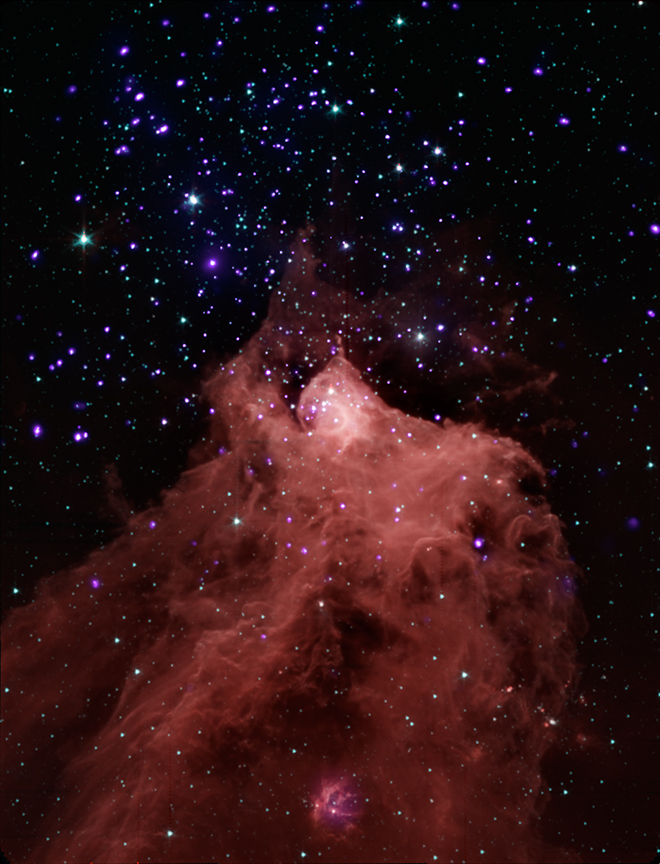
A new study from two of NASA's Great Observatories provides fresh insight into how some stars are born, along with a beautiful new image of a stellar nursery in our Galaxy. The research shows that radiation from massive stars may trigger the formation of many more stars than previously thought.

While astronomers have long understood that stars and planets form from the collapse of a cloud of gas, the question of the main causes of this process has remained open.

One option is that the cloud cools, gravity gets the upper hand, and the cloud falls in on itself. The other possibility is that a "trigger" from some external source -- like radiation from a massive star or a shock from a supernova -- initiates the collapse. Some previous studies have noted a combination of triggering mechanisms in effect.

By combining observations of Cepheus B from the Chandra X-ray Observatory and Spitzer Space Telescope, researchers have taken an important step in addressing this question. Cepheus B is a cloud of mainly cool molecular hydrogen located about 2,400 light years from the Earth. There are hundreds of very young stars inside and around the cloud -- ranging from a few millions years old outside the cloud to less than a million in the interior -- making it an important testing ground for star formation.


Cepheus B – press for 660×864 image


More: here, here, here, here, here
Read More >>

An Eagle of Cosmic Proportions

An Eagle of Cosmic Proportions (7/16/09)
Located 7000 light-years away, towards the constellation of Serpens (the Snake), the Eagle Nebula is a dazzling stellar nursery, a region of gas and dust where young stars are currently being formed and where a cluster of massive, hot stars, NGC 6611, has just been born. The powerful light and strong winds from these massive new arrivals are shaping light-year long pillars, seen in the image partly silhouetted against the bright background of the nebula. The nebula itself has a shape vaguely reminiscent of an eagle, with the central pillars being the “talons”.


Eagle Neblula – click for 1280×1280 image
Read More >>

NASA's Spitzer Sees the Cosmos Through 'Warm' Infrared Eyes

NASA's Spitzer Sees the Cosmos Through 'Warm' Infrared Eyes (8/5/09)
NASA's Spitzer Space Telescope is starting a second career and taking its first shots of the cosmos since warming up.

The infrared telescope ran out of coolant May 15, 2009, more than five-and-a-half-years after launch. It has since warmed to a still-frosty 30 degrees Kelvin (about minus 406 degrees Fahrenheit).

New images taken with two of Spitzer's infrared detector channels — two that work at the new, warmer temperature — demonstrate the observatory remains a powerful tool for probing the dusty universe. The images show a bustling star-forming region, the remains of a star similar to the sun, and a swirling galaxy lined with stars. ...

The first of three images shows a cloud bursting with stars in the Cygnus region of our Milky Way galaxy. Spitzer's infrared eyes peer through and see dust, revealing young stars tucked in dusty nests.


Cygnus region – click for 750×663 image
Read More >>

Stellar family in crowded, violent neighbourhood proves to be surprisingly normal

Stellar family in crowded, violent neighbourhood proves to be surprisingly normal (6/4/09)
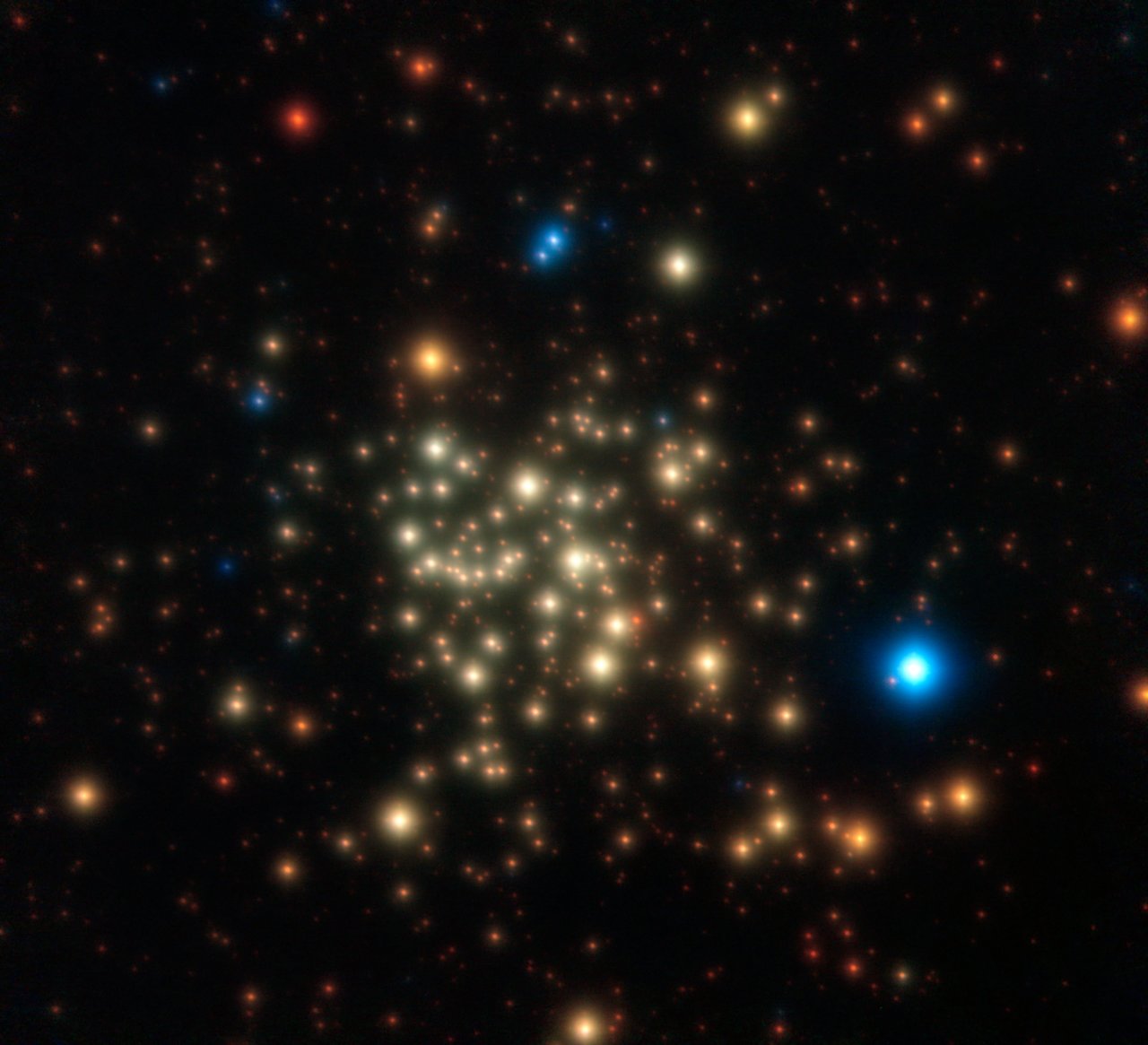
Using ESO’s Very Large Telescope, astronomers have obtained one of the sharpest views ever of the Arches Cluster — an extraordinary dense cluster of young stars near the supermassive black hole at the heart of the Milky Way. Despite the extreme conditions astronomers were surprised to find the same proportions of low- and high-mass young stars in the cluster as are found in more tranquil locations in our Milky Way.

The massive Arches Cluster is a rather peculiar star cluster. It is located 25 000 light-years away towards the constellation of Sagittarius (the Archer), and contains about a thousand young, massive stars, less than 2.5 million years old [1]. It is an ideal laboratory to study how massive stars are born in extreme conditions as it is close to the centre of our Milky Way, where it experiences huge opposing forces from the stars, gas and the supermassive black hole that reside there. The Arches Cluster is ten times heavier than typical young star clusters scattered throughout our Milky Way and is enriched with chemical elements heavier than helium.


Arches Cluster – click for 1280×1165 image


More: here
Read More >>

The cosmic "dark ages"

In brief, "dark ages" refers to the period after recombination occurred, about 380,000 years after the big bang, creating the cosmic microwave background (CMB), up to and partly including the time that the first stars had formed, perhaps as early as four hundred million years later, and caused the reionization of much of the neutral hydrogen in the universe.

That's a mouthful, but it's important to understand in order to have a useful discussion of the conditions that existed when the first stars and first galaxies in the universe formed. Many important open questions in astrophysics right now have to do with the nature of these events. Since I expect to discuss some of these questions, it's necessary to say some things about the "dark ages". That's what this note is about.

Let's start with the CMB. I'm going to give just a sketch. You might want to consult other references if you need more detail.

The period of time in which the CMB emerged is also known as the period of recombination. This was not an instantaneous process, but it did proceed relatively quickly, and is often thought of as a single event.

Basically, before recombination matter (mostly hydrogen and helium) and energy (light, i. e. photons) existed in thermal equilibrium. That is, the following reaction could occur with equal probability in either direction:
H + γ ⇄ p + e-

Here, H stands for a hydrogen atom (with one electron), γ is a photon, p is a proton, and e- is an electron. (We'll ignore helium, for simplicity.) What this formula says is that a photon of sufficient energy could dislodge an electron from a hydrogen atom to form a proton and a free electron, and with equal probability protons and free electrons could combine to form a hydrogen atom and a photon.

As the universe cooled after the big bang, the average temperature of the matter-energy plasma steadily dropped. Before the period of recombination, hydrogen atoms could exist, but not for very long, because most photons had enough energy to completely dislodge an electron, so the reaction went from left to right as often as from right to left.

Over a period of time lasting a few tens of thousands of years the situation changed so that most photons no longer had enough energy to dislodge an electron. (A low energy photon could still interact or "scatter" with a hydrogen atom by raising an electron to a higher energy level, but we can gloss over that detail.) Note that the average or "typical" photon energy may be a lot lower than what's needed to dislodge an electron, as long as there are still enough higher-energy photons around. This is a statistical situation governed by the Maxwell-Boltzmann equation, but all that really matters is that eventually photons and neutral hydrogen atoms "decouple" statistically.

So at some point you have recombination, when electrons combine with protons to make neutral hydrogen, and the process (mostly) doesn't reverse. Occasionally, a photon and a hydrogen atom may still interact, but as the universe expands, it's increasingly less likely for a photon and an atom to come close enough to interact, until the probability of interaction is essentially zero. This second stage is sometimes referred to as "decoupling" of matter and photons.

Thus the period of "dark ages" began right after the relatively brief process of recombination and decoupling. For simplicity, we date this point to a single time when the process was about half complete, roughly 380,000 years after the big bang.

This period is termed "dark", even though there were plenty of photons around, because there were as yet no stars or other compact sources of illumination. (There's another reasons for calling it "dark", which we'll get to in a moment.)

CMB photons have a nearly perfect black-body distribution. There is a clear peak of maximum energy in this distribution. What we observe is that this peak occurs at about 2 mm, in the microwave part of the spectrum. But the time of decoupling, 380,000 years after the big bang, corresponds to a redshift of z≈1100, so at the time of decoupling the peak photon energy was around a wavelength of just 2.2 μm (2200 nm) in the infrared part of the electromagnetic spectrum. (If you need to refresh your memory about how redshift works, check here.) So "dark" is not exactly the right term to use, but compared to abundant light from stars, it's not unreasonable.

After the time of recombination/decoupling, most hydrogen and helium atoms were neutral and un-ionized. This went on for several hundred million years. One of the most interesting open questions is about determining more exactly how long this lasted. We can reasonably guess what probably brought the dark ages to an end: formation of the first stars in the universe. But we don't have a good idea of just when this started, or how long the process took.

In this period, matter was beginning slowly to come together in higher-density clumps under the force of gravity. Dark matter, which outweighed ordinary matter then (as now), by a ratio of about 5.5:1 speeded up this process.

It was precisely this formation of regions of higher matter density that enabled the first stars to form. But because of this same higher density of matter around newborn stars, the abundant high-energy photons produced by these stars were again likely to interact with the nearby un-ionized matter, which scattered them and reduced their energy – dimming the light of these first stars.

One of the large uncertainties concerns the characteristics of this first generation of stars. We have no direct evidence about them. What we think we know about them is based on theoretical models rather than direct observation. (We discussed formation of the first stars back here.) However, it's widely believed that these stars were unlike stars formed later, right up to the present time. The first stars were probably quite large (maybe as much as 200 solar masses), very hot, and very bright. Because they burned their fuel so rapidly, their lifetimes would be very short, perhaps less than a million years.

Some of the light from extremely hot, massive stars such as those of the first generation is well into the ultraviolet part of the spectrum, around 90 nm. Such photons have an energy above 13.6 eV (91.2 nm wavelength), enough to completely ionize hydrogen. If these stars formed, say, 400 million years after the big bang, at a redshift of z≈11, the wavelength of their light would be shifted to the area beyond 1100 nm, which is in the infrared. That's beyond the range of human eyes, or most astronomical instruments. Consequently, we would have a very hard time detecting light from the first stars, even if they weren't so far away (over 13 billion light-years) and obscured by clouds of atomic hydrogen. That time period would still seem "dark" to us – there would be very little we could "see".

However, the first stars radiated so much energy, especially at ultraviolet wavelengths, that over time they effectively reionized all of the hydrogen in their vicinity. And this is (probably) what brought about the epoch of reionization in the universe, effectively ending the "dark ages".

The first stars were probably not part of galaxies, though we don't know for sure. If that's the case, they would be even harder to observe. The first objects we will be able to detect from this period almost certainly will be galaxies or quasars (which are galaxies with a very active central black hole). So the question of when galaxies began to form is separate, but equally puzzling. There is evidence that the first galaxies in fact did form before the end of the dark ages – because we can actually observe a few that show evidence of un-ionized hydrogen.

What we can say for sure is that the first stars must have consisted only of the primordial elements hydrogen and helium, since heavier elements (except for a small trace of lithium) formed and dispersed only when the first stars exploded as supernovae. But that did happen rather quickly, since the first stars were very luminous, and consequently had very brief lives.

As noted, we aren't very sure about when this first generation of stars appeared, because we can't yet observe them directly. But we do have some evidence concerning the epoch of reionization, and hence we have some idea of when it ended.

One kind of evidence involves studying the spectra of some of the most distant objects we are currently able to observe – quasars. We have detected a number of quasars at redshifts between 6 and 7. This range represents a time period from about 780 to 950 million years after the big bang.

There are absorption lines in the spectra of these quasars, and they tell us not only about the redshift, but give other information as well. Among the most important lines are those due to hydrogen that's not fully ionized, such as lines of the Lyman series. For the most part these lines are due to hydrogen in the vicinity of the source, in which case the lines are quite sharp and distinct.

But suppose there is a substantial amount of incompletely ionized hydrogen between us and the source. If this gas is at a distance sufficiently less (in terms of redshift), the absorption lines will be fuzzy instead of sharp. This effect is called a Gunn-Peterson trough.

In 2001 a quasar was identified at z=6.28, which showed a Gunn-Peterson trough, while other quasars with z≤6 did not. This suggests that reionization was mostly complete by 950 million years after the big bang, but not by 900 million years. [1][2]

Quasars, by themselves, are a possible contributor to reionization, in addition to the earliest stars. Quasars certainly produce enough high-energy photons. However, the question is whether there were enough quasars in existence during the epoch of reionization to account for the effect. Since only the very brightest quasars can currently be observed at that distance (z≥6), it's not possible to reliably estimate how many quasars altogether were around then. Rough estimates suggest there weren't enough.

There is another source of evidence for reionization, one very different from the Gunn-Peterson trough. This involves a very detailed study of anisotropies (irregularities at small angular scales) in the CMB. The CMB has many anisotropies due to conditions existing from the earliest moments after the big bang. However, if reionization occurred, certain kinds of additional characteristic anisotropies will also be present. These result from polarization of CMB light due to Thomson scattering of photons by free electrons (if such exist in sufficient numbers). Since free electrons are a by-product of reionization, they provide a very good marker, if they can be detected.

Unfortunately, the earliest data analysis (in 2003) from the Wilkinson Microwave Anisotropy Probe suggested that reionization occurred in the range 11<z<30, which corresponds to a mere 100 million to 420 million years after the big bang. This is not compatible with the quasar evidence. It's also rather implausible at the high z end, if reionization was caused by the first stars.

Fortunately, however, later data analysis (released in 2008) restated the range for reionization to 7≤z≤11. [3] z=7 still doesn't quite mesh with the quasar data, but it's pretty close. z=11 corresponds to 420 million years after the big bang, which is quite plausible for appearance of the first stars. Note that if this range is correct, then the reionization process took a lot of time, maybe 400 to 500 million years. First generation stars almost certainly weren't around that long. Such stars have very short lifetimes, and new stars of this kind can't form, because the gas from which they could form would contain considerable amounts of elements heavier than helium, precluding the formation of more stars like those of the first generation.

A third possible source of evidence comes from surveys looking for very faint, high-redshift galaxies (not quasars). Some objects have been found up to z=7.5 – about 710 million years after the big bang. [4] What isn't clear is whether these objects were either abundant enough or had hot enough stars to contribute significantly to reionization. But when the James Webb Space Telescope goes to work, sometime after mid-2013, we should be able to find many more early galaxies. The planned upgrade to the Hubble Space Telescope this year would also help – if it occurs.

Further reading:

[1] Evidence for Reionization at z ~ 6: Detection of a Gunn-Peterson Trough in a z = 6.28 Quasar – 2001 research article on first evidence for reionization (open access)

[2] First Light: Astronomers Use Distant Quasar To Probe Cosmic "Dark Age," Universe Origins (8/8/01) – press release describing the preceding research

[3] A New Day in Precision Cosmology (3/11/08) – news article describing analysis of WMAP data, including information on reionization

[4] Largest Sample Of Very Distant Galaxies Ever Seen Provide New Insights Into Early Universe (7/24/08) – press release

Tags: ,
Read More >>

Wall Divides East and West Sides of NGC 604

Wall Divides East and West Sides of NGC 604 (1/27/09)
A new study unveils NGC 604, the largest region of star formation in the nearby galaxy M33, in its first deep, high-resolution view in X-rays. This composite image from Chandra X-ray Observatory data (colored blue), combined with optical light data from the Hubble Space Telescope (red and green), shows a divided neighborhood where some 200 hot, young, massive stars reside.

Throughout the cosmic metropolis, giant bubbles in the cool dust and warm gas are filled with diffuse, multi-million degree gas that emits X-rays. Scientists think these bubbles are generated and heated to X-ray temperatures when powerful stellar winds from the young massive stars collide and push aside the surrounding gas and dust. So, the vacated areas are immediately repopulated with the hotter material seen by Chandra.


NGC 604 – click for 720×762 image
Read More >>