Pages

Travelog: Arial Shots

When I have the great fortune to travel from place to place, I take my camera with me and document the local scenes and wildlife. My photojournalism usually starts right out the gate with take off. It's fascinating to me to see a city, my own or a new one, from a few hundred feet above. The structures and natural landscapes are still discernible and the vantage is always breathtaking. It really puts an area in perspective. Usually, I notice how most cities are more green than we can really appreciate. Usually there are patches of woods or prairies or water systems connected together by pencil then traces separately by roads. Mainly because airports are pesky places to live, these areas are usually very nice urban wildlife refuges.

My most recent trip - a visit to San Francisco for a Coalition for the Public Understanding of Science Focus group, I flew into Minneapolis and noticed the rising water levels that have been making the news.

Minneapolis, Minnesota near the airport. Saturday, March 20, 2010
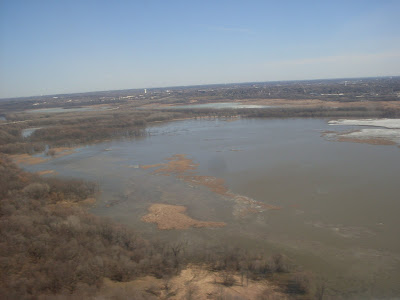
approaching the airport, airplane descending. The trees are submerged.
The high water levels are only a few feet from business buildings.
I'll see more of this high water, down river when I return to St. Louis and as the spring thaw sends more water into the river.
Check out Birdchick's pictures and commentary of the Mississippi River flooding, around the same time in St. Paul, Minnesota.
***
I had a two-stop layover to San Francisco, so my next stop was Salt Lake City, Utah. This is a beautiful city and a chance to see a very different ecosystem as well as a very different geological formation - mountains, the Rocky Mountains to be exact.

I love how this very large urban area (the largest, most populous city in Utah) sits comfortably next to these majestic snow capped mountains. Winter outdoor sports are all the rage here and I bet the wildlife watching (plants and animals) is interesting as well.

I'm imagining how different the urban ecology is here compared to where I live now.

****

Hope you enjoyed my travelog from my latest excursion. I have several more trips planned this summer - science presentations and science conferences. You know I'll share with you.

Please consider supporting Urban Science Adventures! © now and into the future.


Thank you very much,
DNLee

Read More >>

Pub Pubs

When I was a graduate student, I wrote a few papers that only involved other graduate students; no faculty were involved in these papers, and therefore only students were authors and co-authors. We came up with the research ideas by talking with each other, did the work, wrote the manuscripts, revised them, and eventually saw them published.

Our various advisers were pleased that we did so, and some of us benefited from these adviserless publications in our job searches. In fact, one of my co-authors was specifically told by a professor at another university that these publications sans professors were impressive because they clearly demonstrated independence and initiative. And I was told during one job interview that these and other papers without my adviser showed that I had my own ideas.

In some fields and in some sub-disciplines, adviserless papers may be impossible or at least extremely rare. They are not so common in my field, actually, but my fellow grads and I were fortunate to have advisers who liked the fact that we pursued and published our own work. I was never supported by a grant from my adviser anyway, and I came up with my own idea for a PhD project, so I was rather unconstrained in terms of what I worked on.

At the time, I didn't think about whether these adviserless papers were unusual. Whether or not they were at the time, I think they are (even?) more rare now. I discussed this recently with one of these collaborators with whom I wrote a paper when we were both grad students. He thought it might be more rare today, and wondered why it might be more rare, if it even is. Our two main hypotheses are:

1. Science, even at the level of graduate research, has become more interdisciplinary and involves larger groups. Our grad collaboration groups were somewhat interdisciplinary (i.e., we all had different advisers), but not extremely so (i.e., we were working in related fields). Perhaps it is much less likely that a group of grad students can reasonably organize and conduct research as it is done today.

or:

2. The culture of graduate programs has changed. Just comparing grad programs with which my colleague and I are most familiar today with our old grad department, it is clear that there is a lot more active advising today. By active advising, I mean that many advisers are more closely involved in all stages of the research and therefore likely to have contributed ideas, writing, maybe even data (!) to a paper, and therefore will be a co-author. In my old grad department, it was a rather extreme example of sink-or-swim, live-or-die. We were pretty much just set loose, and those who survived were very independent (or learned to be). It was not a great system, but perhaps one outcome was that we produced some original work that did not involve our advisers.

Do I really have to say that I am not basing a major analysis of academic cultural trends on these anecdotes. Experience shows that I need to make this point, or some readers will be shocked shocked shocked at my unscientific musings. But that is merely what they are: musings.

And lest anyone think that we did these adviserless projects because we had no lives outside graduate school and therefore never left our labs and computers and had lots of time: that was only true for some of us. Others in these grad collaborations had families, hobbies, and other outside interests. My first grad collaboration was with an outstandingly smart, kind, and thoughtful older grad student who was married, worked 8-5, and was very into sports of all kinds. Although we had little in common other than our mutual scientific interests, we found ourselves frequently hanging out at lunchtime or in the afternoon, talking about Science, and eventually the ideas we kicked around turned into a paper in a high impact journal within our field.

There is one aspect of that anecdote that might be illuminating in terms of the general issue of whether/how grad collaborations occur, and it is related to the topic of (undergrad) student lounges discussed last week: we grad students had a place to hang out. We had abysmal office space, but there was a central area with a couch and a table and some chairs and a scary refrigerator, and a lot of Science was discussed in that place. There was also a subset of us who regularly went out for coffee and cookies together in the afternoon (in fact, I have published a paper with my most frequent afternoon cookie companion from grad school) or to a local pub (I have published with my pub companions as well, so you I guess you can say that I have pub pubs, and hence the strange title of this post). Because we had these other occasions at which Science was discussed at length, I don't think our grad lounge area was the key factor in nucleating grad collaborations. It was nevertheless a factor.

I would be happy if grad students in my department collaborated with each other and wrote papers. Some do, but it is rare. As an adviser paying a student from a grant, I would want to be aware of such independent student collaborations in case I needed to give any general advice about priorities or time in relation to the grant that was funding them, but overall I think that these grad collaborations should be encouraged. They are difficult things to foster because of course the whole point is that advisers not be involved, but perhaps we advisers who value such experiences can at least be supportive when such collaborations spontaneously generate.
Read More >>

Spotted on Sunday: Gateway Arch

yes, I took this picture.


Spotted on Sunday: Me and my family at one of our National Parks - the Gateway Arch & Jefferson Nation Expansion Memorial. We visted the Gateway Arch when they were in town (St. Louis) for my defense.

Read More >>

Selected readings 4/3/10

Interesting reading and news items.

These items are also bookmarked at my Diigo account.


Out There: A Strange Zoo of Other Worlds
More than 400 worlds have been found beyond the reach of our sun, and the tally is rising rapidly. From super-Earths to giants dwarfing Jupiter, our galaxy is a zoo of different kinds of planets. [Space.com, 2/14/10]

Detecting Our Martian Cousins
The iguanas of the Galapagos Islands have evolved many unique characteristics due to their isolation from mainland iguanas. Because they can't swim long distances, biologists believe that the first Galapagos iguanas arrived on natural rafts made from vegetation. The same thing may have happened across the ocean of space. Some researchers speculate that life on Mars - if there is any - may be composed of "island species" that were carried away from Earth on interplanetary meteorites. [Physorg.com, 2/15/10]

The rhythm of our star
When we look at the Sun we cannot penetrate beyond its outer surface, the photosphere, which emits the photons that make up the radiation we can see. So how can we find out what is inside it? [Physorg.com, 2/15/10]

‘X-woman’ challenges out-of-Africa theory
DNA from a female of previously unknown hominid – dubbed the X-woman – lived in southern Siberia some 40,000 years ago and could be a new branch on the human family tree, a finding that would rewrite Homo's exodus from Africa. [Cosmos, 3/25/10]

Is this a new species of human being?
Scientists have extracted DNA from a bone discovered in Siberia that almost certainly belongs to a new kind of human – one that may have lived as recently as 30,000 years ago. Will this transform our views of human evolution? [Guardian, 3/26/10]

Near-threshold computing could enable up to 100x reduction in power consumption
While electronic devices have greatly improved in many regards, such as in storage capacity, graphics, and overall performance, etc., they still have a weight hanging around their neck: they’re huge energy hogs. When it comes to energy efficiency, today’s computers, cell phones, and other gadgets are little better off than those from a decade ago, or more. [Physorg.com, 2/17/10]

Rock climber takes on surfer's theory
The “exceptionally simple theory of everything,” proposed by a surfing physicist in 2007, does not hold water, says Emory mathematician Skip Garibaldi. Garibaldi, a rock climber in his spare time, did the math to disprove the theory, which involves a mysterious structure known as E8. [eScienceCommons, 3/18/10]

Nasa rides 'bucking bronco' to Mars
It weighs almost a tonne, has cost more than $2bn and, in 2013, it will be lowered on to the surface of Mars with a landing system that has never been tried before. The Mars Science Laboratory will "revolutionise investigations in science on other planets", says Doug McCuistion, director of Nasa's Mars exploration programme. [BBC News, 2/17/10]

Primordial giant: The star that time forgot
If the original conditions of the universe were preserved in these dwarf galaxies, there would be no reason why further waves of megastars should not continually form and die within them throughout cosmic time. If it is the absence of metals that determines stellar size, behemoth stars are not restricted to the furthest reaches of the universe: they could be found in any dwarf galaxy with a low enough metal content, including places well within reach of our telescopes. It is a line of reasoning that the identification of SN 2007bi now seems to support in spectacular fashion. [New Scientist, 2/15/10]

Do-It-Yourself Genetic Engineering
The first thing to understand about the new science of synthetic biology is that it’s not really a new science; it’s a brazen call to conduct an existing one much more ambitiously. For almost 40 years, genetic engineers have been decoding DNA and transplanting individual genes from one organism into another. [New York Times, 2/10/10]

The writing on the cave wall
What emerged was startling: 26 signs, all drawn in the same style, appeared again and again at numerous sites (see illustration). Admittedly, some of the symbols are pretty basic, like straight lines, circles and triangles, but the fact that many of the more complex designs also appeared in several places hinted to von Petzinger and Nowell that they were meaningful - perhaps even the seeds of written communication. [New Scientist, 2/17/10]

Comet crash creates potential for life
Striking a glancing blow to a planet could create the perfect conditions in a comet's icy core to create amino acids — molecules that are vital to forming life on Earth. [Nature News, 3/26/10]

Scientists supersize quantum mechanics
A team of scientists has succeeded in putting an object large enough to be visible to the naked eye into a mixed quantum state of moving and not moving. [Nature News, 3/17/10]

Everything you ever wanted to know about particle smashers (but were afraid to ask)
On March 30th, humanity is scheduled to start running the biggest, baddest particle collider ever constructed, the one that makes its closest competitor, Fermi's Tevatron, so out-of-date that the current plan is simply to shut the Tevatron down. But Brookhaven's RHIC, which can't even reach the Tevatron's energies, will be kept running indefinitely. [Nobel Intent, 3/28/10]

Evolution: Revenge of the hopeful monster
Experiments have revealed how single mutations can have huge effects that drive evolution. But small steps pave the way. [Nature News, 2/17/10]

Astronomy: The decadal dinner club
As hundreds of US astronomers draft their latest decadal wish list of new projects, Nature took a short-cut by convening a small survey around a dinner table. [Nature News, 2/17/10]

What Is Time? One Physicist Hunts for the Ultimate Theory
One way to get noticed as a scientist is to tackle a really difficult problem. Physicist Sean Carroll has become a bit of a rock star in geek circles by attempting to answer an age-old question no scientist has been able to fully explain: What is time? [Wired, 2/26/10]

Physicists look for the arrow of time, biologists find it
Carroll set up the problem by noting that, based on thermodynamics alone, we shouldn't expect that the Universe should be anything more than a momentary dip from maximum entropy. Unfortunately, that means that anything outside of the room we're in, and all of past history, is likely to be unreliable, an illusion of our specific entropy dip. We avoid this thermodynamic awkwardness because the big bang provides us with a low entropy boundary state. [Nobel Intent, 3/1/10]

Earth science: The climate machine
A new generation of sophisticated Earth models is gearing up for its first major test. But added complexity may lead to greater uncertainty about the future climate. [Nature News, 2/24/10]

Life beyond our universe: Physicists explore the possibility of life in universes with laws different from our own
Whether life exists elsewhere in our universe is a longstanding mystery. But for some scientists, there?s another interesting question: could there be life in a universe significantly different from our own? A definitive answer is impossible, since we have no way of directly studying other universes. But cosmologists speculate that a multitude of other universes exist, each with its own laws of physics. Recently physicists at MIT have shown that in theory, alternate universes could be quite congenial to life, even if their physical laws are very different from our own. [Physorg.com, 2/22/10]

Dopamine and Obesity: The D2 Receptor
Dopamine is a signaling molecule known as a neurotransmitter, which is released from one neuron and binds to receptors on another neuron to produce effects. There are two major classes of receptors which bind dopamine (called dopamine receptors, obviously), the D1 like and the D2 like. Both types of dopamine receptors are very important in addiction related stuff. [Neurotopia, 4/1/10]

Cognition Without Control
In "Cognition Without Control: When a Little Frontal Lobe Goes a Long Way," neuroscientist Sharon Thompson-Schill argues that kids' inability to filter out distractions is a good thing. In fact, she argues, it's precisely what makes them such prodigious learners of language. Written with a scientist from Stanford and a postdoc from her lab and published in Current Directions in Psychological Science, the paper looks at how immature, driven-to-distraction brain structures make possible the learning of complex social and linguistic conventions. [Physorg.com, 2/24/10]

On the hunt of what makes all of us recoil
The pungent sting of wasabi, the searing pain of tear gas, and the watery eyes we get from chopping an onion are all triggered by an ancient chemical sensor that is found in everything from humans to mollusks and may hold the key to developing new kinds of insect repellents and pain medications. Research by Brandeis University scientists finds that the ability to detect noxious compounds comes from a biological pathway older than our sense of smell, emerging far in the evolutionary past, about half a billion years ago. ... The sensor’s ubiquity and stability suggested it does something essential for the survival of animals, but what? [Boston.com, 3/29/10]


RSS access:
Blog posts labeled "readings"
Items saved at Diigo
Read More >>

Unchanging

An ancient post that still gets comments from time to time, in many cases from non-academics, concerns the topic of whether a woman chooses to change (or hyphenate) her name when she gets married.

The most recent comment was from a smug and delusional person who seems to think that women who don't take their husband's last name are more likely to get divorced. Somehow I think the commenter was expressing their own insecurities rather than making a statement based on fact. Somehow I doubt that, after ~ 20 years in a marriage in which neither one of us at any time wanted me to change my name, the name issue is going to break up my marriage.

In this blog, I try to examine issues from various points of view, recognizing that we all have different experiences and priorities in our lives. But sometimes I make an unequivocal statement. This is one of those times:

Whether or not a woman changes her last name to her husband's has nothing to do with how much they love and respect one another. It has nothing to do with the strength of their bond. It is a personal decision that should be respected, no matter what that decision is.

I am now quite used to seeing the CVs of women who changed their names after first publishing under a different last name. In fact, this week I am spending a lot of time gazing at CVs for yet another committee that does this kind of thing, and have seen good examples of this. The change in name is easily and efficiently explained in a footnote to the CV. I completely don't care whether/why a woman changed her name. And I have no regrets about not changing my name. To each her own.
Read More >>

It's April no fooling

Wow! It's April already. The last couple of weeks have been like a whirlwind. I was completely preoccupied with defending my dissertation, but things didn't slow down after that. It picked up speed. Let me recap the last couple of weeks.


I defended March 10. That's my celebration cake featuring, yes, buttercream prairie voles - a whole family, including mama vole with attached pinky pups.

Visited San Francisco for the first time in my life. It was grand. I love it. Saw all of the sights. Took one of those double-decker tour buses and saw all of the sights.

Really, really great science museum. It's a Planetarium, Aquarium, Natural History Museum, and Terrarium all in one. Plus, it has a living roof. I checked out the Sharks & Rays swimming.

Chinatown
I serendipitously discovered that the American Chemical Society was in San Francisco a the same time for the Spring 2010 National Meeting & Exposition. This scientific society is so large they host spring and summer meetings. Insane. I tried to stop through and check out the exhibit hall, perhaps meet some chemists to interview; but I couldn't get through security. No kidding.

Then I took the BART over to Berkeley, homeland of my academic parents. I was lured to the Bay for a focus group meeting with COPUS, or the Coalition on the Public Understanding of Science. It's a grassroots community of researchers, scientists, engineers, teachers, and everyday people who want to share science with everyone.

Here's just a sample of some of the grand people I met with. I'm super excited about the future direction of COPUS and I'm looking to engage every single of one you. Look out.

I also got to catch up with some friends and fellow bloggers who live in The Bay area.
My friend Alex is an awesome science photographer.


And I finally got to meet my newest blogging BFF, Rue of Outdoor Afro. We had a blast. If I land a job out here, I already having a running buddy. She's the best.


Wow! Which brings me to today. It's a beautiful spring day in my part of the country. How's the weather in your neighborhood?The sunny days, warmer weather, the need to move and exercise more fills me with such energy. Everything is sprouting and growing, almost overnight. Have your cameras ready and take lots of photos. The trees and lawns will be blooming in no time.

And April is the perfect time to celebrate Green. Through the many earth-centered initiatives you're bound to find a way to connect to the mother of us all - Mother Earth. Join me and others in these initiatives.
Earth Day: April 22, 2010
National Arbor Day: April 30, 2010
All this Greeness has inspired the upcoming edition of the Diversity in Science Carnival. The April carnival will be hosted at Rooted in the Earth (no the pun did not escape me). Since April is the month we celebrate earth day, arbor day, environmental awareness and all other earthy-eco-related things, the the theme for Diversity in Science Carnival will be “All Shades of Green” Diversity in Outdoor and Environmental Awareness. If you are blogger interested in participating, please submit your posts via the carnival submission form.
But also be sure to check out the super-fab March Diversity in Science Carnival. Wild About Ants did a superb job with the Women's History Month theme.
Read More >>

Office Hour Chat

Every week I sit in my office during my designated office hour(s), and I get some student visitors during this time, especially before a problem set deadline or exam. Students also stop by my office at random times; they are welcome to come to my office whenever my door is open. Of course many students also send questions by e-mail, instead of or in addition to asking me questions in person, and I always reply.

This classic system of in-person office hours supplemented by e-mail works pretty well. There should not be any students who cannot somehow get their questions answered in a timely way.

Nevertheless, I have long felt dissatisfied by the limitations of this system. In part my dissatisfaction has stemmed from a feeling that students were waiting until the last minute (that is, just before the final exam) to study the review materials I provide after every class, and many were not reading the textbook, although I carefully selected a textbook that complements the class and has useful diagrams and information to which I specifically refer in class.

On the one hand: That's their problem, not mine.

But still. Is there any way that is relatively painless for us all abd that I could fix these classic problems be fixed in any way, at least for some students, at least a bit?

I don't know, but here is a new thing I have tried this term: I have an online office hour, at least once/week (perhaps more just before the final exam), and I use a designated networking site that I set up specifically for this class. During the e-office hour, I "chat" online in realtime with the students. I am sure others are doing this, but I just started this term.

This is much better than e-mail question-and-answer because it is interactive, allowing instant follow-up questions and clarification, and all students who login can see or participate in the chat. I can answer a question once, and all the students, even the lurkers, can see the answer. It is sort of like a review session, but it is more versatile because it is logistically so easy, I can have a mini review session every week, even if I am out of town. And, if I am at home, I can bring my cats to my "office hour".

Some students have not participated at all; some of these might participate just before the final exam; some might not ever participate. In that sense my e-office hour doesn't solve the problem of reaching every student, e.g., the terminal procrastinators, the insanely busy, or those drenched in apathy. Perhaps the students who participate in the online chat are the ones who were already keeping up with the review materials.

But perhaps I will be able to help a few more students in a somewhat more constructive way than otherwise, and that will be progress. That is what I want to try to evaluate at the end of the term. For now, though, I am happy with the chatty office hour and the easy way to increase substantive interactions with my students.

What I haven't figured out yet is whether there is a course size at which this type of online chat office hour is no longer manageable or whether it works for any size of course. Has anyone tried this with a giga-class yet?
Read More >>