Pages

Stimulating NF-κB for radiation protection

Can't resist posting about this, as it relates to one of my favorite transcription factors, NF-κB. (What' so great about NF-κB? I dunno. Maybe it's the catchy name. Besides, one of the systems it plays an important part in regulating is the immune system, especially with respect to inflammation. It's also important in the connection between inflammation and cancer. For more about it, check some other posts.)

NF-κB is actually a family of proteins, rather than a single one. It is also related to homologous proteins in a wide variety of animals, including fruit flies, sea urchins, anemones, and sponges – which is about as diverse a collection as there is in the animal department.

NF-κB is present in cells most of the time. That is, it doesn't need to await certain cell signaling events in order to be produced, which means it's always ready, albeit in an inactive state, to go to work when needed. For example, when a receptor (IL1R) for the immune system cytokine IL-1 fires up, the resulting signaling activates NF-κB that is already present.

Other receptors related to IL1R, called Toll-like receptors, can also lead to the activation of NF-κB. A specific Toll-like receptor in humans (TLR5) reacts to a bacterial protein called flagellin, which is normally found in the flagella of flagellated bacteria. That's not too surprising – this is one rather obvious way for the immune system to detect the presence of bacteria.

Now, another side of NF-κB is that it also regulates genes that control cell survival and proliferation. Specifically, it causes cells to resist apoptosis. Cancer cells take (unfair) advantage of this fact to upregulate NF-κB in order to promote their own nefarious proliferation. In particular, some cancer cells eventually become resistant to the radiation used in radiotherapy – precisely because those cells are the survivors of earlier radiotherapy.

All this background led some clever biologists to think that NF-κB could be useful in cases when one wants to protect cells from being killed by radiation – such as following a nuclear accident or explosion. It might also be helpful for astronauts on long space missions far from the Earth's protective magnetic shield against radiation.

Cancer researchers are looking for safe ways to inhibit NF-κB from protecting cancer cells. However, other biologists reasoned that doing the opposite might be a good way to protect healty cells from radiation. And further, perhaps exposing cells to flagellin might be a convenient way of activating NF-κB (instead of using an actual bacterial infection).

That line of thinking led to this:

New Drug Protects against Radiation Damage
A new drug may protect healthy tissue during cancer-killing radiation treatments or other exposures. Molecular geneticist Andrei Gudkov and colleagues report in Science this week that they protected mice from the cell-damaging effects of radiation by injecting them with a compound that helps cells resist apoptosis, or self-destruction.

Previous studies have found that cancerous cells use nuclear factor kappa-beta--a transcription factor, or protein that turns on or off a gene's protein-making ability--to outlive normal cells and grow out of control. But healthy cells in the gut switch on the same transcription factor when they interact with benign and beneficial bacteria that reside there. Specifically, the protein flagellin in some of the microorganisms' whiplike tails (which they use for propulsion) binds with a receptor on the gut cell and triggers the production of the transcription factor.

The experiment of injecting mice with flagellin and then exposing them to ordinarily lethal radiation seems to have been successful:
The injection not only protected the mice's cells but also toughened them against the effects of free radicals (molecules that can damage DNA or genetic material inside them) as well as beefed up the animal's immune systems. Mice without the injection died after the radiation treatments. "Never before has a single agent been capable of doing all three things together," [lead researcher Andrei] Gudkov says.


Further reading:

Bacteria tails could protect against 'dirty' bomb – news article in NewScientist

Drug Experiment Blocks Radiation Damage – AP news article – also here

Drug Bestows Radiation Resistance on Mice and Monkeys – news article in Science about the research.

An Agonist of Toll-Like Receptor 5 Has Radioprotective Activity in Mouse and Primate Models – technical paper in Science that reports the research.

Tags: ,
Read More >>

Spitzer Sees Shining Stellar Sphere

Spitzer Sees Shining Stellar Sphere
Millions of clustered stars glisten like an iridescent opal in a new image from NASA's Spitzer Space Telescope.

Called Omega Centauri, this sparkling orb of stars is like a miniature galaxy. It is the biggest and brightest of the more than 150 similar objects, called globular clusters, that orbit around the outside of our Milky Way galaxy. Stargazers at southern latitudes can spot the stellar gem with the naked eye in the constellation Centaurus.


Omega Centauri – click for 800×913 image


More: Omega Centauri Looks Radiant in Infrared
Globular clusters are some of the oldest objects in our universe. Their stars are over 12 billion years old, and, in most cases, formed all at once when the universe was just a toddler. Omega Centauri is unusual in that its stars are of different ages and possess varying levels of metals, or elements heavier than boron. Astronomers say this points to a different origin for Omega Centauri than other globular clusters: they think it might be the core of a dwarf galaxy that was ripped apart and absorbed by our Milky Way long ago.

In fact, as would be appropriate for what was once an independent galaxy, it seems that Omega Centauri may contain its own intermediate-mass black hole:

Black Hole Discovered In Center Of Enigmatic Omega Centauri
A new discovery has resolved some of the mystery surrounding Omega Centauri, the largest and brightest globular cluster in the sky. Images obtained with the Advanced Camera for Surveys onboard the NASA/ESA Hubble Space Telescope and data obtained by the GMOS spectrograph on the Gemini South telescope in Chile show that Omega Centauri appears to harbour an elusive intermediate-mass black hole in its centre.
Read More >>

Consciousness, free will, etc.

For quite a long time, the subject of "consciousness" was not considered especially suitable for scientific investigation. A tremendous amount has been written about it, of course. But most of that has been written by philosophers rather than working scientists. Quite a few, if not a substantial majority, of philosophers seem to think that consciousness is a "mystery" that isn't likely to be understood scientifically anytime soon, if ever.

Well, on one hand, when a subject is not very amenable to scientific investigation, then it usually is philosophers, rather than scientists, who write and speak about it. Only when you see that situation change, and you have actual experimental scientists working on the problem and having the technology to actually conduct meaningful experiments, is it time to regard the subject as fair game for science.

At one time even physics was a subject discussed more by philosophers than by scientists. But that changed when people like Galileo and Newton came along, followed by many others. In regard to consciousness, perhaps the technology known as "functional MRI" may be the factor that tips the scales towards real science.

On the other hand, my general opinion of philosophers is well expressed by a quote attributed to one of the all time greatest scientists, C. F. Gauss: "When a philosopher says something that is true, then it is trivial. When he says something that is not trivial, then it is false."

However that may be, we are now in fact seeing real scientific work being done on the subject of consciousness. It's a vast field, I can only scratch the surface here, and I won't go into much detail about any of this. But perhaps a good example of relevant recent research on consciousness is this:

Brain scanner predicts your future moves
Long before you decided to read this story, your brain may have already said "click that link".

By scanning the brains of test subjects as they pressed one button or another – though not a computer mouse – researchers pinpointed a signal that divulged the decision about seven seconds before people ever realised their choice. The discovery has implications for mind-reading, and the nature of free will.

More reports on this research: here, here
Much more: here

Seven seconds. Think about that for a bit. Where, exactly, is "free will", if the brain has already made, or almost made, a decision seven seconds before one is even conscious of a decision having been made?

Sure, one can argue that "free will" comes into play near the final stage of the process, when a course of action is consciously considered before commitment is made to it. Perhaps. But consider something like drug addiction. Just how much "free will" does an addict actually have to resist his/her cravings? Rather little, no? There's quite a bit of research into addiction now, and it is supporting the idea that addictive behavior is largely driven by brain chemistry. I could cite dozens of recent reports in this area, but I need to move on to other stuff right now. Maybe more on addiction later.

Oh yes, and there are a number of other brain states that appear to significantly affect behavior much more strongly than does conscious deliberation. States such as pain, extreme hunger or thirst, the experience of being tortured by agents of the U. S. government, etc.

There's another area of research that comes to mind in connection with significant unconscious influences on people's thoughts and behavior. Psychologists have a term for it: "priming". What it means is that one can manipulate, at least on a statistical basis, the behavior of another person, such as an experimental subject, a voter, or a "consumer", by subtly exposing the subject to various kinds of cues before eliciting the behavior to be manipulated. The subject may be consciously aware of the cues, but not of how they affect subsequent behavior.

Again, I could probably come up with many examples of studies on this if I had more time. Maybe later. Just two examples now, this story that appeared last year: Who’s Minding the Mind?. I wrote about that here, along with another, somewhat older story (A New Study Suggests A Relationship Between Fear Of Death And Political Preferences). Something to think about in this election year.

Moving right along, this all sets the stage for the following very recent report:

Blind to Change, Even as It Stares Us in the Face
The phenomenon that Dr. Wolfe’s Pop Art quiz exemplified is known as change blindness: the frequent inability of our visual system to detect alterations to something staring us straight in the face. The changes needn’t be as modest as a switching of paint chips. At the same meeting, held at the Italian Academy for Advanced Studies in America at Columbia University, the audience failed to notice entire stories disappearing from buildings, or the fact that one poor chicken in a field of dancing cartoon hens had suddenly exploded. In an interview, Dr. Wolfe also recalled a series of experiments in which pedestrians giving directions to a Cornell researcher posing as a lost tourist didn’t notice when, midway through the exchange, the sham tourist was replaced by another person altogether.

The article is a report by Natalie Angier on research into consciousness and attention by neuroscientist Jeremy Wolfe. I won't attempt to say much about it, except that it concerns the interplay of consciousness and attention. And how in some sense we are not really conscious of as much as we think we are. The sense data are streaming into our brains, and they do register at some level that appears to be conscious. But in fact, only a part of the information stream that is the focus of "attention" actually seems to matter." Attention" is the brain's mechanism for limiting actual processing to just a part of the data stream that, somehow, seems most important.

I won't attempt to summarize more than that. Angier is a pretty good writer. Read the article for yourself. Actually, speaking of Angier, I should remark that I have expressed reservations before about her writing style (here). There I described her style as "too flowery and gaudy for my taste". The article mentioned above is fairly tame in that regard. But sometimes what she writes seems, to me anyhow, to be best described as somewhat twee.

Now, "twee" is a word you may not be familiar with if you have been exposed mainly to U. S. English (and you don't do crossword puzzles). It's a British word. A rough American equivalent might be "affected". However, I used "twee" to make a point. Namely, that if you didn't know the meaning, but you looked it up, I'm pretty sure you won't have much trouble remembering it. Why? Because I brought it to your attention.

So you see, although you were probably conscious of the word when you read it, having had your attention focused on it will tend to be the catalyst that gets it added to your memory.

The brain has other mechanisms for directing consciousness in certain ways and for raising the probability that certain kinds of data get remembered. Emotion is one such psychological mechanism that has this effect. I've touched on this tangentially when I wrote about stress and memory here. Also think about "flashbulb memories".

The point is that sensory data that is accompanied by significant emotional valence tends to be preferentially stored in memory. Various hormones and growth factors (such as BDNF) seem to play a role in this process. Consciousness per se... not so much. You have been conscious of quite a lot that you have already forgotten the next day (such as, perhaps, what you had for breakfast a day or two ago).

Here's another report of recent research that tends in the same direction. It concerns the role of emotion in the sense of smell, and which olfactory experiences tend to be stored in memory:

One Bad Experience Linked To Sniffing Out The Danger
Each human nose encounters hundreds of thousands of scents in its daily travels perched front and center on our face. Some of these smells are nearly identical, so how do we learn to tell the critical ones apart?

Something bad has to happen. Then the nose becomes a very quick learner.

New research from Northwestern University's Feinberg School of Medicine shows a single negative experience linked to an odor rapidly teaches us to identify that odor and discriminate it from similar ones.

More reports on this research: here, here.

I don't think I need to comment further on that, with respect to how the emotional circuitry of the brain influences the memory storage circuitry.

Time to wrap up now. I'm going to indulge in a bit of anecdotal reporting on a few of my own observations on consciousness. This is just speculation on my part, not scientific data at all, of course. Think about your own experiences and see whether they aren't consistent with the possibility that consciousness is just another brain mechanism, which serves various purposes, and interacts in different ways with other brain mechanisms. If this is so, eventually we should be able to understand scientifically what the biology of consciousness is.

First off, I'll note that I recently had a colonoscopy. (Nothing bad found. Thanks for asking.) The most interesting part of the experience was how readily consciousness can be turned on and off. Before the procedure began, I was injected with two drugs: Demerol and Versed. The former blocks pain. The latter is a strong sedative that basically turns off consciousness for a brief, fairly predictable period of time.

For a couple of minutes after receiving the Versed, I didn't notice anything unusual, no drowsiness, no disorientation, nada. I just looked around and noticed various features of the immediate environment, such as the staff and the monitoring instruments. I can still picture that stuff fairly clearly. Of the next half hour or so while the procedure was going on, I can recall nothing at all. And then I was awake again, and everything seemed pretty normal. I can recall that period clearly too.

What I conclude from this is that consciousness and memory formation are both processes and/or mechanisms that can be turned off pretty mechanically with a simple chemical. Probably the memory formation is turned off first, so that the intermediate state of drowsiness (if it even occurred) was not remembered. And then as soon as the chemical has been metabolized away, consciousness and memory formation resume with little aftereffect. (Physicians maintain that a patient's judgment can be compromised for several hours afterwards. Perhaps so, but I could detect little evidence of that.) I was also told that patients under the effects of the drugs are still consciousness enough to follow verbal instructions. But of course, I have no memory of whether this is true.

This experience was not like falling asleep normally, when there is usually a definite period of drowsiness that one can often remember the next day. Nevertheless, once asleep one is no longer conscious in the usual sense. Again this suggests that consciousness is just a mechanism that can be turned off (though not by means of volition, unfortunately) at appropriate times.

But we all realize that many mental processes do not cease when we are asleep. For instance, perceptual data is still coming in and processed by the brain to some extent. Noises, especially, that can and do wake us up. Then there is dreaming, which seems to engage large parts of the machinery of consciousness, including emotional subsubsystems (fear and pleasure), and perceptual processing systems of vision and hearing – only on internally generated rather than external sensory data. Sometimes external perceptual data becomes part of the dream consciousness, but usually not.

Another interesting aspect of dreaming is how it interacts with memory. We all know how quickly, after we wake up, we forget about what we may have been dreaming. This suggests that the short term memory system has been functioning, but loses its content more or less as usual. Intermediate and long term memory systems seem to be shut down. It's very unusual (in my experience) to remember any dreams several hours later, unless I happened to think of them immediately after waking up.

Only, this doesn't seem to be entirely true. I've not infrequently had the experience with dreams, when I can "remember" details of being in places and situations and in the company of people that I've encountered in other dreams, perhaps not at all recently. So it seems that there is some sort of long term memory mechanism and storage capability that is specifically dedicated for use while dreaming. Perhaps this is just an aspect of the déjà vu effect.

Another intesting question about the state of consciousness during sleep is whether, or to what extent, the brain continues to engage in creative problem solving. We all know about the advice, when one has a difficult problem, to "sleep on it". This does seem to help a little, but probably it's more a case of letting sleep restore the freshness and alertness of one's mind. Ceasing to think about problems for awhile (whether hours or days) often has similar benefits. I'd say that I experience creative insights into problems rather more often in some place like the shower or out on a walk than I do right after awakening. So it doesn't seem to me that a great deal of actual ratiocination is going on during sleep. At least in my experience.

One last sort of observation, concerning how attention facilitates memory. I think most people find it a little difficult to recall what they've had to eat for lunch even a day or two ago, certainly a month or even a week ago. Unless, that is, there was something unusual about the circumstances of the meal. Such as eating something one hasn't tried before, or at least not for a long time. Or having a meal in a restaurant or location one hasn't eaten in often (or ever). In such cases, one tends to recall many little details of the experience, not just the items in the meal itself. For instance, one tends to remember noticing specific ingredients in what's eaten, and what flavors seemed to be especially pleasant or unpleasant.

When I think about it, I can still recall where I was the first time I had a cola beverage, and how I enjoyed it. I was only six or so. Now, perhaps what I can remember was not actually the first time. And perhaps I'm only remembering past experiences of having that memory. But still... this is about an experience that was decades ago, and without particularly intense related emotions, just general pleasure. But the experience was marked by having my full attention at the time. Needless to say, I can't summon up the perceptual experience of (probably) any other consumption of a similar beverage... except the one I had today.

From that experience, I draw the conclusion that attention is a mechanism which is separate from consciousness, yet which regulates it in such a way that essentially permanent long term memories can be formed. I don't think it's too much of a stretch to imagine that specific biological features will eventually be identified that implement the mechanisms of attention and consciousness in general.
Read More >>

Recommended Children's Science Literature - Book Reviews 2

The month of April celebrates National Library Week (April 13-19)! To celebrate, I will post Book reviews of Children's Science Literature.
Here are three books, each a finalist in the 2007 Animal Behavior Society Children’s Book Award for best Animal Behavior book.


Octopuses
by Sandra Markle

Maybe it’s me, but I’m still learning so much about invertebrate sea animals. This trade book is the perfect primer for Octopus behavior for youth and adults alike. Octopuses have so many cleaver ways of escaping predators – color camouflage, can change color and pattern and texture to resemble habitat surfaces, and they can morph shape and color to resemble other sea animals. Plus the glossary section is complete and perfect. The Pictures are phenomenal!

B&N Synopsis
Octopuses are predators. They use their eight arms to catch crabs and all kinds of shellfish to eat. But octopuses are prey too. To defend themselves, they distract enemies by squirting ink into the water, and then quickly make their escape. They can change color and shape to blend into their background or resemble another less-tasty animal. Some octopuses are poisonous and warn would-be predators by sporting bright colors. These special abilities help octopuses survive and thrive in the warm coral reefs and the cold depths of the ocean.


Where in the Wild: Camouflaged Creatures Concealed…and Revealed.
by David M. Schwartz, Yael Schy, Dwight Kuhn (Photographer)

This a great book for elementary students. The authors use poetry to cleverly describe how some animals hide in plain site. It’s amazing and so are the illustrations. It shows a picture of the camouflaged animal in its habitat. Then you open the flap it is reveals where the animal is in the shot. Great for inter-disciplinary lessons, too – Science and Language arts.

Naturally Wild Musicians: The Wondrous World of Animal Song
by Peter Christie

This book was great! Not like most other trade books. It provides perfectly described scenarios of animal communication through songs and singing. Many different species of animals, such as birds, katydids, frogs, toads, even fish use song to communicate with each other. They sing to attract mates, defend territories, duel with rivals, and hunt prey. It is a quick read and each section can be tackled on its own for shorter bursts of reading. And the illustrations are great.

Synopsis from B&N
Well-illustrated with photographs of animals in action, this book looks at how animals use music to communicate, to proliferate and to stay alive. The text is structured like a thesis, with each section stating and then supporting a fact about animal song. There are several funny anecdotes throughout the text, but no continual narrative line for those looking for an actual story about animal song. This text would be a good reference tool for lessons about animal behavior or music in nature.
Read More >>

Exploding star in NGC 2397

Exploding star in NGC 2397 (3/31/08)
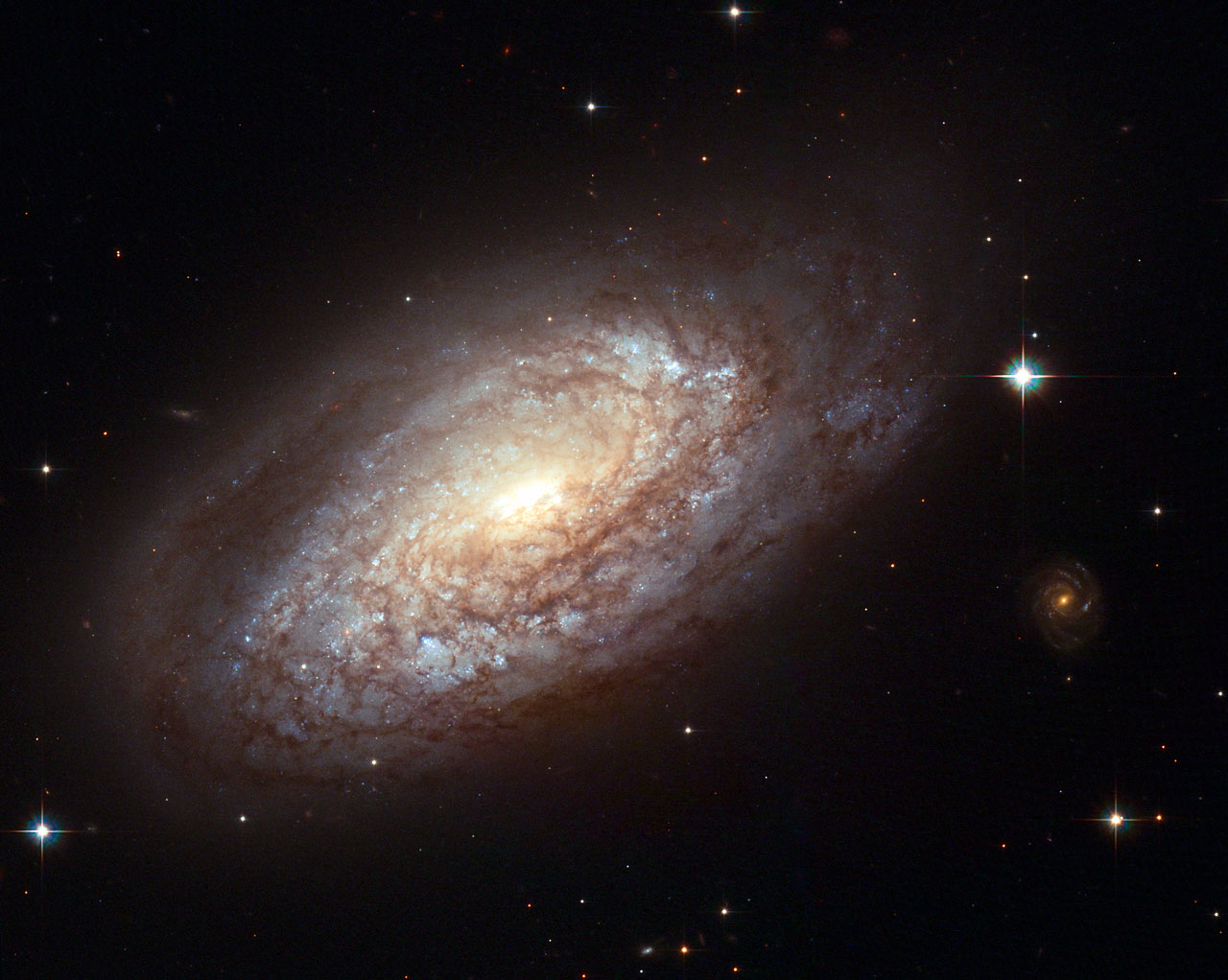
The latest image from the NASA/ESA Hubble Space Telescope reveals a sharp view of the spiral galaxy NGC 2397. This image also shows a rare Hubble view of the late stages of a supernova - SN 2006bc, discovered in March 2006.

NGC 2397, pictured in this image from Hubble, is a classic spiral galaxy with long prominent dust lanes along the edges of its arms, seen as dark patches and streaks silhouetted against the starlight. Hubble’s exquisite resolution allows the study of individual stars in nearby galaxies.

Located nearly 60 million light-years away from Earth, the galaxy NGC 2397 is typical of most spirals, with mostly older, yellow and red stars in its central portion, while star formation continues in the outer, bluer spiral arms. The brightest of these young, blue stars can be seen individually in this high resolution view from the Hubble’s Advanced Camera for Surveys (ACS).


NGC 2397 – click for 1280×1022 image

Read More >>

More about alternative energy

About a month ago, I wrote about the shortcomings of various alternative energy sources. That was mainly about a variety of problems with nuclear energy, solar energy (photovoltaics), and hydrogen.

I didn't even get into the subject of biofuels, but I should have, because the problems in that area are becoming painfully obvious.

Ordinarily I would not expect to find much significant reporting on a scientific/technical subject in Time magazine, especially something that challenges "conventional wisdom". But via DarkSyde at Kos I see there's an interesting article on the problems of "biofuel": The Clean Energy Scam
Several new studies show the biofuel boom is doing exactly the opposite of what its proponents intended: it's dramatically accelerating global warming, imperiling the planet in the name of saving it. Corn ethanol, always environmentally suspect, turns out to be environmentally disastrous. Even cellulosic ethanol made from switchgrass, which has been promoted by eco-activists and eco-investors as well as by President Bush as the fuel of the future, looks less green than oil-derived gasoline.

Meanwhile, by diverting grain and oilseed crops from dinner plates to fuel tanks, biofuels are jacking up world food prices and endangering the hungry.

The Time article focuses on the loss of rainforest, and consequently the loss of its ability to soak up and sequester CO2. When the forest is gone, CO2 will still be incorporated in biomass (crops of some sort). But then that is converted to biofuel, and released back into the atmosphere when it's burned. (To say nothing of the energy that's just wasted along with release of CO2 when the forest biomass is burned to clear it away.) Given all the energy that has to be expended to grow and harvest biofuel crops, with resulting additional release of CO2, we are worse off in terms of greenhouse gas emissions than if we just burned oil (or even coal).

But that's not the only serious problem. Crops that are grown to make fuel (from sugar cane, corn, switchgrass, or whatever) use land where food crops (for people and animals) could be grown instead. Driving up the cost of food for everyone on the planet. (Have you checked the price of bread or eggs at the market recently?)

Economists have spoken out about this problem for several years, when the hype for biofuels and ethanol was just beginning to build. For instance, we have from Howard Simons in early 2006: Making Our Food Fuel Isn't the Answer
If high prices strengthen energy's claim on food supplies, governments everywhere will intervene on behalf of their hungry citizens. If low prices torpedo biofuels' economics, governments everywhere will respond with subsidies for these industries. Only an elimination of current mandates and subsidies today will avoid these problems tomorrow, but the likelihood of this happening is near zero. Somehow I believe we will rue the day when we decided to make food and fuel substitutes at the margin.

In early 2007 Paul Krugman picked up the story: The Sum of All Ears
There is a place for ethanol in the world’s energy future — but that place is in the tropics. Brazil has managed to replace a lot of its gasoline consumption with ethanol. But Brazil’s ethanol comes from sugar cane.

In the United States, ethanol comes overwhelmingly from corn, a much less suitable raw material. In fact, corn is such a poor source of ethanol that researchers at the University of Minnesota estimate that converting the entire U.S. corn crop — the sum of all our ears — into ethanol would replace only 12 percent of our gasoline consumption.

So ethanol doesn't even help the U. S. all that much in terms of dependence on foreign oil. And this February Krugman returned to the subject here, linking to this: Ethanol Demand in U.S. Adds to Food, Fertilizer Costs
About 33 percent of U.S. corn will be used for fuel during the next decade, up from 11 percent in 2002, the Agriculture Department estimates. Corn rose 20 percent to a record on the Chicago Board of Trade since Dec. 19, the day President George W. Bush signed a law requiring a fivefold jump in renewable fuels by 2022.

Increased demand for the grain helped boost food prices by 4.9 percent last year, the most since 1990, and will reduce global inventories of corn to the lowest in 24 years, government data show. While advocates say ethanol is cleaner than gasoline, a Princeton University study this month said it causes more environmental harm than fossil fuels.

And then last week Krugman had even more: Grains Gone Wild
The subsidized conversion of crops into fuel was supposed to promote energy independence and help limit global warming. But this promise was, as Time magazine bluntly put it, a “scam.”

This is especially true of corn ethanol: even on optimistic estimates, producing a gallon of ethanol from corn uses most of the energy the gallon contains. But it turns out that even seemingly “good” biofuel policies, like Brazil’s use of ethanol from sugar cane, accelerate the pace of climate change by promoting deforestation.

And meanwhile, land used to grow biofuel feedstock is land not available to grow food, so subsidies to biofuels are a major factor in the food crisis. You might put it this way: people are starving in Africa so that American politicians can court votes in farm states.

Here's a report of a scientific study on the issue: Some Biofuels Risk Biodiversity And Could End Up Harming Environment
Corn-based ethanol is currently the most widely used biofuel in the United States, but it is also the most environmentally damaging among crop-based energy sources.

Finally, to bring this back to a solid scientific foundation, Sean at Cosmic Variance reminds us that Energy Doesn’t Grow on Trees
In particular, biofuels (such as ethanol) and hydrogen are not actually sources of energy — given the vagaries of thermodynamics, it costs more energy to create them than we can get by actually using them, as there will inevitably be some waste heat and entropy produced
.

Although all this bad news about just about every prospective near-term form of alternative energy is discouraging, there are a few other options that may become available in the slightly more distant future. There's the old perennial, controlled nuclear fusion. Even though work on that is even more active than ever, it's still at least several decades away.

But there's another significant option that's often overlooked: solar power satellites. This technology uses very large arrays of photovoltaic panels high in orbit around the earth. The energy is beamed back to the ground in the form of microwaves. (So this should not be confused with simply using mirrors to redirect additional sunlight, which presents serious problems of its own.)

Solar power satellites also have many uncertainties and potential problems, but the largest is simply boosting enough of them into orbit, and maintaining them. A possible approach to those problems involves space elevators. But those, again, present a whole additional set of challenges.

For now, here are a couple of articles from last fall with more details:

Pentagon backs plan to beam solar power from space

New Space Solar Power Report from DoD NSSO

Tags: , , ,
Read More >>

Urban WIldlife Watch - Flying Squirrels


Photo credit: National Geographic and http://www.nassaucountyny.gov/


How do Flying Squirrels Fly?

As the name would imply, flying squirrels are better suited for air travel. Scientists from Missouri studied these animals and found that their bodies, from their legs and hips, to the extra skin along the sides of their bodies, to their tails, reveal that these little squirrels are built for gliding across the sky.

Flying squirrels, Glaucomys sabrinus, are small rodents about half the size of the more familiar tree squirrel. Like the tree squirrel they live in trees, preferably older hardwood forest habitats of hickory and oak, because older trees provide the ideal habitat they require. They live in tree cavities and rotten snags and eat lichens and fungi on the forest floor.

They are called flying squirrels because they can leap from a tree branch, sail across the night sky, and land on another tree branch or the ground more than 100 feet away. The extra fold of skin that runs from their front legs to their back legs is called a gliding membrane. The squirrel uses the gliding membrane like a sail and its long tail like a boat rudder to maneuver across the night sky. So flying squirrels don’t actually fly, they glide.

The scientists wanted to learn how flying squirrels are able to glide such amazing distances in the air. The objective of the study was to learn more about how this animal moves both in the air and in the trees. Scientists examined the dynamics of gliding locomotion such as take off or launch, gliding, and landing components and looked at its walking behavior on tree branches. Launch speed, landing speed, and glide distance were measured for each squirrel in the study. Using frame-by-frame digital photography, the researchers were able to slow down the action and measure the angle of the jump and landing. They also measured launch and landing forces using specially designed launching and landing branches. To analyze flying squirrels walking behavior, they used wooden dowels that simulated tree branches of different diameters to see if squirrels responded differently when walking on larger or smaller branches. Using frame-by-frame digital video they were able to closely examine each squirrel’s walking behavior. The researchers measured speed, stride, how much weight each foot supported with each step, and the amount of time each foot is on the dowel when the animal is walking.

The team of researchers found that the aerial locomotion of flying squirrels is quite impressive. Squirrels can take off at speeds of nearly 10 yards per second, meaning they can glide very long distances. The farther a squirrel glides, the faster it glides. They actually take off at higher speeds if they are gliding longer distances. And they speed up faster as they approach landing in longer glides. Typically, squirrels land at a 45 degree angle, but the landing angle increases with distance. Moreover, the average observed landing force is about 2.9 times the subject’s body weight. This is true for both heavy squirrels, like pregnant females, and smaller squirrels like juveniles. A squirrel’s size has nothing to do with how well or fast it glides. Furthermore, when flying squirrels aren’t flying, they’re walking, on tree branches, that is. No matter the size of branch, large or small, they walk. As the squirrels travel along a branch, they maintain a steady, relatively slow pace.

Why do flying squirrels fly, or rather glide? The authors did not directly test this question but they think that gliding gives these squirrels a great advantage in patchy forests habitats. Firstly, gliding requires less energy than walking, which allows for travel from one place to another very quickly. Second, long distance gliding is a great way to escape a predator. If a flying squirrel spots a predator, it can distance itself from that predator very quickly. Finally, gliding reduces travel time between food patches. Squirrels are able to visit more food patches over greater distances. In complex habitats, like the ones flying squirrels live in, getting from one patch to the next and escaping predators as quickly as possible is always a plus.

As a confirmation, the scientists also examined the lower anatomy of flying squirrels. They examined the hip and thigh bones of flying squirrels. Based on size, shape, and position of these bones the scientists found that flying squirrels seemed to be better designed for leaping and less for walking along branches. They believe this is one reason why these squirrels are able to achieve such strong take offs and able to glide so far.
ResearchBlogging.org
Scheibe, J., Paskins, K., Ferdous, S., & Birdsill, D. (2007). Kinematics and Functional Morphology of Leaping, Landing, and Branch Use in Glaucomys sabrinus Journal of Mammalogy, 88 (4), 850-861 DOI:

Read More >>