Pages

Exercise and cancer

We all know that exercise is a Good Thing – for cardiovascular health, for weight control, to reduce risks of diabetes and metabolic syndrome, and even to ward off Alzheimer's disease and dementia (see here, here, here, here, here).

Now there is recent research that exercise might be beneficial in reducing risks of various kinds of cancer:


Tags: , ,
Read More >>

Portrait of a Dramatic Stellar Crib

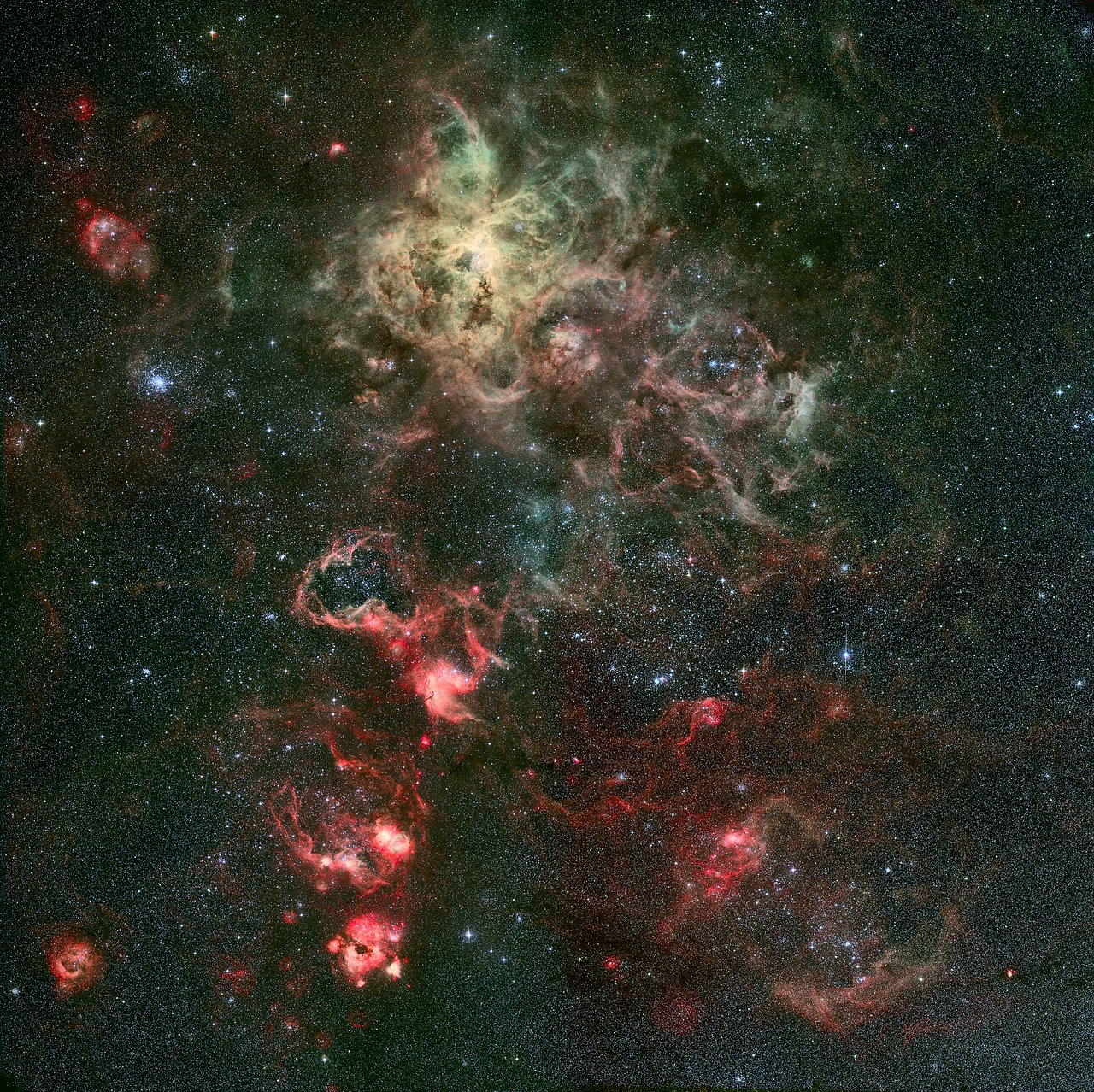
Portrait of a Dramatic Stellar Crib (12/21/06)
Known as the Tarantula Nebula for its spidery appearance, the 30 Doradus complex is a monstrous stellar factory. It is the largest emission nebula in the sky, and can be seen far down in the southern sky at a distance of about 170,000 light-years, in the southern constellation Dorado (The Swordfish or the Goldfish). It is part of one of the Milky Way's neighbouring galaxies, the Large Magellanic Cloud.

The Tarantula Nebula is thought to contain more than half a million times the mass of the Sun in gas and this vast, blazing labyrinth hosts some of the most massive stars known. The nebula owes its name to the arrangement of its brightest patches of nebulosity, that somewhat resemble the legs of a spider. They extend from a central 'body' where a cluster of hot stars (designated 'R136') illuminates and shapes the nebula. This name, of the biggest spiders on the Earth, is also very fitting in view of the gigantic proportions of the celestial nebula - it measures nearly 1,000 light-years across and extends over more than one third of a degree: almost, but not quite, the size of the full Moon. If it were in our own Galaxy, at the distance of another stellar nursery, the Orion Nebula (1,500 light-years away), it would cover one quarter of the sky and even be visible in daylight.


Tarantula Nebula – click for 1280×1278 image

Read More >>

Art, fractal and otherwise

Need a little visual diversion? How about some art with a scientific and mathematical angle – fractal art?

Painting by numbers
[N]ature abounds with examples of fractals: branching rivers and blood vessels, swirling cloud systems, the repeating patterns of mountain ranges and the rocks that comprise them.

People have long looked at these patterns and been fascinated, but it was not until the 1960s, when computers became sufficiently powerful, that mathematicians, scientists and engineers began to create and investigate fractals in their infinite detail.

It's been a fruitful endeavor. Fractal science allows researchers to perceive order in apparent disorder. Fractal concepts have been used to analyze the distribution of galaxies in the universe, the frequencies of economic cycle indices and the probabilities of earthquakes and wildfires.

If you're just interested in some relevant links, the article offers some for a couple of fractal artists: Kerry Mitchell and Janet Parke.

Art and science/mathematics get along very well, I think, as I sort of suggested not long ago.

Bathsheba Grossman's art mentioned in that recent post is not purely mechanical in the way (some) fractal art is, in that the latter may be (though it isn't always) generated purely by computer algorithms. Grossman's work, as with some fractal art, exhibits imaginative human intervention in a number of ways. And the same can be said of other forms of expression now regarded as "art" with little dispute, such as photography.

Even when the subject of a photograph is captured purely mechanically by a camera and reproduced mostly mechanically, the artist's creative intervention is still involved in various ways, such as choice of subject, waiting for the "decisive moment", cropping of an image in the camera or afterwards, lighting, and so forth. And that's before indisputably creative activity in manipulation of photographic images in the printing process or (more recently) by digital means.

But let's consider fractal art that consists purely of the execution of a computer algorithm. Is that still art? I think it can be, because the "creator" of such a work still chooses the algorithms, the initial inputs, and various parameters of the algorithm.

Still, some people may question whether it's art. Now, I don't feel a need to change anyone's mind about that, since art is still ultimately something perceived in the mind of the beholder. If it doesn't work for you as "art", then it ain't art – for you.

Caution: beyond this point I'm just going to ramble a bit, without any pretense of being rigorous or scientific. If you have little patience for that sort of thing, you can cease and desist reading right here.

I recently witnessed an online discussion among intelligent people about the ancient question of "what is art?" Though I refrained from joining that discussion, there were some points raised, which probably always are in this sort of discussion, and which I wanted to reply to. So I'll do it now.

One point is the assertion that "art must communicate some message". But that assertion can lead to further questions. For instance, can we analyze such communication in an information theoretic way, à la Claude Shannon? And what is a "message" in the first place?

People with a scientific or engineering bent are particularly wont to attempt such an analysis, but I have my doubts about that approach. I would simply ask, what is the message, if any, that is communicated in a work by someone like Jackson Pollack? I don't know. Perhaps someone could contrive to find a message in a Pollack painting.

But that doesn't seem necessary to me. I can still enjoy a Pollack painting because it engages and stimulates my visual sensory apparatus, and it is "good" art because the pleasure of the stimulation it provides doesn't quickly become tiresome and lose its ability to engage. To this way of thinking, some of the better examples of fractal art (at least) also deserve to be called art, even if no specific "message" is communicated.

Another problem with the idea of "message" and "communication" being present in a proper work of art is the subject of much "postmodern" analysis of art, and in particular the "deconstruction" of a work of art. There's no way I can possibly do justice to this point of view in the space of a few paragraphs – people write long, convoluted books about such things. Nevertheless, my understanding of this idea, sketchy as it may be, is that postmodernism argues against inherent "meaning" in a cultural artifact, because most of the "meaning" actually depends on cultural context that the artifact implicitly references. And "deconstruction" of a work of art (or of other cultural artifacts like "messages" and "narratives") is the process of making explicit the cultural frames, assumptions, context, abstractions, metaphors, categories, etc., to which the artifact makes allusion, and without which the artifact cannot be understood or said to have any particular meaning at all.

A fine example, it seems to me, would be the Cycladic statues, such as have just been in the news on account of recent excavations, though many instances have long been known. The news article explains
The Cycladic culture — a network of small, sometimes fortified farming and fishing settlements that traded with mainland Greece, Crete and Asia Minor — is best known for the elegant figurines: mostly naked, elongated figures with arms folded under their chests. It flourished in 3200-2000 B.C.[E.], then was eclipsed by Crete and Mycenaean Greece.

But in spite of this antiquity, the figures seem like very modern abstract art and appeal to modern artistic sensibilities. Yet we know almost nothing about the culture in which the figures were created, and have very little idea of what they "meant" to people of that culture.
The figurines were made following a pattern that changed little over 800 years. They have been variously interpreted as depicting gods or venerated ancestors, serving as replacements for human sacrifice, grave goods — even children's toys.

Might we say, then, that art can be appreciated even if we don't know what a piece of art "means", even if it doesn't have an invariant, unambiguous meaning? And further, that what's important in art – whether it be fractal forms, Jackson Pollack paintings, Ansel Adams photos, or Cycladic statues – is its ability to capture our attention (at least for awhile) and to "entertain" us and our senses?

Indeed, as I'm writing this, I'm also listening to some Beethoven piano sonatas. Music is certainly an example of a type of art which is primarily appreciated, without apology, as a form of entertainment, sensual gratification. (Even though it is well recognized that there is a such a thing as "program music", in contrast to "absolute music".) This is as true of Beethoven's music as it is of the music of the recently deceased James Brown (about whom and whose music I know essentially nothing).

Fine. Now having said all that, I'm going to reverse direction and consider the opposite point of view: art as message. In the first place, there's a lot of art (or what is asserted by some to be art) which is not entirely pleasing either to the senses or to the reflective mind. For example, novels of Dostoevsky or Kafka, or paintings by Pablo Picasso (Guernica) or Francisco Goya (The Third of May). Zillions of other examples could be cited, many of which might rather more likely be described as "disturbing" or "emetic", rather than as "entertaining" or "pleasing". About the only thing that could be described as pleasing about such works is the intellectual pleasure of grasping their message. That's certainly a valid kind of pleasure, but still...

A particular type of art in this category came up in the discussion mentioned previously. Or rather two related types: found art and performance art. An early example of found art is Marcel Duchamp's Fountain – a urinal. Examples of performance art can be found in the work of Karen Finley, involving (according to Wikipedia) "graphic depictions of sexuality, abuse, and disenfranchisement."

What's "entertaining" about this sort of thing (apart, perhaps, from erotic elements and fetishes)? Well, not necessarily anything, in any customary sense of "entertaining". The art here, if any, resides in its message. But many people assert that they can scarcely, if at all, see any real message. The example cited in discussion, if I recall correctly, was a load of trash dumped on the lawn before a civic building. "You call that art?" many people ask rhetorically.

Well, yes, as a matter of fact, provided one allows as art artifacts or performances which use at least some modicum of imagination to convey a message. What I would say is that in many cases people don't recognize the message because they don't like the message, though they in fact perceive it subliminally at some level. Further, a difficulty in perceiving the message results when the viewer does not share much of the artist's conceptual framework. In other words, as postmodernists point out, most or all of the meaning of an artifact or performance resides in its cultural context, categories, allusions, etc.

Just as one can't appreciate a novel written in a language one doesn't know, one can't (fully) appreciate a nonverbal artifact if one doesn't know all the concepts and associations that the artifact embodies for the artist. Communication can't effectively occur unless there is a sufficient amount of shared conceptual space. (Try explaining diffeomorphisms to someone who doesn't even know calculus.) And communication must occur for art of the "message" sort to be worthwhile – as opposed to art of the "sensory" sort which appeals directly to the human perceptual apparatus in one or more modalities.

Regarding message art, I've coined an aphorism which, as far as I know, is original. "Art is how we try to explain us to ourselves." Here, "us" could be humans in general, or a specific cultural group. Obviously, this applies mostly to art as a form of communication. When people disagree with this, I take it that they are thinking of more sensory kinds of art. Or perhaps, simply recognizing that message art doesn't always articulate answers and explanatations – sometimes only nagging questions. (Note to self: some other time go into the etymology of words like articulate, artifact, artifice, artificial, etc.)

Time to wrap up. People disagree about what is or is not art because there are acually two rather different things that people can talk about in the category of art. These two things are analogous to what in musicology is called program music vs. what is called absolute music.

This isn't an especially deep or profound observation. In terms of neurobiology, all we're talking about is stuff that goes on in the frontal cortex and other regions that support cognitive functions vs. the stuff that goes on in perceptual regions (e. g. parietal and occipital lobes) and supporting regions that mediate emotions, like the amygdalae.

After all, this is a science blog, so you knew the discussion had to come down to physical realities eventually, didn't you? Nobody here but us reductionists, boss.

Note: This might be a topic to get some good comments on. So if anything I've said here touches a nerve, feel free to comment away.

Tags: , , , , ,
Read More >>

Philosophia Naturalis #5 has been published

Chris Rowan at Highly Allocthonous has posted the 5th edition of Philosophia Naturalis. It's in the form of a great essay about the functions of science blogging. Don't miss it!
Read More >>

Virtual reality to get its own network?

This could be very interesting if it's not, as some suggest, a scam:

Virtual reality to get its own network?
A nonprofit group says it plans to build a network called Neuronet purely to support virtual-reality game and business applications.

Neuronet, which is planned to be separate from the Internet, "will evolve into the world's first public network capable of meeting the data transmission requirements of emerging cinematic and immersive virtual-reality technologies," according to a Thursday announcement from the Vancouver-based International Association of Virtual Reality Technologies.

For more, see the home page of the group that's promting this: International Association of Virtual Reality Technologies

For the skeptical appraisal, see Group promises dedicated VR "Neuronet," skepticism ensues and Is Neuronet A Scam?

If this thing isn't a real project, it should be. If you look at the success of Second Life, you can perhaps imagine where this could go with high-quality video data and user-side equipment to create a "virtual reality" experience.

This particular project may not be for real. But just wait 10 years or so. The applications won't be just game playing. This is the future of business teleconferencing (big bucks there), and eventually virtual gatherings of families and friends.

Tags: ,
Read More >>

Top five nanotech breakthroughs of 2006

Here's an interesting top-something list, from Forbes – nanotechnology:

Top Five Nanotech Breakthroughs Of 2006
This year saw a slew of remarkable nanotech breakthroughs, and narrowing down the top five was no easy task. One major theme of 2006 was the intersection of computing and biology--integrated circuits were used to study everything from neural activity to tissue dynamics, and disposable bio labs-on-a-chip became a reality.

As usual, one can take issue with some of the citations or suggest others. But what's especially interesting here is that in each item, there are actually multiple instances of progress in the same general area. Allow me to illustrate this with several examples.

1) DNA ORIGAMI

There are reports on the work in question here, here, here, and here. This work involves constructing nanoscale objects out of DNA molecules. There is, in fact, a whole subfield of nanotechnology centered around the use of DNA. It's called, DNA nanotechnolgy (unsurprisingly). Prof. Ned Seeman of NYU has been a leader in this field. Some of his references are here (with some nice graphics), here, here, and here. Seeman's laboratory most recently reported a "nanorobotic arm" using DNA – see here, here, and here.

And here's some additional news this year related to DNA nanotechnology:


2) NANOMAGNETS TO CLEAN UP DRINKING WATER

This research obviously has immense real-world importance. But it isn't so much an example of a major area of nanotech activity. Anyhow, here's an overview of the work: Cleaning Up Water with Nanomagnets. The original work was published in Science (November 10, 2006): Low-Field Magnetic Separation of Monodisperse Fe3O4 Nanocrystals.

3) ARRAYS CONNECT NANOWIRE TRANSISTORS WITH NEURONS

Nanowires of various kinds have been big news this year. For examples, see here, here, here, here, here, here, and here.

Similarly, there have been a number of results with interfacing electronics and neurons, for such things as controling prosthetic limbs and playing computer games. One of the more interesting examples is the recent report of a small robot controled through a neuro-electronic interface. Carbon nanotubes have also been used for neuro-electronic interfaces.

But the work mentioned in the Forbes article, where silicon nanowires only 20 nanometers wide can detect signals at as many as 50 places on a single neuron, is certainly impressive. See here, here, or here for details.

Other research into interfacing neurons and carbon nanotubes: here.

4) SINGLE NANOTUBE ELECTRICAL CIRCUITS

Research involving carbon nanotubes is probably the most active area in the whole field of nanotechnology. The examples are far too numerous to mention individually.

Reports on the research referred to in the Forbes article can be found here, here, here, here, here, here, here, here, here, and here.

Other uses of carbon nanotubes in electronics are reported here, here, here

5) NANOPARTICLES DESTROY PROSTATE CANCER

There's a general problem with uses of advanced drugs as therapeutics, especially for cancer and in gene therapy – delivering the drugs as specifically as possible to the organs or tissues where the drug should be active, while avoiding tissues where the drug could be unnecessarily harmful. Chemotherapy is perhaps the principal example of this problem. It is possible to design nanoparticles which gain entry only to certain types of cells, so encasing a drug inside such a particle may solve the problem.

Research involving chemotherapy for prostate cancer was reported in April of this year, and is a noteworthy example of this approach. Reports about the research can be found here, here, here, here, here, here, and here. An especially long and informative article about MIT cancer research, including the nanoparticle work, is here. Here's a more general overview: Tumor-Seeking Nanoparticles.

Nanoparticles can also be used to deliver imaging or contrast agents to cancer cells in order to make them easier to detect. There have been a number of other research results reported this year involving nanoparticles for drug delivery or imaging. A few recent examples, just since October:


-------------------

For another review of important nanotechnology results this year, with many links, take a look at: The Year in Nanotech – Dazzling displays, handheld sensors, cancer killers, and nanotube computers.

-------------------

Tags: , , , ,
Read More >>

Clues to the origins of life

The question of how life originated on Earth is one of the really big open questions for science. Right up there with questions like how the universe itself started and how the human mind works.

Questions about how life began have been asked for a long time, of course. But only within roughly the last 50 years, since DNA and related biochemistry began to be understood, has it been possible to address such questions scientifically.

DNA, and its very close relative RNA, provide the framework for one essential of life: the storage of information, which allows for "blueprints" that describe a living organism to be conveniently encoded, so that individual organisms can be duplicated and, ultimately, evolve into more complex organisms. We now understand pretty well how DNA and RNA work, so one key question now is – how did DNA and RNA, the carriers of genetic information, come about?

DNA and RNA are made up of relatively simple organic molecules – sugars and phosphate groups that can polymerize to form a backbone, and a small number of bases which encode information by the way they are ordered in their attachment to the backbone. The information encoded in DNA details how to make proteins, which are also polymeric organic molelcules, consisting of amino acids attached to each other in a sequence specified (mostly) by the DNA. It is the proteins that make up the bulk of the cellular machinery that constitutes a stand-alone single-celled organism, or by grouping together makes a multi-celled organism. So a large part of the question of life's origins comes down to that of how these various organic chemicals came to exist.

In addition to the organic chemicals that make up an organism, another necessity of life is the ability to utilize energy that is ultimately obtained from the environment. In most cases, this energy is derived from sunlight, although in a few rare cases it can come from radioactive elements. Either way, an organism needs to tap into the environmental energy in order to drive chemical reactions which power cellular mechanisms that enable reproduction, locomotion, and (in multicellular organisms) growth. (More complex organisms can also derive their energy from "food", in the form of simpler organisms that have stored up environmental energy obtained more directly.) So another key question is: when and how did these energy-management processes come about?

There have been recent research findings that are relevant to various of these questions.

Let's consider the origins of organic compounds first. One line of thinking is that organic compounds were primarily synthesized from inorganic compounds in natural processes here on Earth. The names Aleksandr Oparin and J. B. S. Haldane are associate with this idea. The classic experiment testing the idea is known as the Miller-Urey experiment, after Stanley Miller and Harold Urey, and was first conducted in 1953, the same year that the structure of DNA was identified by Francis Crick and James Watson. As yet, this is still just a conjectural possibility.

An alternative scenario for the origins of organic compounds is that some simple ones formed in space, which is known to happen, and that some of the basic building blocks of life, such as amino acids, were introduced to Earth on meteorites. This possibility has gained more plausibility from the recently announced finding of apparent "organic materials" in a meteorite that fell in 2000.

NASA Scientists Find Primordial Organic Matter In Meteorite
In a paper published in the Dec. 1 issue of the journal Science, the team, headed by NASA space scientist Keiko Nakamura-Messenger, reports that the Tagish Lake meteorite contains numerous submicrometer hollow organic globules.

Because the meteorite immediately became frozen in ice after it landed, the possibility of contamination from terrestrial material was minimized. Further, the isotopic composition of hydrogen and nitrogen in the globules is quite unlike what is normally found on Earth. It also appears that the material in the meteorite formed at least 4.5 billion years ago – before the Earth and the other planets themselves.
"The isotopic ratios in these globules show that they formed at temperatures of about -260° C, near absolute zero," said Scott Messenger, NASA space scientist and co-author of the paper. "The organic globules most likely originated in the cold molecular cloud that gave birth to our Solar System, or at the outermost reaches of the early Solar System."

Additional references:

Just about two weeks later, results from a completely different souce appeared that also showed the existence of organic compounds in primorial solar system material. This was from the Stardust mission to retrieve grains of matter from the comet 81P/Wild-2:

Comets hold life chemistry clues
Scientists studying the tiny grains of material recovered from Comet Wild-2 by Nasa's Stardust mission have found large, complex carbon-rich molecules.

They are of the type that could have been important precursor components of the initial reactions that gave rise to the planet's biochemistry.

Unlike the case with the Tagish Lake meteorite, it was possible to identify many of the organic compounds in the returned material:
These Wild-2 compounds lack the aromaticity, or carbon ring structures, frequently found in meteorite organics. They are very rich in oxygen and nitrogen, and they probably pre-date the existence of our Solar System.

"It's quite possible that what we're seeing is an organic population of molecules that were made when ices in the dense cloud from which our Solar System formed were irradiated by ultraviolet photons and cosmic rays," Dr Sandford explained.

"That's of interest because we know that in laboratory simulations where we irradiate ice analogues of types we know are out there, these same experiments produce a lot of organic compounds, including amino acids and a class of compounds called amphiphiles which if you put them in water will spontaneously form a membrane so that they make little cellular-like structures."

Additional information from the special Stardust issue of Science (December 15, 2006 – sub. rqd. for full access):

Although these results indicate that organic material formed in or before the earliest stages of the solar system might have seeded organic chemistry on Earth, there is as yet no evidence that this actually is how it happened. An even more radical possibility is that actual living carbon-based organisms that originated outside of our solar system "transplanted" life to Earth. This idea is known as panspermia, but so far, there's little or no credible evidence for it. Short of that, we know at least that the organic compounds for life either originated on Earth or arrived from outside.

So let's move on and turn to the question of how the earliest organisms managed energy supplies in order to reproduce and move. Every organism on Earth that produces energy from the chemical processing of carbohydrates, fats, and proteins uses, a complex series or reactions known as the citric acid cycle (also known as the Krebs cycle). (There are other energy-producing processes, of course, such as photosynthesis.) The question to be answered is how this complex series of reactions first arose:

New Insights Into The Origin Of Life On Earth

In an advance toward understanding the origin of life on Earth, scientists have shown that parts of the Krebs cycle can run in reverse, producing biomolecules that could jump-start life with only sunlight and a mineral present in the primordial oceans.

The Krebs cycle is a series of chemical reactions of central importance in cells -- part of a metabolic pathway that changes carbohydrates, fats and proteins into carbon dioxide and water to generate energy.

Since the cycle can run backwards, it is possible to identify an inorganic compound that may have kickstarted the process:

Nature's Jump-Starter
Reporting in next week's Journal of the American Chemical Society, researchers at Harvard University say they may have found at least one of the original players. Called sphalerite, the compound is a mix of zinc and sulfur ejected from hydrothermal vents and known to have been plentiful in Earth's early seas. Geochemist and co-author Scot Martin says the team's new lab experiments show that when immersed in sterile water and exposed to sunlight, sphalerite can create three of the five basic organic chemicals necessary to start the Krebs cycle in relatively quick fashion. Further research is needed to isolate the other compound or compounds that could have produced the remaining two Krebs ingredients, he notes. If scientists can find their sources, then they will know that the five chemical foundations of the Krebs cycle were being manufactured easily and routinely in Earth's early oceans.

In addition to relatively simple organic chemical building blocks and chemical reactions that can release energy to make an organism that is "alive", there is a third prerequisite for life: some method of storing information about an organism's composition and structure so that the organism can replicate itself, instead of simply disappearing after each generation. In other words, genetic material.

Today, that genetic material consists of DNA and RNA, which in turn are made up of a handful of bases that act as symbols encoding the genetic message and are arranged along a linear backbone of simple sugar and phosphate groups. But are these the only possible chemical entities that can perform this kind of function?

In the past, other possibilities have been suggested, such as peptide nucleic acids (PNAs). A PNA has a backbone formed of simple molecules consisting of carbon, nitrogen, hydrogen, and oxygen. These are liked together by peptide bonds, which form when H- and OH- units from two molecules combine to form H2O, leaving the original molecules joined to each other. Such peptide bonds also form the backbone of proteins. But unlike proteins, PNAs have DNA-like bases attached to the backbone instead of amino acids. However, PNAs do not occur naturally, so they do not seem to have played a role in life on Earth.

If there are other ways of structuring a backbone, perhaps comparing them to what is actually used in RNA (the sugar known as ribose) and DNA (the sugar deoxyribose) would suggest why the latter proved to win out. That was the idea behind this research:

Uncovering DNA's 'Sweet' Secret
“These molecules are the result of evolution,” said Egli, professor of Biochemistry. “Somehow they have been shaped and optimized for a particular purpose.”

“For a chemist, it makes sense to analyze the origin of these molecules.”

One particular curiosity: how did DNA and RNA come to incorporate five-carbon sugars into their “backbone” when six-carbon sugars, like glucose, may have been more common? Egli has been searching for the answer to that question for the past 13 years.

Recently, Egli and colleagues solved a structure that divulges DNA's “sweet” secret. In a recent issue of the Journal of the American Chemical Society, Egli and colleagues report the X-ray crystal structure of homo-DNA, an artificial analog of DNA in which the usual five-carbon sugar has been replaced with a six-carbon sugar.

It was found that homo-DNA is more stable that DNA/RNA and it allows a wider variety of bases to be attached. So why didn't it prevail?
[D]espite homo-DNA's apparent versatility in base pairing and its thermodynamic stability, other features of the molecule's architecture probably preclude it from being a viable genetic system

For example, it cannot pair with other nucleic acids — unlike DNA and RNA which can and must pair with each other. Also the steep angle, or inclination, between the sugar backbone and the bases of homo-DNA requires that the pairing strands align strictly in an antiparallel fashion — unlike DNA which can adopt a parallel orientation. Finally, the irregular spaces between the “rungs” prevent homo-DNA from taking on the uniform structure DNA uses to store genetic information.

The findings suggest that fully hydroxylated six-carbon sugars probably would not have produced a stable base-pairing system capable of carrying genetic information as efficiently as DNA.

So that variation didn't work out. But what about the possibility of using a different set of bases than the purines and pyrimidines which actually occur? That was investigated in this study:

Origin Of Life: The Search For The First Genetic Material
To find the right track in searching for the origins of life, the team is trying to put together groups of potential building blocks from which primitive molecular information transmitters could have been made. The researchers have taken a pragmatic approach to their experiments. Compounds that they test do not need to fulfill specific chemical criteria; instead, they must pass their “genetic information” on to subsequent generations just as simply as the genetic molecules we know today—and their formation must have been possible under prebiotic conditions. Experiments with molecules related to the usual pyrimidine bases (pyrimidine is a six-membered aromatic ring containing four carbon and two nitrogen atoms), among others, seemed a good place to start. The team thus tried compounds with a triazine core (a six-membered aromatic ring made of three carbon and three nitrogen atoms) or aminopyridine core (which has an additional nitrogen- and hydrogen-containing side group). Imitating the structures of the normal bases, the researchers equipped these with different arrangements of nitrogen- and hydrogen- and/or oxygen-containing side groups.

Unlike the usual bases, these components can easily be attached to many different types of backbone, for example, a backbone made of dipeptides or other peptide-like molecules. In this way, the researchers did indeed obtain molecules that could form specific base pairs not only with each other, but also with complementary RNA and DNA strands. Interestingly, only one sufficiently strong pair was formed within both the triazine and aminopyridine families; however, for a four-letter system analogous to the ACGT code, two such strongly binding pairs are necessary.

The conclusion was that the critical factor affecting the composition of modern genetic material was the structure of the bases rather than the structure of the backbone. It was necessary to have only certain bases which are capable of pairing up in specific ways, as occurs in double-stranded DNA and DNA-RNA combinations.

Tags: , , , , ,
Read More >>