Pages

Hubble snaps heavyweight of the Leo Triplet

Hubble snaps heavyweight of the Leo Triplet (4/8/10)
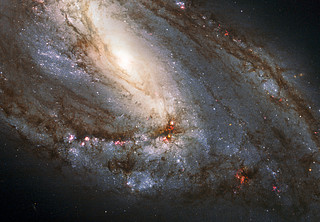
Hubble has snapped a spectacular view of the largest "player" in the Leo Triplet, a galaxy with an unusual anatomy: it displays asymmetric spiral arms and an apparently displaced core. The peculiar anatomy is most likely caused by the gravitational pull of the other two members of the trio.

The unusual spiral galaxy, Messier 66, is located at a distance of about 35 million light-years in the constellation of Leo. Together with Messier 65 and NGC 3628, Messier 66 is one third of the Leo Triplet, a trio of interacting spiral galaxies, part of the larger Messier 66 group. Messier 66 wins out in size over its fellow triplets — it is about 100 000 light-years across.

Messier 66 is the proud owner of exclusive asymmetric spiral arms which seem to climb above the galaxy's main disc and an apparently displaced nucleus. This asymmetry is unusual; most often, dense waves of gas, dust and newly born stars wind about the galaxy's centre in a symmetric way. Astronomers believe that Messier 66's once orderly shape has most likely been distorted by the gravitational pull of its two neighbours.


M 66 – click for 1280×886 image


More: here, here, here
Read More >>

Editorial Opinion

There are many different ways that one can be involved in the editorial aspects of scholarly journals, and one's experience with the editorial universe can also vary considerably depending on whether a journal is published by a professional society or by a for-profit company.

Some variations on the wonderful world of editing a journal include:

1. being on an editorial board that essentially serves as a pool of reviewers (i.e., if you agree to be on the editorial board, you agree to review most manuscripts that are sent to you);

2. being on an editorial board that exists only as a list of names on a journal to show.. actually, I don't know what it shows. When I agreed to be on the EB for one particular journal, I assumed that I would actually do more than just have my name listed, but so far I haven't done anything. Does my Distinguished Name add luster to this journal, inspiring more people to read it? No way. The only people who would read this journal already have an intense interest in this very specific aspect of Science. Perhaps the in-name-only EB is like having a list of "fans" or "friends" of the journal.

3. being an associate editor for journals that have an extra editorial layer between the reviewers and the editor(s). I have been an AE at various times in the past. This type of editorial organization can be a bit inefficient, but this type of structure makes sense for some journals that have a somewhat broad scope. The editors need a pool of experts who are better qualified to select reviewers and provide their own comments on the manuscript and the reviews, but the editor or editors make the final decisions.

4. being the editor of a journal. Variations on this include: (a) being the one and only chief editor of a journal, and (b) being one of 2 or more other editors who are autonomous in their decision-making. And of course these editors can either be part of a system that has associate editors or an active editorial board, or may themselves be directly involved in selecting reviewers.

I have been or currently am involved in one or more of each of the above except 4a.

Somewhere in the blogosphere recently -- I am sorry I don't remember the blog, as I was roaming somewhat indiscriminately at the time -- I read someone's opinion that editors should be eliminated so that reviewers and authors could communicate more directly. I don't remember if the person holding this opinion has ever been an editor, but I'm inclined to think not.

As anyone who has received reviews for their own manuscripts likely knows, reviews vary a lot in terms of constructiveness, thoroughness, usefulness, and politeness. Part of an editor's job is to even out some of the roughness of the reviews, to provide more substance if the reviews lack it (in some cases by finding additional reviewers), to guide authors regarding revisions, and to reconcile disparate reviews or choose one review over another as being more instructive. In rare cases, editors rescind reviews or reviewer comments that are offensive. We keep the system running despite the vagaries of the reviewers (and authors).

Being an editor of a journal that covers a broad range of topics is difficult because you have to rely so much on the expertise of others, but it is also difficult editing a more specialized journal in which you know many of the authors and reviewers. In that situation, your own professional interactions with specific individuals are at stake and may be influenced by your editorial work.

In my work as an editor, I have found it essential to have a good online editing system that keeps track of reviewer data such as: time since last review for this journal (so I don't overload anyone with too many reviews), average time it takes a reviewer to submit a review, and information about the reviewing habits of an individual (e.g., do they routinely return thorough and useful reviews or are their reviews shallow and useless?). If someone is known to me in advance to be a not-so-great reviewer but is nevertheless someone who can provide an important point of view, I might try to get an additional reviewer for the manuscript in question.

I try to keep the system moving as rapidly as possibly, but of course I am somewhat at the mercy of the reviewers for this. Even so, when reviewing time becomes too prolonged, I have several contingency plans: (1) I have a small group of willing "emergency reviewers" who might be able to provide a rapid review; I try not to use this group if at all possible, but they have saved the day on a number of occasions; (2) I act as a reviewer myself, if I feel qualified to comment on the manuscript's topic; or (3) If I have one thorough review in hand, I will just use that and add my own comments (not as a reviewer, but just to make note of anything I think the one reviewer missed). In some cases a delinquent review is submitted in time to be of use during the revision process. So far I have not had any situations in which a late review contained information that would have changed my editorial decision on a manuscript if I had the review earlier, but perhaps I have just been lucky.

It has been important for me to find the right balance in terms of time I spend on editing tasks and the types of editing activities that I do. At the moment, I am quite content with my editing experiences both in terms of types and the time involved. Perhaps in the future I will want to branch out to other editorial experiences, for the challenge or for variety, but right now, things are good the way they are.

I have also served on a search committee that evaluated candidates to be editor of a journal, and this was kind of interesting because each candidate had a different combination of skills. But which was the right combination?

Some of the candidates were excellent scientists and would have added prestige to the journal, but it was clear (in some cases by their own admission) that they did not have the organizational skills or the time to do a good job. Other candidates seemed to have excellent organizational skills and editorial experience, but they were not well respected as scientists. We didn't want someone whose major qualifications were clerical skills. And other candidates had other liabilities (e.g., a candidate who had lots of editorial experience but who had been sanctioned for plagiarism). And what if someone is an excellent scientist and quite organized, but is a polarizing figure, well known for being involved in disputes that at times involved unprofessional behavior? Is that relevant to an individual's qualifications to be an editor? In fact, it probably is quite relevant.

But why be so picky? These people were interested in spending vast amounts of time for no/low pay as a professional service. Shouldn't a journal be happy just to find someone willing to do the "job"?

Fortunately, amazingly, we eventually found a person who was excellent in all respects for this particular position. I guess as long as there are people like that who have the energy, skills, and personality to succeed in the job, the system will continue to function.

I don't know what it's like in other fields, but as an editor of a journal in my field of the physical sciences, I have been impressed with the dedication and care that many reviewers take with their reviews. Therefore, despite the peer reviewing system's flaws -- and colleagues and I recently encountered a rather shocking example of one of these flaws (perhaps more on that some other time) -- my experience has shown that it is mostly a good system that involves a lot of conscientious reviewers and editors who give their time and share their expertise to make it work.

[I haven't decided yet about Monday's topic, but I have a few more things to say on the topic of being an Editor. Also, perhaps we can all share our most disturbing experiences with reviewers and editors next week, to balance out today's mostly-positive view of the peer review system. So save your stories of that sort for next week!]
Read More >>
Playing the Game (2)

Citation index considerations aside, have you made any publication decisions specifically because you wanted to increase your number of publications, on the cynical-but-perhaps-justified assumption that more papers = better?

For example:

1. Have you taken what probably should have been one paper and split it up into two or more shorter (but nevertheless distinct) papers for the sole purpose of increasing the total number of papers on your CV?

Figuring out how many papers should be written about the results of a particular research effort is a bit of an art, and in some cases more papers is the best decision. Sometimes you know in advance whether to write results up as one or more paper(s), and sometimes you don't know until you start writing.

My question, therefore, refers to cases in which the main motivation for splitting up a project into n>1 papers is to crank up the publication numbers.

2. Have you published what probably should have been one paper but that instead were two or more related papers that were not as distinctly separated in content as in the first scenario? (i.e., shingling)

This is also a fuzzy concept because sometimes you want to publish one short and zippy paper and then another, longer one in a more specialized journal. Is that shingling? Or what if you decide to publish some different-but-related papers because each involves different groups of co-authors and it makes logistical sense to keep the publications separate? Or maybe you want to publish a review paper that summarizes information in some of your other papers. There are many legitimate ways in which similar papers are published by the same author.

But then there are other cases. I recall one time when I brought a manuscript to review on an airplane. This was back in the Days of Paper, so I had a hard copy of the manuscript, and had turned to a page with a figure on it. I was traveling with some colleagues to a conference, and a colleague in a different-but-related field was sitting next to me. He was also reviewing a manuscript, and turned the document to a page with a figure on it. It was the exact same figure. Yes, I know that manuscripts in review are confidential, but there we were, sitting next to each other with two different manuscripts submitted to two different journals at the same time, and there was at least one thing in both manuscripts that was identical. So we started comparing. The two manuscripts had the same authors, the same figures using the same data for the same topic, and only a slightly different "spin" put on different aspects of the data. Those two manuscripts clearly represented shingling of a sort that was probably not OK. We informed the editors of the journals.

3. Have you ever submitted a paper before the project had advanced as far as it probably should have before writing up part of it as a manuscript; i.e., a premature manuscript that was probably publishable but that you knew would be much better if you worked on the research more? (but you didn't feel you could afford to wait longer because you needed publications on your CV sooner rather than later)

As with the other cases, this is not an obviously bad thing to do either. Maybe you would have waited longer to publish if you already had tenure, but there are also good aspects of publishing a preliminary paper to communicate initial results rather than waiting, perhaps years, to publish one big definitive paper. You'd want to be as confident as possible that the preliminary paper was sound, but if you feel you have something to say that is of interest, I think it can be very useful to publish early and often.

I know that that is "playing the game" and perhaps contributing to the mass proliferation of academic articles so that the flow of information is overwhelming and the very act of publishing a scholarly work is devalued etc. etc., but I think that if you have something interesting to say, it's a good thing if you write it up and get it out there.

Ideally, in the course of your career, you will publish some short papers and some longer, more detailed papers and some review papers and some papers in Awesome Journal X and some other papers in Specialized Journals Y and Z, and it will all even out. It's in the early stage of an academic career when every decision about what/where/how much to publish can seem so critical.

From what I've seen in the physical sciences, the "best" route to take at all stages of an academic career is to try for a balance between publishing a reasonable number (according to the norms of your specific field) of very good but perhaps not awesome papers in respected journals, and then some (but likely fewer) rather awesome paper(s). This is preferable to having lots of narrowly focused papers or only/mostly having "big idea" papers. Together, however, these different types of publications demonstrate the breadth and depth of your research.

When deciding how to divide up a big project into papers, I try to optimize publication quality, speed, and impact, as well as consider what is most fair to the most number of co-authors, particularly students, postdocs, and/or tenure-track colleagues. This not always a straightforward decision, of course, and sometimes I wonder if I would do just as well by consulting a Magic 8-Ball for advice.

Or maybe I should go back for yet more training in Responsible Research Conduct. Surely somewhere in all those case studies and PowerPoint presentations, there is a nifty formula for sorting all of this out easily. {note use of delusional font}
Read More >>

Happy International Beaver Day

Happy International Beaver Day!
photo credit: Gainesville State College Tumbling Creek Woods Beaver Pond web page
Today, Tuesday, April 7th is International Beaver Day!
The Beavers, Wetlands and Wildlife Organization is trying to show people how important beavers really are, and the group has produced an educational DVD and sent 1,000 copies to teachers all over the state of New York.

One member says the beaver is one of the most important wild animals for a number of reasons. First, because they build dams and prevent flooding. And second, because beavers protect us from greenhouse gas emissions.

"Beaver wetlands, like all wetlands, are the best ecosystem for storing carbon," said Sharon Brown, of Beavers, Wetlands, and Wildlife. "And if they are destroyed, carbon dioxide goes into the air and that's a dangerous greenhouse gas."

April 7 was chosen as International Beaver Day because it is the birthday of the late Dorothy Richards of Little Falls, who studied beavers for 50 years.
Beavers, scientific name Castor canadensis, are the largest rodent in North America, and the second largest rodent in the world. Beavers are important animal ecologically and historically. In fact, Missouri (the state where I live now) and the westward expansion of the United States can credit the humble beaver for its place in history. Why? Beaver fur was the number one commodity in the new world and the many systems of rivers and wetlands in the western half of North American proved to be very successful trapping grounds in the 1700 and 1800s. Even today, Beaver are still very important fur species. Though I am no fan of fur, I recognize the important roles trapping, hunting, and fishing have in wildlife species management plans. Because we value our current and urban lifestyles, it is important that we take the time to appreciate wildlife and understand more about their behavior and ecology so that they will be around for centuries to come.
In fact, I know a fellow scientist who researches on beavers. I found one of his scientific papers online that you could read for yourself and learn more about Beavers and why they are important.

Understanding North American Beaver Behavior as an Aid to Management
by Bruce Schulte and Dietland Mueller-Schwarze
The next question you may be wondering is, "Do beavers live in or near cities? Or do they only live out in the forest or country?" The answer is a big YES, to both questions. Beavers do live in and near urban areas if the habitat is right. What's the right habitat? Flowing water like rivers (large or small) or streams and creeks. Beavers live right here in St. Louis along the Mississippi and Missouri Rivers. I've see their dams under the bridges - the MLK near downtown, the I-270 and the Old Chain of Rocks Bridges. Huge, big, towering dams. Sorry, I don't have any photos (another reason I wish I had bigger, better camera equipment. I love to show real pictures and proof to you.) But they look like this:

photo credit: Skip Mackey Fishing Stories webpage

If you've ever notice a huge pile of sticks and branches in the water, then you can best believe you have come across a beaver dam. Another sign of beaver activity is this:

This chewed off stump, often near a river or stream means you have active, healthy beavers near by. Beavers are important wetland species, because they are engineers, literally. They create habitat for other animals - like fish, insects, birds, other mammals. Create pools of water for land animals to drink from, and bridges for land animals to cross from one side of the habitat to another. This exposes them to new resources like shelter, mates, food, and places to hide from predators. So, think fondly of the beaver and keep your eyes open for these amazing creatures.
Read More >>

Playing the Game (1)

This spring, I have to refresh my ethics training, a ritual that is annoying mostly because the university makes it so extremely difficult for faculty and postdocs not involved in the biomedical sciences to find relevant ethics training opportunities. I am really not that interested in spending 2 days learning about research with human subjects, as my research involves no human subjects (other than grad students..).

And now all our graduate and undergraduate students who receive a salary or stipend from NSF must be trained in ethics.

Ethics training is important, but it is boring: don't plagiarize, don't fabricate data, don't falsify data. And the case studies are bizarre.

So let's forget about whether the postdoc should hide the data outliers that may or may not be due to a power fluctuation during extremely expensive analyses at a national lab even though the grad student involved in the research thinks that they should at least inform their PI, and consider some more interesting situations. For example, following on yesterday's citation theme:

Has your awareness of the importance of citation data affected your decisions about publishing?

That is, would you have made a different decision about anything related to publications (authorship, type/number/format of publications etc.) if your citation metrics were not being constantly tabulated for all the world to see?

When answering the first-order question, consider only whether you have ever considered the impact of a publication decision on your citation indices. Such considerations are not a priori unethical; it is possible that such considerations will result in your making a completely ethical and smart decision that helps your career. An example of that might be to send a manuscript to a journal that is indexed instead of to an edited volume being published as a not-indexed book. You do not change anything about the authorship or content of the paper; just the publication venue.

But now consider whether you have ever made a citation-fueled publication decision that might not have been entirely ethical but that could possibly be justified because "That's how the game is played." (others are doing it; if you don't play the game, you lose; etc.).

I don't think I've made any unethical decisions about research publications, but I definitely had citations in mind a couple of years ago when I decided to revise a much-cited technical document that was originally authored by someone else (now long retired) and that was in great need of an update. In that case, though, I wasn't thinking so much of my own citation index, but was instead intrigued by the idea of transferring citations from Journal 1 to Journal 2, in part because I am involved in the editing of Journal 2 and therefore have an interest in promoting the success of Journal 2. I hasten to add that I am paid nothing for my editorial work for Journal 2, so financial considerations were not involved. There were in fact valid scientific reasons for publishing the update in Journal 2, in addition to my personal affection for Journal 2. In the end, though, I published the update in Journal 1, but I admit that my original intentions were rather craven and driven in part by thoughts of citations.

That's the worst example I can think of for myself, but perhaps that is because I am a tenured mid-career professor. If I were on the tenure-track today, I am sure it would be difficult not to consider citation index issues when making publication decisions, although if it makes any of my early-career readers feel any better, I happen to know that at least some promotion & tenure committees at research universities are specifically instructed not to consider the h-index or other citation statistics when reviewing files for tenure and promotion.

to be continued..
Read More >>

Travelog San Francisco: Blooms from The Bay

I visited the Bay area (San Francisco and Berkeley, California) for the first time year. I LOVED the Bay. I could so live there.


Spring time blooms in Union Square, San Francisco


The color of San Francisco is violet. These blue-violet colored flowers seemed to be everywhere. This picture was taken at Golden Gate Park.
This plant reminds me of the water pickerels in Missouri. Are they related? I'm asking my botany friends.


A very pretty in pink cultivar. Notice the bee?
Berekely

Daisy-type flowers, you know Asteriidae were my favorite flowers. Isn't the purple color just lovely. The bright California sunshine really made the color pop!
Berekely

I just loved this flower when I saw it. Warm tones like dark oranges, yellows and reds are my favorite colors.
Berekely

Staring down the center I seemed to be carried away. I loved low the uniformly yellow-orange flower had a deeper hue in the middle near the anthers and filament. The anthers and petals are the exact same hue. Lovely.
My friend Rue, of Outdoor Afro, later told me this is the California Poppy, the state flower of California.
California Love


Thanks for supporting Urban Science Adventures! © now and into the future.


Thank you very much,
DNLee

Read More >>

Just Checking

If you have published at least one paper in a journal that is included in a citation index, how often do you check your own citation statistics? Do you know what your h-index is? (I mean, do you know the number, not what the h-index is.) Do you subscribe to a citation alert service so you are notified when someone cites your paper? Do you check up on the citation data of certain colleagues, whether or not your intentions are good?

I am not so interested in opinions about whether you think citation indices are a nifty metric or the worst thing to happen to academe since faculty meetings were invented, but go ahead and rant in the comments if you must.

Mostly I am wondering how often we are checking on our own citation data, no matter what we think of the significance (or lack thereof) of these data.

How often do you check your citation statistics?
As often as possible
Quite regularly, but not obsessively
Every once in a while, when I think of it
Maybe once a year, if that
Never
pollcode.com free polls

Do you know what your h-index is?
Yes, I know exactly what it is
Sort of
No, I have no idea
pollcode.com free polls
Read More >>